
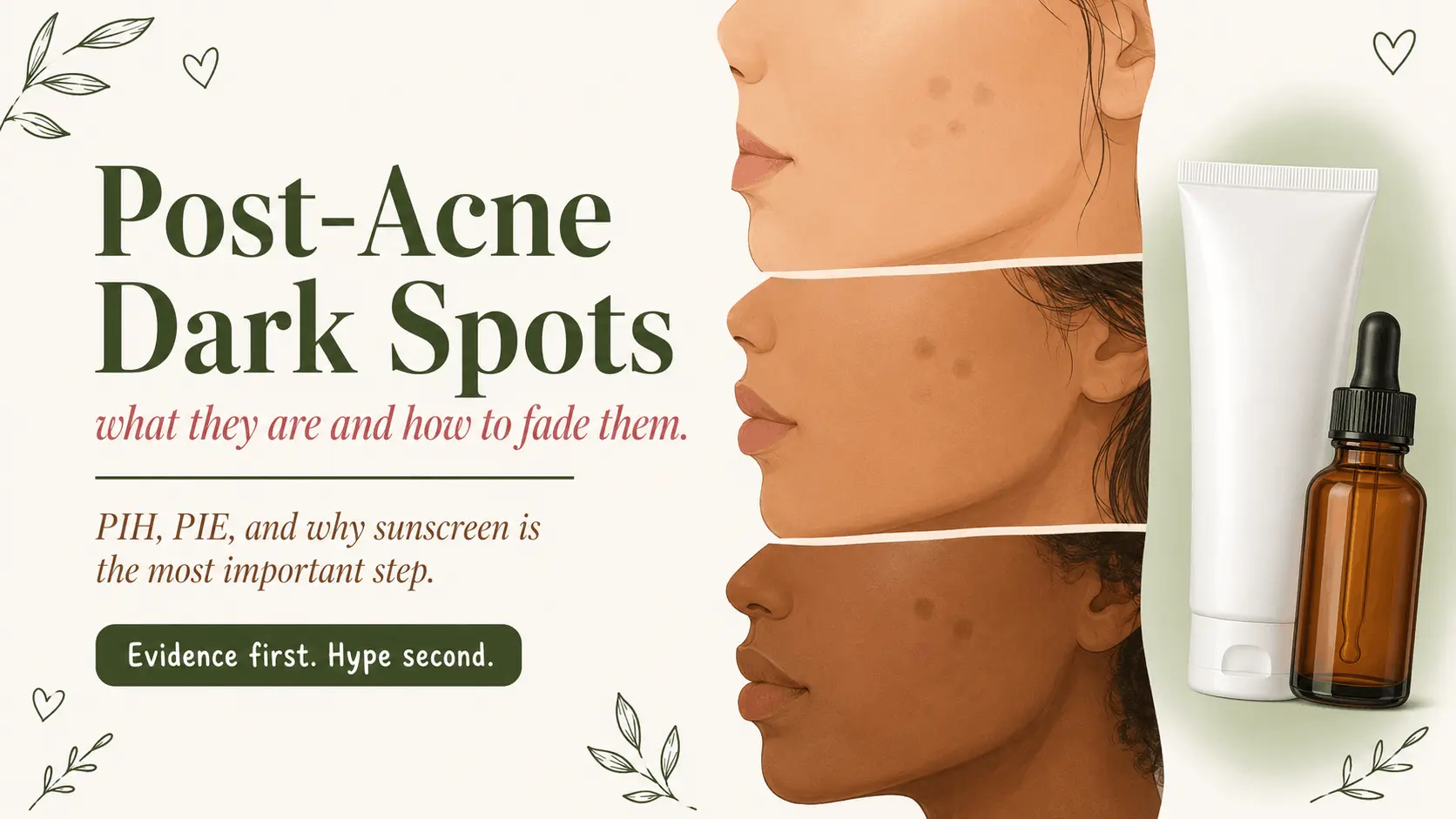
The most evidence-supported way to fade post-acne dark spots is to control new breakouts, use broad-spectrum SPF 30 or higher consistently, and introduce one well-supported treatment at a time. Retinoids and hydroxy acids have the largest body of higher-quality topical evidence for PIH, while azelaic acid has direct acne-related evidence. Niacinamide and topical tranexamic acid may also help, but irritation can trigger or worsen pigmentation.11213
In this guide
What are post-acne dark spots?
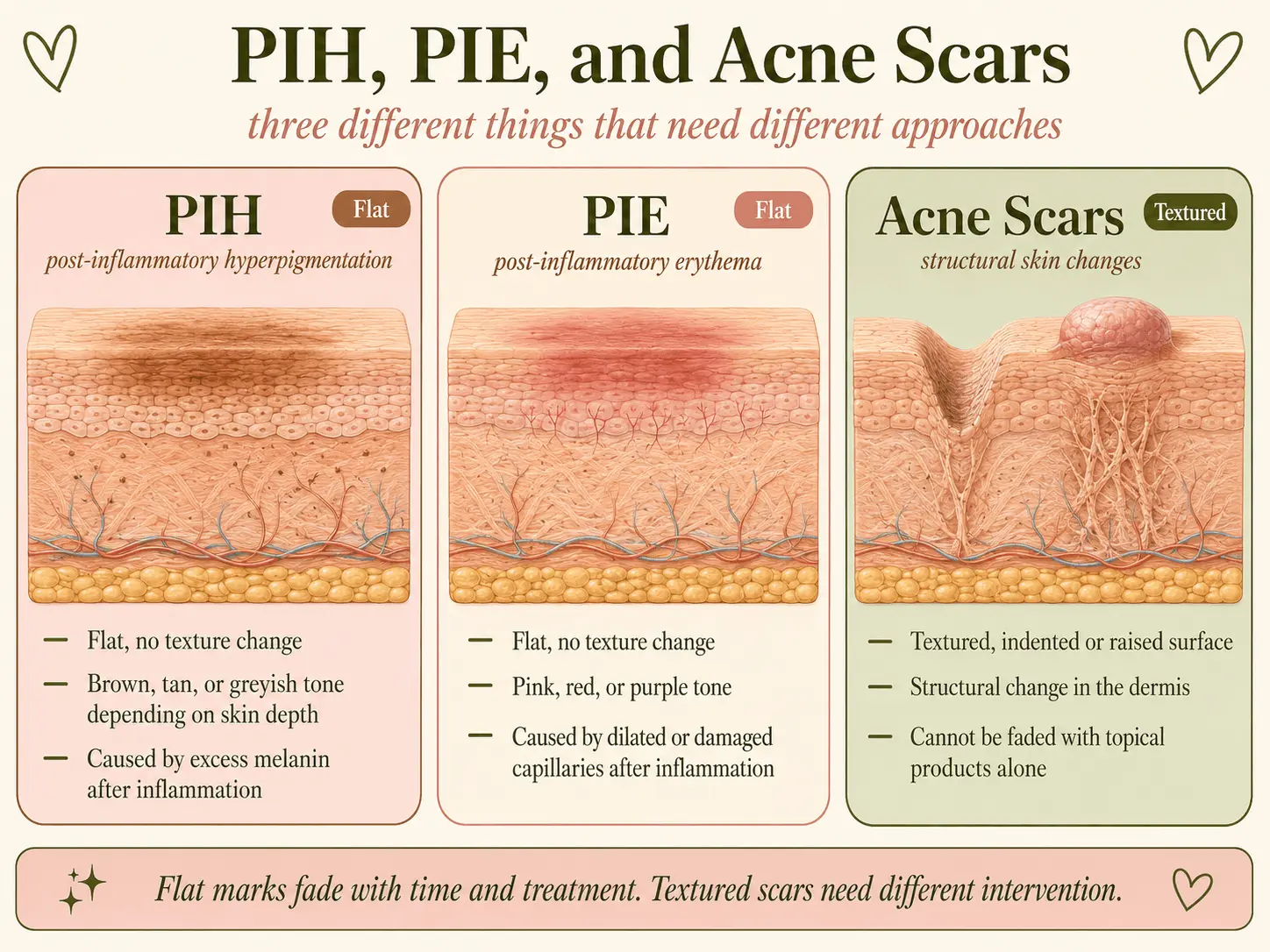
Most flat brown, dark brown, gray or blue-gray marks left after acne are post-inflammatory hyperpigmentation, usually shortened to PIH. Inflammation can stimulate increased melanin production and deposition; after the acne lesion settles, the pigment may remain visible.212
PIH is not the same as a textural acne scar. PIH is flat discoloration, while atrophic and hypertrophic scars alter the skin's structure or surface. A pigment-focused treatment may fade PIH, but it cannot rebuild an indented scar.12
PIH vs PIE vs acne scars: check the color and texture
| What you see | Most likely | What it means |
|---|---|---|
| Flat brown, dark brown, gray or blue-gray mark | Post-inflammatory hyperpigmentation | Extra melanin after inflammation. Pigment-focused treatment and sun protection may help. |
| Flat red, pink or purple mark | Post-inflammatory erythema | Persistent vascular redness. Dark-spot products may not be the best match. |
| Indented, pitted or raised area | Acne scar | Structural tissue change. Topical brighteners will not correct the texture. |
Some marks contain more than one component. A spot can be both red and brown, or a scar can have pigment over it. When you are unsure, a dermatologist can distinguish pigment, vascular redness and scarring more accurately than a product quiz.
Why do dark spots after pimples take so long to fade?
Fading speed depends on pigment depth, the severity and duration of inflammation, skin tone, light exposure and continued irritation. Epidermal pigment generally fades faster. Deeper dermal pigment can appear gray or blue-gray and may persist much longer.36
PIH can affect every skin tone, but it is more common and often more persistent in darker skin phototypes. This makes irritation prevention particularly important: prolonged inflammation from an unsuitable peel or serum can worsen pigmentation.412
- Picking, squeezing and scratching can intensify inflammation and increase the risk of a persistent mark.12
- Repeatedly switching products can irritate the skin before any treatment has time to work.
- Ultraviolet radiation and visible light can worsen or prolong hyperpigmentation, particularly in darker skin tones.6
- Ongoing acne keeps creating new marks, which can make a routine look ineffective.
If your breakouts keep returning in one area, read why acne keeps coming back in the same spot. If your skin is tight, shiny, flaky or stinging, check our guide to oily but dehydrated skin before adding another active.
What actually helps fade post-acne dark spots?
A 2022 systematic review found that retinoids, hydroxy acids and broad-spectrum sunscreen were supported by the greatest number of higher-quality studies. Newer acne-specific trials and reviews also support azelaic acid, although evidence strength and study design vary by treatment.1513
1. Daily sunscreen
Effective dark-spot treatment starts with photoprotection. Use a broad-spectrum, water-resistant SPF 30 or higher and reapply according to the label, especially after swimming or sweating and during extended outdoor exposure. For persistent pigmentation, especially in darker skin tones, tinted sunscreen containing iron oxides can add visible-light protection.6
Sunscreen does not directly bleach a mark. It helps prevent ultraviolet and visible-light exposure from worsening pigmentation and supports the fading process. The best sunscreen is one you can apply in an adequate amount and use consistently.6
Need a lightweight sunscreen example? See our Beauty of Joseon Relief Sun ingredient review, or use the broader evidence-based SPF guide to choose a formula.
2. Azelaic acid
Azelaic acid can address acne and pigmentation through anti-inflammatory, comedolytic and pigment-related effects. In a 2024 randomized, double-blind, placebo-controlled trial, 72 people were enrolled and 60 completed 12 weeks. PIH measures improved from baseline in both groups, while melanin content in azelaic-acid-treated PIH lesions decreased at week 12; between-group findings were clearer for PIE than for the main PIH lesion score. The trial supports benefit, but the PIH-specific comparative result was not uniformly superior on every measure.5
Azelaic-acid strength, vehicle and regulatory status vary by product and country. A higher percentage is not automatically better if the formula causes irritation or cannot be used consistently. Follow the product label or a clinician's directions, and reduce frequency if irritation develops.
3. Topical retinoids
Adapalene, tretinoin, trifarotene and tazarotene treat acne and can gradually improve acne-related pigmentation. Their preventive value matters: fewer inflammatory lesions generally means fewer new marks. In a 24-week phase IV trial, trifarotene produced a greater reduction in the post-acne hyperpigmentation index than vehicle at week 24, but the groups were comparable on the study's primary overall disease-severity endpoint at week 24.7
The tradeoff is irritation. Dryness, peeling, stinging and burning can occur, especially early in treatment, and excessive irritation may worsen PIH. As a precaution, topical retinoids should not be used during pregnancy or while planning pregnancy.18
4. Niacinamide and topical tranexamic acid
Niacinamide may reduce melanosome transfer and can support barrier function. It has some clinical evidence for PIH, but direct evidence for niacinamide alone in acne-induced PIH is limited. Treat it as a potentially useful supporting ingredient, not a guaranteed spot eraser.112
Topical tranexamic acid is promising but not as established as first-line acne therapies. In a 2023 single-blind randomized trial, 5% tranexamic acid solution and 20% azelaic acid cream both improved acne-related PIH over 12 weeks. Side effects were less frequent with tranexamic acid at week 4, but not significantly different at weeks 8 or 12.9
5. Glycolic acid and salicylic acid
Glycolic acid can promote exfoliation of pigmented epidermal cells, while salicylic acid can be useful when comedonal acne and oiliness are contributing to new lesions. Professional peel studies support benefit for PIH and post-acne hyperpigmentation in skin of color, but those high-concentration procedures are not equivalent to leave-on home products.1011
At home, use acids conservatively. Daily exfoliation is not automatically faster or better. Persistent redness, tightness, burning, flaking or worsening discoloration suggests that the routine may be too irritating. Read how to use salicylic acid 2% and our review of The Ordinary Glycolic Acid 7% before combining exfoliants.
6. Clinician-directed hydroquinone
Hydroquinone is an established depigmenting treatment that may be recommended for selected cases of PIH, often for a limited course and with clinician oversight. Availability varies by country, and misuse or prolonged unsupervised use can cause irritation and rare complications such as exogenous ochronosis.1213
7. Vitamin C and kojic acid
Vitamin C and kojic acid can interfere with pathways involved in pigment production, but outcomes depend heavily on formulation and tolerability. L-ascorbic acid is chemically unstable in many formulas and can sting; kojic acid can also irritate or cause contact dermatitis. Leave-on products provide longer contact time than wash-off soaps, but direct comparative evidence for acne-related PIH remains limited.612
| Ingredient | Best fit | Main caution |
|---|---|---|
| Azelaic acid | Active acne plus brown post-acne marks | Stinging, dryness and itching can occur |
| Retinoid | Recurring acne, clogged pores and long-term PIH control | Irritation; avoid during pregnancy |
| Niacinamide | Sensitive or dehydrated skin needing a supportive brightener | Benefit is variable; acne-specific monotherapy evidence is limited |
| Topical tranexamic acid | Acne-related PIH when a topical option is appropriate | Less established than standard acne treatments; irritation is still possible |
| Glycolic or salicylic acid | Texture, congestion or acne plus superficial pigment | Overuse can worsen irritation and PIH |
| Hydroquinone | Clinician-directed treatment for persistent PIH | Irritation; country-specific access; avoid prolonged unsupervised use |
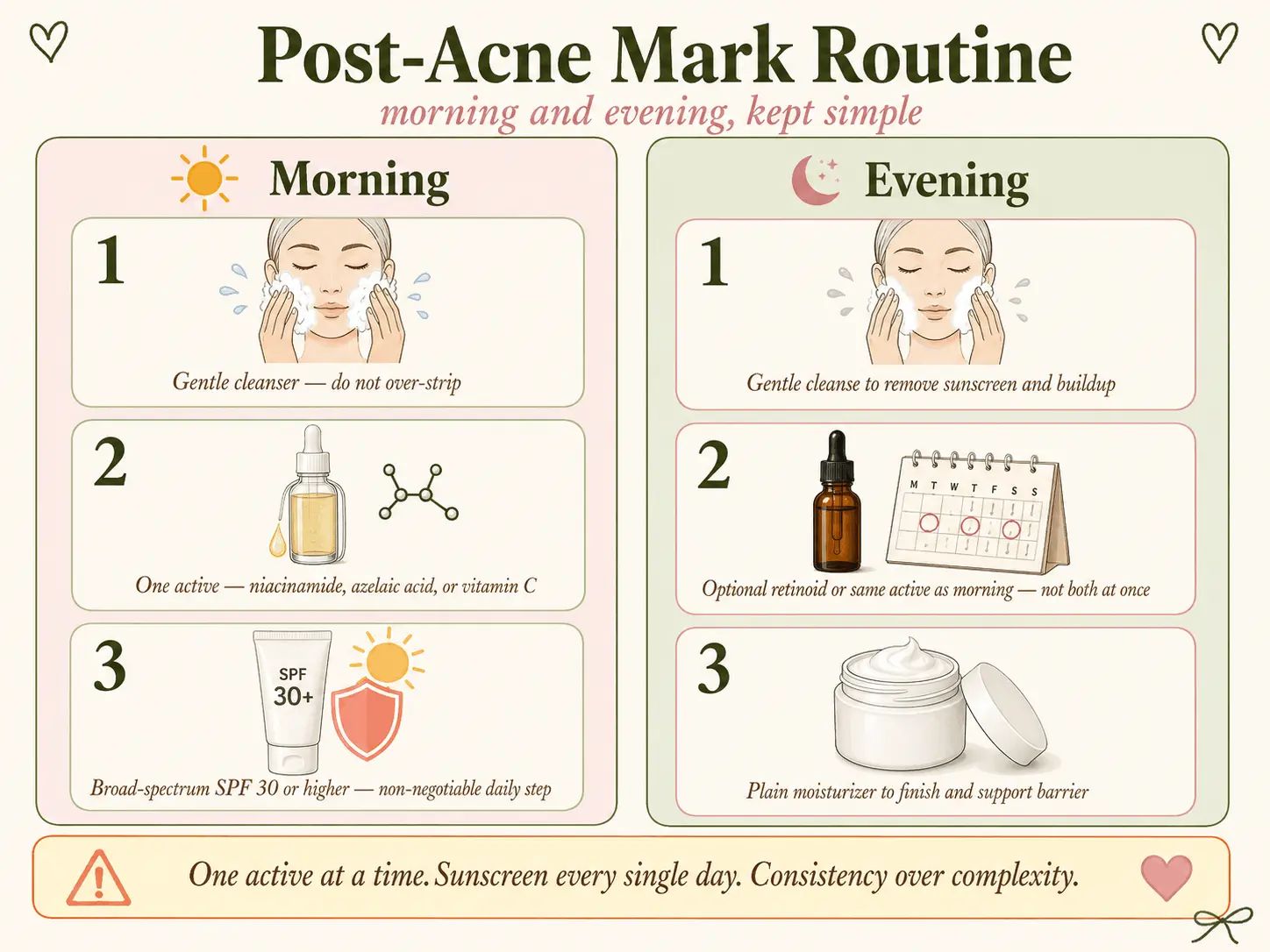
A simple routine to fade acne marks without damaging your skin
1. Gentle cleanser or water rinse. 2. Optional niacinamide, azelaic acid or antioxidant serum. 3. Moisturizer if needed. 4. Broad-spectrum SPF 30 or higher.
1. Gentle cleanser. 2. One main treatment, such as azelaic acid, a retinoid or a carefully chosen acid. 3. Moisturizer. Introduce one active at a time and follow its label or your clinician's instructions; use it less often if irritation develops.
You do not need azelaic acid, retinol, glycolic acid, salicylic acid, tranexamic acid and vitamin C in the same week. A routine that looks impressive on paper but causes inflammation is a bad PIH routine.
Persistent burning, swelling, cracking, severe peeling or worsening dark patches are not signs that a product is “working.” Stop the irritating product, simplify the routine and seek medical advice if the reaction is severe or does not settle.
For irritation troubleshooting, read is my skin barrier damaged or is it acne?, nine signs you overdid your skincare routine, and why moisturizer burns.
How to combine dark-spot ingredients safely
Azelaic acid and salicylic acid
Azelaic acid and salicylic acid can be used within the same overall routine, but starting both at high frequency can increase irritation. One cautious option is to introduce one product first, then add the other on separate days only if the skin remains comfortable. Product directions and individual tolerance should determine frequency.
Azelaic acid and retinoids
Azelaic acid and a topical retinoid may both address acne and PIH. People prone to irritation may separate them between morning and night or alternate days. Moisturizer can improve tolerability and does not inherently cancel the treatment's effect.
Glycolic acid and retinoids
Do not assume that combining exfoliation with a retinoid will fade marks faster. Using glycolic acid and a retinoid together can increase dryness and inflammation. Consider pausing glycolic acid while adapting to a retinoid, or use it less frequently on separate days if tolerated.
Hypochlorous acid spray
Hypochlorous acid is not an established pigment-correcting treatment. It may be used as a low-irritation adjunct for some acne-prone or irritated skin, but direct evidence that facial sprays reduce acne-related PIH is limited. It should not replace sunscreen or an evidence-based acne treatment. Read our full hypochlorous acid face spray review for the evidence and limits.
How long do post-acne dark spots take to fade?
A spot only a few shades darker than the surrounding skin may fade naturally within roughly 6 to 12 months. Deeper gray or blue-gray pigment can take years. In treatment studies, early measurable changes are commonly assessed after about 8 to 12 weeks, while fuller improvement may take several months.5679
- Weeks 1 to 4: prioritize tolerability and acne control. Dramatic fading is unlikely.
- Weeks 8 to 12: early improvement may become visible in some people if the diagnosis and treatment are appropriate.
- Months 3 to 6: clearer changes may emerge with consistent treatment and control of new breakouts.
- Beyond 6 months: persistent, deep or mixed discoloration may warrant clinician-directed treatment or a procedure.
Common mistakes that make acne dark spots worse
| Mistake | Why it backfires |
|---|---|
| Scrubbing or exfoliating every day | Repeated irritation can worsen inflammation, disrupt barrier function and trigger additional pigmentation. |
| Spot-treating only old marks | New acne continues producing new PIH. |
| Skipping sunscreen on cloudy days | UVA reaches the ground on cloudy days, and visible light can contribute to hyperpigmentation in darker skin tones. |
| Judging a product after one week | Most treatment studies assess change over at least 8 to 12 weeks, and fuller fading can take months. |
| Using lemon juice, baking soda or toothpaste | These substances can irritate or burn skin and are not established treatments for acne-related PIH. |
| Treating every mark as PIH | PIE and textural scars need different strategies. |
When should you see a dermatologist?
Seek professional care for painful nodular or cystic acne, scarring, rapidly worsening or unusually persistent discoloration, or reactions involving swelling, blistering or crusting. A dermatologist can discuss prescription azelaic acid, retinoids, hydroquinone, procedures and other options. Peels, lasers and energy-based devices require particular caution in darker skin because treatment-induced inflammation can cause additional PIH.41213
Build the full acne cluster: compare salicylic acid 2%, learn why oily skin can still be dehydrated, and protect progress with the evidence-based SPF guide.
Frequently asked questions
What is the fastest way to fade post-acne dark spots?
Control active acne, use broad-spectrum sunscreen consistently, and choose one evidence-supported treatment such as azelaic acid or a retinoid. More irritation does not mean faster fading.
Are brown acne marks scars?
Flat brown or gray marks are usually post-inflammatory hyperpigmentation rather than textural scars. Indented or raised areas indicate structural scarring.
Can salicylic acid remove dark spots?
Salicylic acid may help indirectly by treating acne and reducing new lesions. Professional 30% peel studies show improvement in post-acne hyperpigmentation, but that evidence cannot be applied directly to a 2% home product. Overuse can irritate skin and worsen PIH.
Is azelaic acid good for acne marks?
Yes. Azelaic acid has direct clinical evidence for acne-related PIH and can also treat active acne. Early changes may appear after 8 to 12 weeks, but results vary by formula, strength, adherence and pigment depth.
Does niacinamide fade post-acne marks?
Niacinamide may support gradual brightening and barrier function, but evidence for niacinamide alone in acne-induced PIH is limited compared with the volume of marketing claims.
Can dark spots get worse before they get better?
Marks can darken after ultraviolet or visible-light exposure and after new irritation. Burning, prolonged redness or worsening pigment is a reason to reduce or stop the irritating product.
Can I use azelaic acid with salicylic acid?
Yes, but introduce them one at a time. Using them on separate days or reducing the frequency of one product may lower the risk of dryness and irritation.
How long do acne dark spots last?
Some superficial marks fade within 6 to 12 months after the cause is controlled. Deeper pigment can persist for years. Treatment studies often assess early change after 8 to 12 weeks, but visible results vary.
Sources
- Tan MG, Kim WB, Jo CE, et al. Topical treatment for postinflammatory hyperpigmentation: a systematic review. J Dermatolog Treat. 2022;33(5):2518-2526. PubMed. doi:10.1080/09546634.2021.1981814.
- Davis EC, Callender VD. Postinflammatory hyperpigmentation: a review of epidemiology, clinical features and treatment options in skin of color. J Clin Aesthet Dermatol. 2010;3(7):20-31. PubMed.
- Silpa-Archa N, Kohli I, Chaowattanapanit S, Lim HW, Hamzavi I. Postinflammatory hyperpigmentation: A comprehensive overview: Epidemiology, pathogenesis, clinical presentation, and noninvasive assessment technique. J Am Acad Dermatol. 2017;77(4):591-605. PubMed. doi:10.1016/j.jaad.2017.01.035.
- Mar K, Khalid B, Maazi M, et al. Treatment of Post-Inflammatory Hyperpigmentation in Skin of Color: A Systematic Review. J Cutan Med Surg. 2024;28(5):473-480. PubMed. doi:10.1177/12034754241265716.
- Shucheng H, Zhou X, Du D, et al. Effects of 15% Azelaic Acid Gel in the Management of Post-Inflammatory Erythema and Post-Inflammatory Hyperpigmentation in Acne Vulgaris. Dermatol Ther (Heidelb). 2024;14(5):1293-1314. PubMed. doi:10.1007/s13555-024-01176-2.
- American Academy of Dermatology. How to fade dark spots in darker skin tones. AAD. Accessed July 26, 2026.
- Alexis A, Del Rosso JQ, Forman S, et al. Importance of treating acne sequelae in skin of color: 6-month phase IV study of trifarotene with an appropriate skincare routine including UV protection in acne-induced post-inflammatory hyperpigmentation. Int J Dermatol. 2024;63(6):806-815. PubMed. doi:10.1111/ijd.17189.
- European Medicines Agency. Updated measures for pregnancy prevention during retinoid use. EMA. Accessed July 26, 2026.
- Sobhan M, Talebi-Ghane E, Poostiyan E. 20% azelaic acid cream versus 5% tranexamic acid solution for acne-related postinflammatory hyperpigmentation. J Res Med Sci. 2023;28:18. PubMed. doi:10.4103/jrms.jrms_443_22.
- Sarkar R, Parmar NV, Kapoor S. Treatment of Postinflammatory Hyperpigmentation With a Combination of Glycolic Acid Peels and a Topical Regimen in Dark-Skinned Patients: A Comparative Study. Dermatol Surg. 2017;43(4):566-573. PubMed. doi:10.1097/DSS.0000000000001007.
- How KN, Lim PY, Wan Ahmad Kammal WSL, Shamsudin N. Efficacy and safety of Jessner's solution peel in comparison with salicylic acid 30% peel in the management of patients with acne vulgaris and postacne hyperpigmentation with skin of color: a randomized, double-blinded, split-face, controlled trial. Int J Dermatol. 2020;59(7):804-812. PubMed. doi:10.1111/ijd.14948.
- Elbuluk N, Grimes P, Chien A, et al. The Pathogenesis and Management of Acne-Induced Post-inflammatory Hyperpigmentation. Am J Clin Dermatol. 2021;22(6):829-836. PubMed. doi:10.1007/s40257-021-00633-4.
- Lopez-Estebaranz JL, Lopez-Pando M, Mitsunaga K. Practical Therapeutic Strategies for Acne-Induced Hyperpigmentation Across all Skin Types. Am J Clin Dermatol. 2026;27(4):697-707. PubMed. doi:10.1007/s40257-026-01044-z.
Medical disclaimer: This article is for general education and does not replace diagnosis or treatment from a qualified clinician. Seek medical advice for severe acne, scarring, persistent discoloration, pregnancy-related treatment questions, or a significant reaction to skincare.
Stay curious, stay evidence-based.