
Hypochlorous acid sprays are suddenly everywhere: acne routines, gym bags, post-laser aftercare, “safe for sensitive skin” shelves, and TikTok videos claiming they calm almost anything. The science is interesting but the internet version is too confident.
The honest answer: hypochlorous acid, usually shortened to HOCl, is a genuinely useful gentle antimicrobial and soothing ingredient. It may help inflamed, acne-prone, sweaty, irritated, or post-procedure skin. But it is not a replacement for proven acne treatments, it is not a rosacea cure, and some wound-care claims online are being stretched.
HOCl spray can be a smart support product if your skin gets red, sweaty, itchy, acne-prone, or easily irritated. Its best-supported benefits are gentle antimicrobial cleansing and good tolerability. Its weakest claims are “cures acne,” “treats rosacea,” or “replaces prescription skincare.”
Table of Contents
What is hypochlorous acid?
Hypochlorous acid is a weak acid made naturally by your immune system. During an immune response, neutrophils use the enzyme myeloperoxidase to generate HOCl from hydrogen peroxide and chloride ions. In plain English: your body makes HOCl as part of its microbial defense system.
In skincare, brands use stabilized, low-concentration HOCl solutions as sprays, mists, gels, or wound cleansers. Most face sprays are mostly water and salt, with a small amount of active available chlorine species. The formulation matters a lot: pH, concentration, storage, bottle design, and shelf life can change how active the product stays.
HOCl is an oxidizing antimicrobial molecule: it can damage microbial proteins and membranes, while also forming chloramine compounds that may help tone down inflammatory signaling.
How HOCl works on skin
HOCl works mainly through oxidation. It reacts with sulfur- and nitrogen-containing groups in microbial enzymes, proteins, membranes, and other structures. That broad, nonspecific damage is why HOCl can act against many bacteria in lab settings, including Staphylococcus aureus, Cutibacterium acnes, and Pseudomonas aeruginosa.
It also has a plausible anti-inflammatory side. HOCl can react with taurine in tissues to form taurine chloramine. Taurine chloramine has been shown in mechanistic research to reduce NF-κB-related inflammatory signaling and cytokines such as TNF-α. That helps explain why some people experience HOCl as calming rather than harsh.
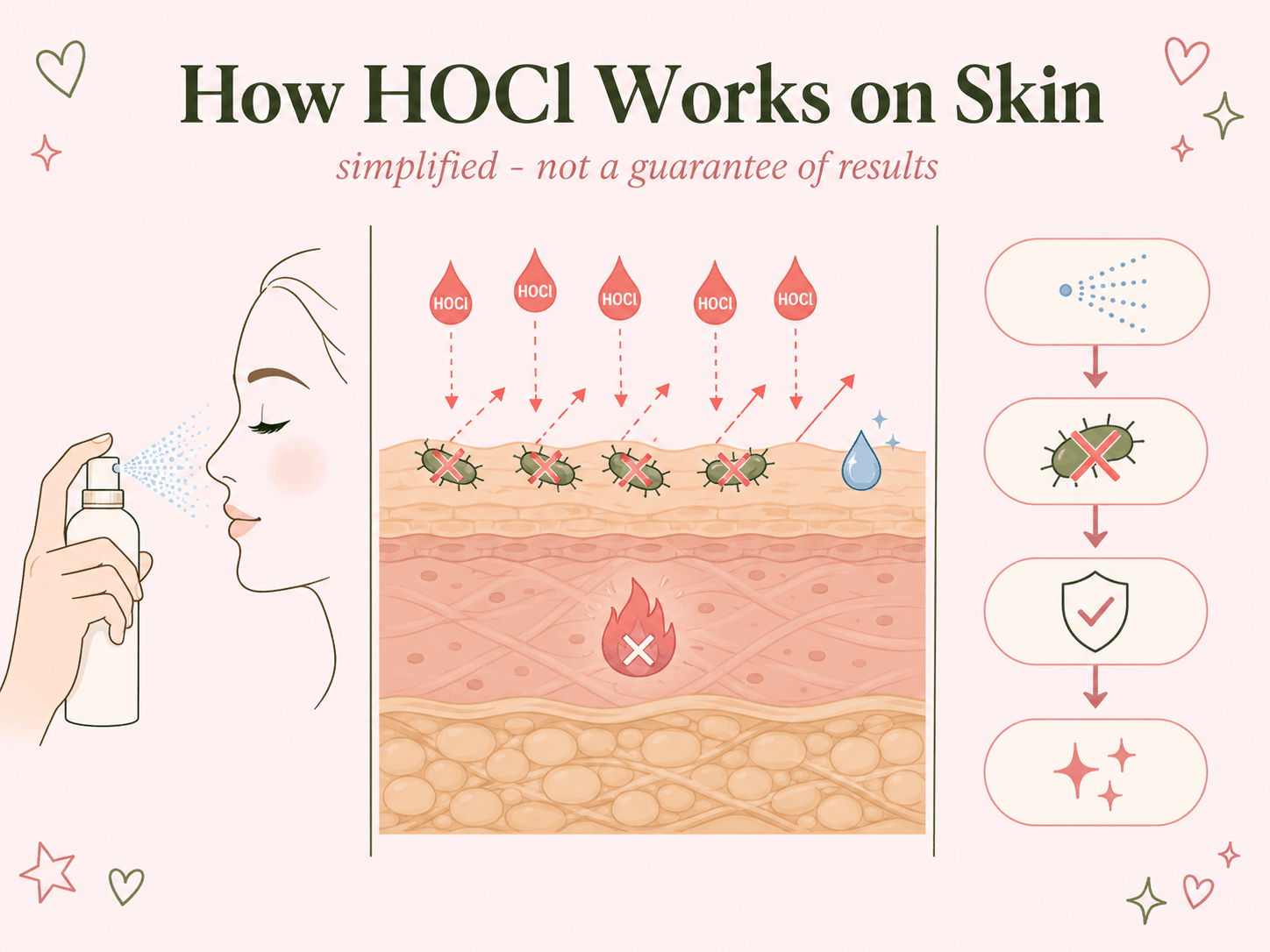
Lab kill-time data does not automatically prove real-world acne or rosacea improvement. Skin has oil, sweat, dead cells, biofilm, product residue, and different contact times. A spray that kills microbes in a dish can still have only modest clinical effects.
What does the evidence actually support?
The evidence is not “fake,” but it is thinner than the marketing. HOCl has stronger support as a gentle wound cleanser/antimicrobial support product than as a mainstream acne or rosacea treatment. The best practical use is as an adjunct something that supports the routine not the main treatment doing all the work.
Reasonable evidence and clinical use, especially for cleansing, wounds, and irritation-prone skin.
Small trials suggest benefit, but evidence is not strong enough to replace standard acne treatments.
Mechanistically plausible, but large dedicated clinical trials are lacking.
Can hypochlorous acid help acne?
Maybe especially inflammatory, irritated, or sweat-triggered breakouts but do not treat it like a first-line acne medication.
Two acne-related studies are usually cited. One older randomized trial compared a super-oxidized solution to benzoyl peroxide in mild-to-moderate inflammatory acne and found comparable improvement, but the authors still called for larger studies. Another split-face trial tested 0.005% sodium hypochlorite solution, a related but not identical compound, and reported improvement in mild-to-moderate acne lesions.
That is interesting. But the American Academy of Dermatology’s acne guideline still gives strong recommendations to treatments like benzoyl peroxide, topical retinoids, topical antibiotics when appropriate, oral doxycycline, and isotretinoin for severe or treatment-resistant acne. HOCl is not a core guideline acne treatment.
Use HOCl as a low-irritation support spray after sweating, after cleansing, or between stronger acne treatments. Keep benzoyl peroxide, adapalene/tretinoin, azelaic acid, salicylic acid, or prescriptions as the actual treatment backbone if your acne is persistent.
| Claim | Verdict | Better wording |
|---|---|---|
| “HOCl cures acne.” | No | HOCl may help some inflammatory acne as an adjunct, but it is not a proven cure. |
| “HOCl kills acne-related bacteria.” | Mostly yes | HOCl can reduce bacteria in lab conditions; real-skin benefit depends on product and use. |
| “HOCl is equal to benzoyl peroxide.” | Too strong | One older study found comparable results for a super-oxidized solution, but the evidence base is much smaller than for benzoyl peroxide. |
| “HOCl is good if benzoyl peroxide irritates me.” | Reasonable | It may be a gentler support option, but it may also be less powerful for acne control. |
What about redness, rosacea, eczema, and itching?
This is where HOCl gets tempting and where we need to stay honest. HOCl can feel soothing for some people because it is usually low-sting, antimicrobial, and anti-inflammatory in a mechanistic sense. It may reduce itch or irritation in some settings, and it is widely used in post-procedure or wound-care contexts.
But rosacea is not just “bacteria plus redness.” It can involve vascular reactivity, immune signaling, Demodex-associated inflammation, barrier changes, heat sensitivity, and triggers. There is not enough strong clinical evidence to say HOCl treats rosacea the way established options can.
For eczema-prone skin, HOCl may help by lowering microbial burden, especially S. aureus, and calming itch in some users. Still, eczema care usually needs barrier repair, trigger control, moisturizers, and sometimes anti-inflammatory medication.
HOCl is best described as “supportive skincare,” not “active treatment magic.”
That distinction matters.The WHO wound-care claim: what actually happened?
Some reports and marketing-style summaries say HOCl was added to the WHO Essential Medicines List for wound care. That wording is not accurate.
In 2025, the WHO Expert Committee did not recommend listing hypochlorous acid solution for topical antisepsis and wound care because the evidence for benefit was inconclusive. HOCl was listed separately as an environmental disinfectant, which is a different category from saying it is an essential wound-care medicine.
This does not mean HOCl is useless for wounds. It means the official WHO claim needs to be precise: environmental disinfectant listing is not the same as a wound-care endorsement.
Is HOCl safe?
For most people, a properly formulated low-concentration HOCl spray is likely low-risk. It is usually less irritating than alcohol, high-strength hydrogen peroxide, harsh antiseptics, and many acne actives. That is why people with sensitive or reactive skin often like it.
But “safe” still depends on the product. A face mist, an eyelid hygiene product, a wound cleanser, a sodium hypochlorite solution, and a disinfectant are not all interchangeable. Use products only as labeled.
- Good sign: fragrance-free, dye-free, simple formula.
- Good sign: clear ppm or HOCl concentration listed.
- Good sign: sealed, opaque, or UV-protective packaging.
- Be careful: vague “medical grade” claims without documentation.
- Be careful: old bottles stored in heat, sunlight, or open air.
- Stop using: if it causes burning, swelling, rash, hives, or worsening irritation.
How to use HOCl spray in a skincare routine
The simplest approach is: spray it on clean skin, let it dry, then continue with moisturizer and sunscreen. Do not overthink it. If you are deciding whether to mist again later in the day, read our focused guide to using hypochlorous acid over sunscreen or makeup, including what has not been directly tested.
- Cleanse or rinse first. HOCl works better when it is not fighting through sweat, heavy makeup, sunscreen film, or oil.
- Spray enough to lightly wet the area. You do not need to drench your face.
- Let it dry. Give it a few minutes before layering your next product.
- Follow with moisturizer. HOCl is not a moisturizer and does not replace barrier repair.
- Use sunscreen in the morning. HOCl does not protect from UV damage.
Can you use HOCl with retinoids?
Usually yes, if your skin tolerates it. A practical routine would be HOCl in the morning or after workouts, and your retinoid at night. If you want to use both at night, spray HOCl after cleansing, let it dry, then apply moisturizer and retinoid as usual.
Can you use HOCl with benzoyl peroxide?
You can, but they are both oxidative in different ways, so layering them at the exact same moment is not necessary. A cleaner setup: HOCl after workouts or in the morning, benzoyl peroxide at night or as directed.
Can you use HOCl with vitamin C?
Be more careful with pure L-ascorbic acid vitamin C. HOCl is an oxidizer, and ascorbic acid is oxidation-sensitive. To protect your vitamin C serum’s effectiveness, separate them: vitamin C in the morning, HOCl later in the day or at night.
Building an acne-prone routine? You may also like our guides on moisturizers for oily, acne-prone skin, damaged skin barrier signs, and why moisturizer burns.
How to choose a good hypochlorous acid spray
Do not buy based only on aesthetic packaging. HOCl is chemistry-sensitive. The best product is the one that actually keeps the active ingredient stable and tells you enough about the formula.
Water, salt/saline, and hypochlorous acid are enough. Fragrance is unnecessary.
Many consumer products fall around 50–200 ppm available chlorine, but check the label.
Opaque, airtight, or UV-protective bottles help stability.
This phrase can be marketing. FDA 510(k) clearance applies to specific device uses, not every skincare claim.
Bottom line
Hypochlorous acid spray is worth considering if your skin is sensitive, irritated, sweaty, acne-prone, or recovering from a procedure. It is one of the more reasonable “viral skincare” trends because the mechanism makes sense and the safety profile is generally friendly.
But the best version of the claim is modest: HOCl can support skin by reducing surface microbes and calming irritation. It should not be sold as a cure for acne, rosacea, eczema, wounds, or every mystery redness problem.
HOCl spray is a low-risk, potentially useful add-on especially for sensitive or inflamed skin. Use it as support, not as your entire treatment plan.
FAQ
Does hypochlorous acid spray cure acne?
No. It may help reduce microbes and irritation, but it is not a proven stand-alone acne treatment.
Can I use HOCl every day?
Most low-concentration face sprays can be used daily if tolerated. Follow the product label and stop if irritation develops.
Is HOCl good after workouts?
It can be useful after sweating because it is a gentle antimicrobial mist. Still cleanse properly when you can.
Can I spray it over makeup?
You can, but it probably works better on clean skin. Makeup, sunscreen, and oil can reduce contact with the skin surface.
Is HOCl safe around eyes?
Only use products labeled for eyelid or eye-area use. Do not assume every face spray is ophthalmic-safe.
Does HOCl replace benzoyl peroxide?
Usually no. Benzoyl peroxide has much stronger acne evidence. HOCl may be gentler, but gentler does not always mean equally effective.
References
- World Health Organization. (2025). Hypochlorous acid. WHO Model List of Essential Medicines / Essential Medicines for Children. Section 15.2: Disinfectants. Added in 2025, TRS 1064. WHO eEML medicine entry.
- World Health Organization. (2025). 25th WHO Expert Committee on Selection and Use of Essential Medicines: Expert review A.16 Hypochlorous acid: EML and EMLc. World Health Organization. WHO expert review PDF.
- Reynolds RV, Yeung H, Cheng CE, Cook-Bolden F, Desai SR, Druby KM, Freeman EE, Keri JE, Stein Gold LF, Tan JKL, Tollefson MM, Weiss JS, Wu PA, Zaenglein AL, Han JM, Barbieri JS. Guidelines of care for the management of acne vulgaris. Journal of the American Academy of Dermatology. 2024 May;90(5):1006.e1-1006.e30. doi: 10.1016/j.jaad.2023.12.017. Epub 2024 Jan 30. Erratum in: Journal of the American Academy of Dermatology. 2026 Apr 11:S0190-9622(26)00546-3. doi: 10.1016/j.jaad.2026.04.009. PMID: 38300170. PubMed.
- Tirado-Sánchez A, Ponce-Olivera RM. Efficacy and tolerance of superoxidized solution in the treatment of mild to moderate inflammatory acne. A double-blinded, placebo-controlled, parallel-group, randomized, clinical trial. Journal of Dermatological Treatment. 2009;20(5):289-92. doi: 10.1080/09546630902973995. PMID: 19459079. PubMed.
- Dorostkar A, Ghahartars M, Namazi M, Todarbary N, Hadibarhaghtalab M, Rezaee M. Sodium Hypochlorite 0.005% Versus Placebo in the Treatment of Mild to Moderate Acne: A Double-Blind Randomized Controlled Trial. Dermatology Practical & Conceptual. 2021 May 20;11(3):e2021046. doi: 10.5826/dpc.1103a46. PMID: 34123555; PMCID: PMC8172071. PMC.
- Stough D. Topical Stabilized Super-Oxidized Hypochlorous Acid for Wound Healing in Hair Restoration Surgery: A Real-Time Usage-Controlled Trial Evaluating Safety, Efficacy, and Tolerability. Journal of Drugs in Dermatology. 2023 Dec 1;22(12):1191-1196. doi: 10.36849/JDD.7172. PMID: 38051837. PubMed.
- Haralović V, Mokos M, Špoljar S, Dolački L, Šitum M, Lugović-Mihić L. Hypochlorous Acid: Clinical Insights and Experience in Dermatology, Surgery, Dentistry, Ophthalmology, Rhinology, and Other Specialties. Biomedicines. 2025 Nov 28;13(12):2921. doi: 10.3390/biomedicines13122921. PMID: 41462936; PMCID: PMC12730738. PMC.
- American Academy of Dermatology. (2024, January 31). American Academy of Dermatology issues updated guidelines for the management of acne: Both newly approved and well-established treatments recommended. American Academy of Dermatology. AAD.
- National Rosacea Society. (n.d.). FDA approved treatments for rosacea. National Rosacea Society. National Rosacea Society.
Medical disclaimer: This article is for education only and is not medical advice. If you have severe acne, signs of infection, persistent rash, painful swelling, eye symptoms, open wounds, or worsening skin irritation, speak with a licensed clinician.
Hot girls read the research.