
A moisturizer is supposed to make your skin feel calmer. So when it burns, stings, or makes your face feel hot, it is easy to assume the product is "working" or that your skin just needs to adjust.
Usually, that is not the best explanation. If you use UK spelling, moisturiser means the same thing. The skin problem is the same.
Moisturizer usually burns because your skin barrier is damaged, the formula contains an irritating ingredient, or your skin is reacting to an allergen. If a basic moisturizer burns repeatedly, rinse it off, stop using it, and switch to a bland fragrance-free cream or ointment until your skin calms.
This is where skincare advice online gets messy. Some burning is a predictable side effect of active ingredients like acids or retinoids. But a plain moisturizer that burns every time is not a "detox," not proof that the ingredients are penetrating, and not something you should ignore.
Damaged Skin Barrier: Signs and Repair Routine | Best Moisturizers for Oily Acne-Prone Skin | Salicylic Acid 2%: How to Use Without Irritation
What is in this article
- The short answer
- The skin barrier explanation
- The 7 most likely reasons your moisturizer burns
- Burning moisturizer decision tree
- Ingredients that commonly burn or irritate
- What to do tonight if your moisturizer burns
- Daily barrier repair checklist
- How to choose a moisturizer that is less likely to burn
- When to see a dermatologist
- FAQ
- Sources
The Short Answer.
Your moisturizer can burn for three big reasons:
Your skin barrier is damaged
Dryness, over-exfoliation, retinoids, acne treatments, eczema, shaving, sunburn, cold weather, and harsh cleansing can all make the outer layer of skin more leaky.
The formula is irritating
Acids, fragrance, essential oils, alcohol, strong preservatives, and low-pH vitamin C can trigger burning, especially on already sensitive skin.
You may be allergic to something
Allergic contact dermatitis often shows up later, usually as an itchy rash, swelling, bumps, scaling, or eczema-like patches.
Burning is a signal, not a goal
A tiny, brief tingle from an active can happen. Repeated burning from a basic moisturizer is not something to train your skin to tolerate.
The Skin Barrier Explanation, Without the Jargon.
The top layer of your skin is called the stratum corneum. It works a bit like a brick wall. The skin cells are the bricks, and the lipids between them are the mortar. Those lipids include ceramides, cholesterol, and fatty acids.
When that wall is healthy, it keeps water in and keeps irritants out. When it is damaged, water escapes more easily and ingredients can penetrate more deeply than they should. That can make even a simple moisturizer feel like it is burning.
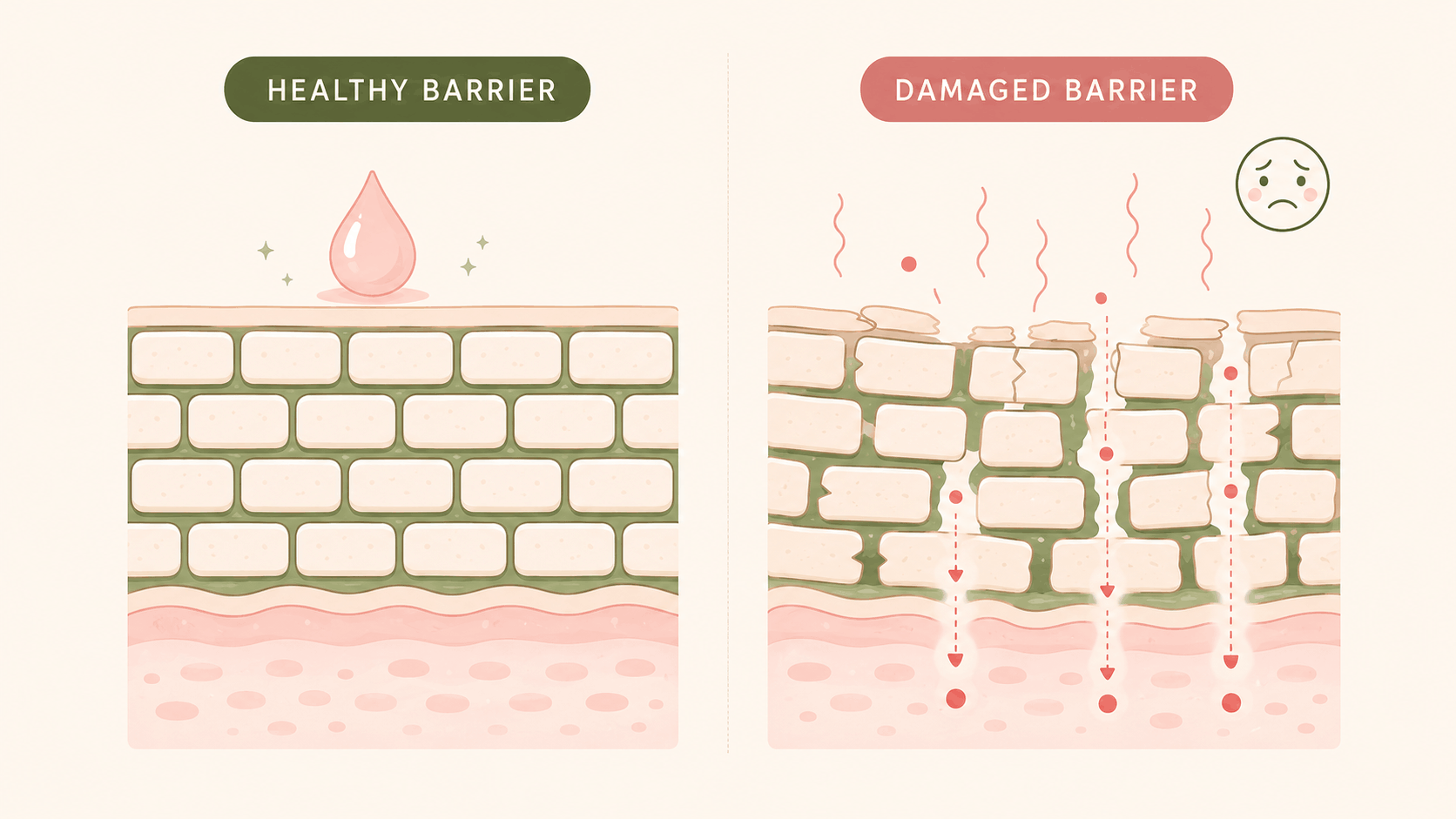
Dermatology literature reports that moisturizers can sometimes cause burning, stinging, irritation, allergic contact dermatitis, contact urticaria, or folliculitis. People with impaired barrier function, such as atopic dermatitis, are especially vulnerable.[1]
That is why a moisturizer can feel fine for months and suddenly burn after a bad week of skincare. Your product may not have changed. Your barrier did.
The 7 Most Likely Reasons Your Moisturizer Burns.
1. Your barrier is overworked
Too much exfoliation, retinoids, acne medication, hot water, harsh cleanser, sunburn, wind, or shaving can leave the skin raw enough that moisturizer stings.
2. Fragrance is irritating your skin
Fragrance is one of the most common problem categories in moisturizers and personal-care products. "Unscented" is not the same as fragrance-free.
3. Your moisturizer contains exfoliating acids
Some moisturizers include glycolic acid, lactic acid, mandelic acid, salicylic acid, or PHA. These can sting because they exfoliate and acidify the skin.
4. You layered it over strong treatments
Moisturizer applied after tretinoin, adapalene, benzoyl peroxide, acids, or vitamin C may sting because your skin is already irritated from the active.
5. You are reacting to a preservative or botanical
Preservatives, essential oils, lanolin, propylene glycol, and plant extracts can trigger contact dermatitis in some people.
6. You have eczema, rosacea, or very sensitive skin
Reactive skin can sting from formulas that other people tolerate easily. A normal-looking face can still have an impaired barrier, and sensitive-skin research often uses stinging tests because burning or stinging can occur without obvious visible damage.[9]
7. You may have contact dermatitis
If burning comes with itching, rash, swelling, blisters, oozing, cracking, or repeated flares, treat it as a medical skin reaction, not a cosmetic inconvenience. Contact dermatitis can come from irritants or allergens, and medical sources describe burning, itching, rash, swelling, blistering, dryness, and cracking as possible symptoms.[2]
Most cases calm down
Once you stop the trigger and simplify your routine, mild irritation often improves. The trick is not adding five more "barrier repair" products at once.
Burning Moisturizer Decision Tree.
Use this as a practical sorting tool, not a diagnosis. The pattern matters: timing, redness, itching, swelling, and whether the same product burns every time.
| Symptom pattern | Most likely explanation | What to do |
|---|---|---|
| Burns for 5 to 10 seconds, no redness, no rash | Mild sensitivity or active ingredient tingle | Monitor. Stop if it repeats, gets stronger, or starts leaving redness. |
| Burns every time you apply it | Barrier damage, irritant formula, or wrong product for your skin | Stop the product and switch to a bland fragrance-free cream or ointment. |
| Immediate burning with redness, warmth, tightness, or pain | Irritant contact dermatitis or an already compromised barrier | Rinse off, pause actives, and keep the routine boring for several days. |
| Itchy rash 24 to 72 hours later | Possible allergic contact dermatitis | Stop the product. If it repeats or persists, ask about dermatology patch testing. |
| Swelling, blisters, oozing, crusting, eye-area reaction, or severe pain | Medical skin reaction or infection risk | Seek medical care. Do not keep experimenting with skincare. |
| Burns after retinoids, acids, benzoyl peroxide, or vitamin C | Overuse irritation or active-related barrier stress | Pause or reduce actives. Reintroduce one at a time only after skin calms. |
The NHS describes contact dermatitis as a reaction that usually appears within a few hours or days after exposure to an irritant or allergen. DermNet notes that allergic contact dermatitis usually appears 24 to 72 hours after contact with the allergen.[4][5]
Ingredients That Commonly Burn, Sting, or Irritate.
No ingredient is bad for every person. Concentration, formula, skin condition, and frequency matter. But some categories are more likely to cause burning, especially when the barrier is already stressed.
| Ingredient category | Why it can burn | Best move if you are sensitive |
|---|---|---|
| Fragrance, parfum, aroma | Can irritate skin and is a major contact allergy category. JCAD found fragrance in 68 percent of moisturizers in a 276-product analysis.[1] | Choose products labeled fragrance-free, not just unscented. |
| Essential oils and botanical fragrance | Plant-derived does not mean gentle. Essential oils can cause allergic contact dermatitis, and DermNet lists common examples including tea tree, ylang-ylang, lemongrass, sandalwood, clove, jasmine, and citrus oils.[7] | Avoid essential oils if your skin stings easily. |
| AHAs, like glycolic and lactic acid | They exfoliate the stratum corneum. Reviews report mild irritation, redness, stinging, and burning, especially when concentration or frequency is too high.[6] | Use less often, use lower strength, and do not apply on raw skin. |
| BHAs, like salicylic acid | Salicylic acid can dry and irritate. Mayo Clinic lists skin irritation and stinging as possible effects of topical salicylic acid, especially when skin is already stressed or products are layered.[8] | Use one exfoliant at a time and moisturise separately. |
| Retinoids, like retinol, retinal, adapalene, tretinoin | Retinoids can cause dryness, peeling, burning, and irritation, particularly when they are introduced too quickly, used too often, or layered with other strong actives. | Start low, go slow, and use a moisturizer sandwich. |
| Low-pH vitamin C, especially L-ascorbic acid | L-ascorbic acid formulas are usually acidic, so they may sting when skin is sensitive, freshly exfoliated, or already barrier-damaged. | Try a gentler derivative or use less often. |
| Alcohol denat or high ethanol formulas | Can feel cooling at first, then dry or sting because it disrupts surface lipids in some formulas. | Avoid high-alcohol leave-on products if your barrier is compromised. |
| Preservatives and solvents | Necessary for safety, but some people react to methylisothiazolinone, formaldehyde releasers, propylene glycol, lanolin, or benzyl alcohol. | If reactions repeat, ask a dermatologist about patch testing. |
If a basic moisturizer burns every time, your skin is not "purging." It is irritated.
Purging is about clogged pores surfacing faster. Burning is a comfort and barrier signal.What to Do Tonight If Your Moisturizer Burns.
Do not panic, but do not keep layering either. Your goal is to remove the trigger and stop adding more variables.
- Rinse it off gently. Use cool to lukewarm water. Do not scrub. Do not use an exfoliating cleanser.
- Stop the product for now. Do not "test it again" on your whole face tomorrow. That is how mild irritation turns into a bigger flare.
- Pause actives for a few days. That means retinoids, acids, benzoyl peroxide, harsh vitamin C, scrubs, peels, and cleansing brushes.
- Use a bland barrier product. Choose a fragrance-free cream or ointment. Petrolatum can be useful on dry or cracked patches if your skin tolerates it.
- Keep cleansing boring. Use a gentle cleanser or just water if your skin is very reactive. Avoid hot water.
- Use sunscreen in the morning. Irritated skin is less tolerant of UV exposure, and many actives increase sun sensitivity.
- Track what changed. New moisturizer, new cleanser, more retinoid nights, shaving, sunburn, cold wind, fragrance, or a new laundry detergent can all matter.
Do not add a new serum, exfoliant, face oil, mask, or "repair ampoule" while your skin is burning. More products mean more possible triggers. The smartest repair routine is usually boring.
Daily Barrier Repair Routine Checklist.
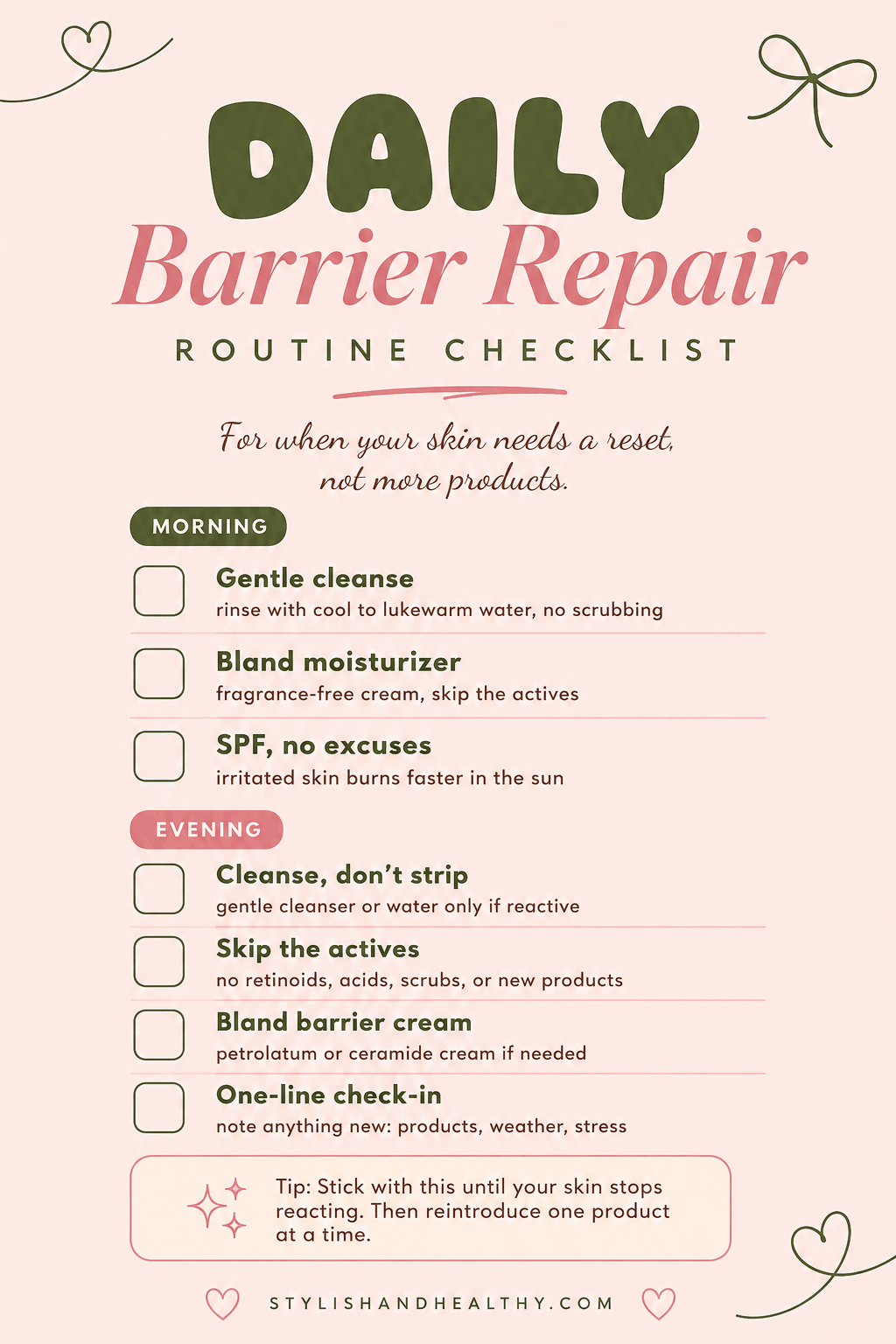
Use this when your moisturizer burns and your routine needs a reset. It keeps the plan simple: gentle cleanse, bland moisturizer, sunscreen, no actives, and one clear daily check-in.
Download the checklistHow to Choose a Moisturizer That Is Less Likely to Burn.
For reactive skin, the best moisturizer is not the fanciest one. It is the one with the least drama.
- Choose fragrance-free, not unscented.
- Look for barrier-supporting ingredients like glycerin, ceramides, cholesterol, panthenol, dimethicone, beta-glucan, squalane, petrolatum, allantoin, or niacinamide.
- Avoid exfoliating acids inside your moisturizer if your skin is already irritated.
- Avoid essential oils and heavy botanical fragrance blends if your skin stings easily.
- Pick cream or ointment textures for damaged, dry, eczema-prone skin.
- Pick light gels or gel-creams only if your skin is oily and not actively cracked or peeling.
- Patch test new products on the inner arm before using them on your face.
The American Academy of Dermatology recommends fragrance-free creams or ointments for eczema-prone skin and advises testing new skin-care products on the inside of the arm every day for 7 to 10 days before broader use.[3]
If you need product ideas for oily or acne-prone skin, read our guide to the best moisturizers for oily, acne-prone skin. If your burning started after exfoliating, our salicylic acid 2% guide explains how to use that ingredient without wrecking your barrier. For the full barrier-repair routine, read Damaged Skin Barrier: Signs and Repair Routine.
Moisturizer Burning Myths.
| Myth | Reality |
|---|---|
| "If it burns, it is working." | Sometimes active ingredients tingle, but burning is not proof of effectiveness. It often means irritation. |
| "Natural moisturizers cannot irritate skin." | Essential oils and botanical fragrance can be major triggers. Natural is not the same as gentle. |
| "Unscented means safe for sensitive skin." | Unscented can still contain masking fragrance. Fragrance-free is the safer label for reactive skin. |
| "You need to exfoliate dry flakes away." | If flakes come from irritation, exfoliating can make the barrier worse. Moisturise and pause actives first. |
| "You should build tolerance to burning." | You build tolerance to some actives slowly. You should not train your skin to tolerate a moisturizer that repeatedly burns. |
When to See a Dermatologist.
Most mild stinging improves when you stop the trigger and simplify your routine. But some reactions need professional care.
The burning is severe, painful, spreading, blistering, swollen, oozing, crusting, or close to the eyes.
You keep reacting to multiple "gentle" products and cannot identify the trigger.
The rash keeps coming back, lasts more than a few days, or does not improve after stopping the product.
You have eczema, rosacea, psoriasis, a history of contact allergy, or a prescription acne routine that is damaging your barrier.
The NHS advises seeing a GP for persistent, recurrent, or severe contact dermatitis symptoms. A doctor may refer you to a dermatologist if the cause cannot be identified or symptoms are not responding to treatment.[4]
Frequently Asked Questions.
Why does my moisturizer burn?
Moisturizer usually burns because your skin barrier is damaged, the formula contains an irritating ingredient, or your skin is reacting to an allergen. Repeated burning from a basic moisturizer is a sign to stop and simplify the routine.
Should I stop using a moisturizer if it burns?
Yes, at least temporarily. Rinse it off gently and stop using it while you figure out whether the problem is the product, your barrier, or a routine conflict.
Can a damaged skin barrier make every moisturizer burn?
Yes. When the barrier is disrupted, ingredients that normally sit comfortably on top of the skin can reach more reactive layers and trigger stinging.
Why does moisturizer burn after retinol or tretinoin?
Retinoids can dry and irritate the outer skin layer, especially when started too often or used with other actives. Moisturizer applied afterward may sting because the barrier is already inflamed.
Why does moisturizer burn around my nose or mouth?
Those areas are easily irritated by wiping, runny noses, toothpaste, acne treatments, saliva, weather, and over-cleansing. They can sting before the rest of your face does.
Is it an allergy if my moisturizer burns?
Not always. Immediate burning is often irritant-based. Allergy is more likely if you get an itchy rash that appears hours to days later, especially if it repeats with the same ingredient category.
What is the safest type of moisturizer for burning skin?
A bland, fragrance-free cream or ointment with barrier-supporting ingredients is usually safest. Avoid actives, fragrance, essential oils, and exfoliating ingredients until your skin is calm.
Final Verdict.
A moisturizer that burns is not automatically dangerous, but it is not something to romanticise either. The most likely story is simple: your skin barrier is irritated, the formula contains a trigger, or your immune system is reacting to an ingredient.
The correct move is not to push harder. Stop the trigger, simplify your routine, use a bland fragrance-free moisturizer, and reintroduce actives slowly only after your skin feels normal again.
Gentle cleanse, bland moisturizer, sunscreen in the morning. No acids, no retinoids, no scrubs, no fragrance, no testing new products. Do that until your skin stops acting reactive, then reintroduce one product at a time.
With love,
Stylishandhealthy
This post is for informational purposes only and does not replace medical advice. If your reaction is severe, painful, spreading, blistering, oozing, close to your eyes, or keeps coming back, speak with a qualified clinician or dermatologist. Ingredient lists can change, so always check the packaging on the product you actually use.
Sources
Click to view all 9 sources
Literature cited in the article. We prioritized peer-reviewed studies, clinical reviews, and dermatology organization guidance over brand claims or influencer advice.
- [1] Zirwas MJ, Stechschulte SA. Moisturizer allergy: diagnosis and management. J Clin Aesthet Dermatol. 2008;1(4):38–44. View source
- [2] Cleveland Clinic. Contact dermatitis: symptoms, causes, types & treatments. Updated March 30, 2023. Accessed June 21, 2026. View source
- [3] Ludmann P. 7 dermatologists’ skin care tips that can relieve symptoms of atopic dermatitis. American Academy of Dermatology. Updated October 10, 2023. Accessed June 21, 2026. View source
- [4] NHS. Contact dermatitis: overview. Page last reviewed May 3, 2023. Accessed June 21, 2026. View source
- [5] Oakley A, Post R, Fuller JS. Allergic contact dermatitis. DermNet. Last reviewed August 2025. Accessed June 21, 2026. View source
- [6] Karwal K, Mukovozov I. Topical AHA in dermatology: formulations, mechanisms of action, efficacy, and future perspectives. Cosmetics. 2023;10(5):131. doi:10.3390/cosmetics10050131. View source
- [7] Ismail FF, Nixon RL. Allergic contact dermatitis to essential oils. DermNet. Published January 2020. Accessed June 21, 2026. View source
- [8] Merative, Micromedex. Salicylic acid (topical route). Mayo Clinic. Updated May 1, 2026. Accessed June 21, 2026. View source
- [9] Pan Y, Ma X, Song Y, Zhao J, Yan S. Questionnaire and lactic acid sting test play different role on the assessment of sensitive skin: a cross-sectional study. Clin Cosmet Investig Dermatol. 2021;14:1215–1225. doi:10.2147/CCID.S325166. View source