
Beauty of Joseon Relief Sun: Rice + Probiotics SPF50+ PA++++ is a fragrance-free facial sunscreen built around four modern UV filters, niacinamide, humectants, emollients, rice extract, and fermented grain extracts. This guide starts with the official ingredient list and answers the questions people most often ask about its filters, fragrance, alcohol, niacinamide, and skin-type fit.
What Is in Beauty of Joseon Relief Sun?
Beauty of Joseon Relief Sun uses four organic UV filters, contains niacinamide, and is officially labeled fragrance-free. It does not use zinc oxide or titanium dioxide. The current official ingredient list includes t-Butyl Alcohol and the fatty alcohol Behenyl Alcohol, even though the brand labels the product alcohol free.
This is a formula- and evidence-based analysis, not a controlled long-term wear test by Stylishandhealthy. The product can still feel different depending on your skin, climate, routine, application amount, and the makeup layered over it.
This page covers the global Relief Sun: Rice + Probiotics SPF50+ PA++++ formula and its official INCI, checked August 1, 2026. It does not cover Relief Sun Aqua-Fresh: Rice + B5 or other market-specific Beauty of Joseon sunscreens. Formulas and regional packaging can change, so compare this list with the ingredient panel on the exact product you purchase.
Beauty of Joseon Relief Sun Official Ingredients.
The current official Beauty of Joseon ingredient list is reproduced below so you can check the complete formula rather than only selected hero ingredients.
Full INCI List
Aqua, Dibutyl Adipate, Propanediol, Diethylamino Hydroxybenzoyl Hexyl Benzoate, Polymethylsilsesquioxane, Ethylhexyl Triazone, Methylene Bis-Benzotriazolyl Tetramethylbutylphenol (Nano), Niacinamide, Coco-Caprylate/Caprate, Caprylyl Methicone, Diethylhexyl Butamido Triazone, Glycerin, 1,2-Hexanediol, Butylene Glycol, Pentylene Glycol, Behenyl Alcohol, Poly C10-30 Alkyl Acrylate, Polyglyceryl-3 Methylglucose Distearate, Decyl Glucoside, Oryza Sativa (Rice) Extract, Tromethamine, Carbomer, Acrylates/C10-30 Alkyl Acrylate Crosspolymer, Sodium Stearoyl Glutamate, Polyacrylate Crosspolymer-6, Ethylhexylglycerin, Adenosine, Xanthan Gum, t-Butyl Alcohol, Tocopherol, Oryza Sativa (Rice) Germ Extract, Camellia Sinensis Leaf Extract, Saccharum Officinarum (Sugarcane) Extract, Macrocystis Pyrifera (Kelp) Extract, Lactobacillus/Pumpkin Ferment Extract, Bacillus/Soybean Ferment Extract, Aspergillus Ferment, Cocos Nucifera (Coconut) Fruit Extract, Panax Ginseng Root Extract, Monascus/Rice Ferment, Lactobacillus/Rice Ferment, Saccharomyces/Rice Ferment Filtrate.
Source: Beauty of Joseon official global product page, checked August 1, 2026. Ingredient lists can change without notice.
The formula begins with water, lightweight emollients and humectants, followed by its main sunscreen filters. Niacinamide appears high in the list. The rest of the formula combines additional humectants, emollients, texture agents, rice-derived ingredients, antioxidants, and fermented extracts.
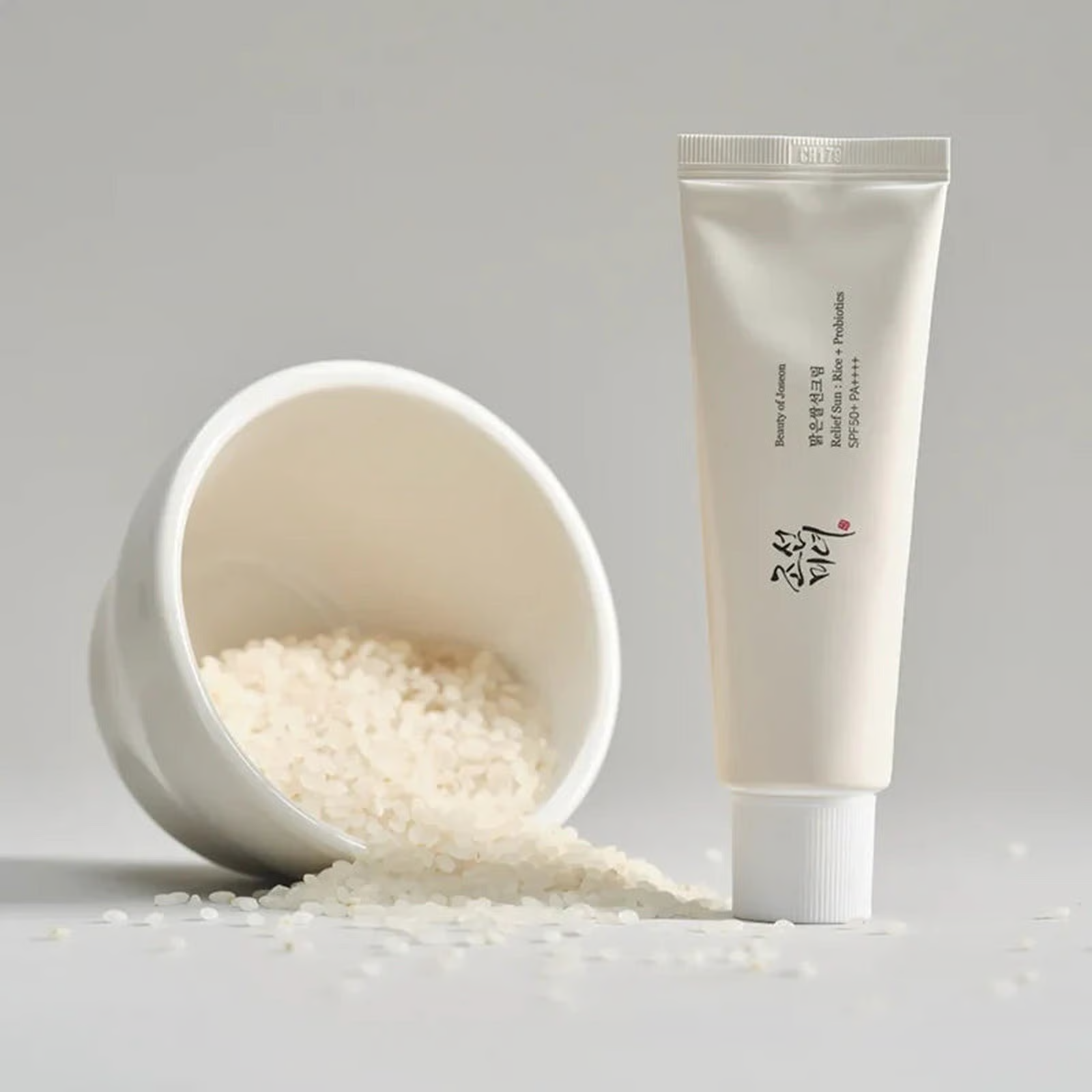
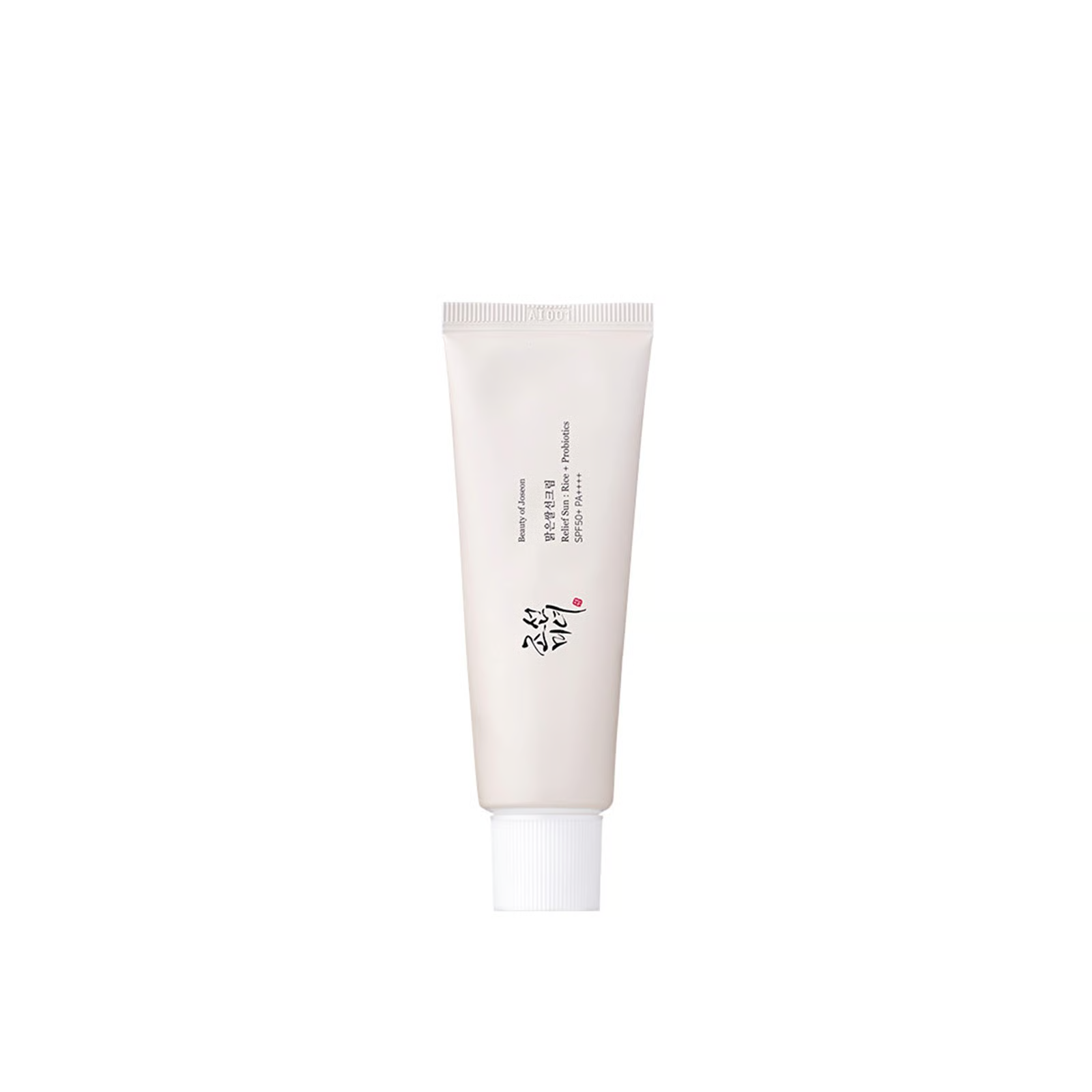
Relief Sun: Rice + Probiotics SPF50+ PA++++
Beauty of Joseon
A strong daily sunscreen formula with four modern UV filters, a hydrating base, niacinamide, rice-derived ingredients, and no listed fragrance. It is less suitable for swimming, heavy sweating, people who want a very matte finish, or routines that specifically require a tinted sunscreen for visible-light protection.
Buy on AmazonWhat UV Filters Are in Beauty of Joseon Relief Sun?
The formula uses four UV filters: Diethylamino Hydroxybenzoyl Hexyl Benzoate, Ethylhexyl Triazone, Methylene Bis-Benzotriazolyl Tetramethylbutylphenol, and Diethylhexyl Butamido Triazone.
| Official INCI name | Main role in the filter system |
|---|---|
| Diethylamino Hydroxybenzoyl Hexyl Benzoate | A photostable organic filter used primarily for UVA protection, especially long-wave UVA. |
| Ethylhexyl Triazone | A highly efficient and photostable UVB filter that helps support the product's high SPF claim. |
| Methylene Bis-Benzotriazolyl Tetramethylbutylphenol (Nano) | Also called MBBT or bisoctrizole. A particulate organic filter that contributes broad UVA and UVB coverage. |
| Diethylhexyl Butamido Triazone | A photostable organic filter that mainly strengthens UVB and shorter-wave UVA protection. |
This is not a zinc oxide or titanium dioxide mineral sunscreen. It is commonly described as a chemical sunscreen because its protection comes from organic UV filters. MBBT is technically a particulate organic filter, which makes the simple chemical-versus-mineral label less precise than the actual ingredient breakdown.
The filter combination is one of the strongest parts of this formula. It combines dedicated UVA and UVB filters rather than relying on one or two older filters to do most of the work.
Is Beauty of Joseon Relief Sun Fragrance-Free?
Yes. Beauty of Joseon currently labels Relief Sun fragrance-free, and the official ingredient list does not include parfum, fragrance, or conventional fragrant essential oils.
Fragrance-free does not mean that no user can react to the formula. Sunscreen filters, preservatives, surfactants, botanical extracts, or other ingredients can still cause irritation in a small number of people. However, removing added fragrance makes the formula more sensible for many users with fragrance sensitivity or acne-prone skin.
Does Beauty of Joseon Relief Sun Contain Alcohol?
The current official ingredient list contains t-Butyl Alcohol and Behenyl Alcohol, while the same product page labels the sunscreen alcohol free. The page does not explain exactly how the brand defines that claim.
These two ingredients are not interchangeable. Behenyl Alcohol is a fatty alcohol used to support texture, consistency, and emollience. Fatty alcohols generally behave differently from ethanol or denatured alcohol and are not automatically drying.
t-Butyl Alcohol is a volatile alcohol and appears much lower in the ingredient list. Its presence does not automatically make the sunscreen harsh, but it does mean that the broad phrase "contains no alcohol at all" would be inaccurate when describing the current official INCI.
If you avoid every ingredient containing the word alcohol, this formula does not meet that standard. Check the packaging of your exact unit because regional or future formulations may differ.
Does Beauty of Joseon Relief Sun Contain Niacinamide?
Yes. Niacinamide is the eighth ingredient in the current official list. Beauty of Joseon does not state its exact percentage on the product page.
Niacinamide is one of the more useful supporting ingredients in the formula. Research supports its role in skin-barrier function, uneven tone, sebum regulation, and visible signs of photoaging. In this sunscreen it should be viewed as a supportive skincare ingredient, not as a substitute for the UV filters or a dedicated pigmentation treatment.
Its relatively high position indicates that it is not merely the final trace botanical in the formula, but ingredient order alone cannot reveal the exact concentration. Avoid websites that assign a precise niacinamide percentage without a direct brand disclosure or formula documentation.
Rice, Ferments and Other Supporting Ingredients.
Outside the filter system, Relief Sun is structured more like a lightweight moisturizing cream than a dry-touch sports sunscreen. That helps explain why many people find it easy to apply in a full sunscreen amount.
Beauty of Joseon states that the formula contains 30% rice extract. Rice-derived cosmetic ingredients have supportive evidence for moisturizing, antioxidant, soothing, and brightening effects, but the sunscreen filters remain the main protective ingredients.
A well-studied supporting ingredient that can contribute to barrier function, tone, oil regulation, and signs of photoaging.
These ingredients help hold water in the upper layers of the skin and support the formula's comfortable, moisturizer-like character.
These emollient and sensorial ingredients improve spread, dissolve or disperse filters, and reduce the chalky feel associated with some sunscreens.
Useful supporting ingredients with antioxidant or soothing rationale, but they are not the principal reason the sunscreen provides protection.
These support the product's skincare story. Evidence for fermented skincare ingredients varies greatly by organism, substrate, concentration, and final formula, so they should not be treated as a guaranteed probiotic treatment.
Is It Good for Sensitive or Acne-Prone Skin?
The fragrance-free design and moisturizer-like base make Relief Sun a reasonable option for many people with sensitive or acne-prone skin. Beauty of Joseon also reports small product studies supporting non-sensitizing and acne-prone-skin suitability. Those brand-reported results are useful context, but they do not guarantee that every sensitive or acne-prone user will tolerate the formula.
A mild surfactant and dispersing ingredient that is tolerated by most users but can be relevant in contact allergy for a small group of people.
Usually well tolerated, but highly reactive skin can respond to almost any complex formula. Patch testing is sensible if you have a history of sunscreen or cosmetic allergy.
The product is not automatically non-comedogenic for every person simply because the brand uses that label. Acne triggers are individual, and breakouts can also result from under-cleansing, heavy layering, sweat, or another product in the routine.
Who Is Beauty of Joseon Relief Sun Best For?
Normal, dry, dehydrated, and balanced combination skin that wants a creamy, comfortable daily sunscreen.
Many acne-prone or fragrance-sensitive users who prefer a moisturizing organic-filter sunscreen.
Very oily skin may find the finish too dewy, especially in hot or humid weather.
Highly reactive, allergy-prone, or rosacea-affected skin because the formula still contains several filters, ferments, and botanical extracts.
Swimming, intense sport, heavy sweating, or long beach exposure where a clearly labeled water-resistant sunscreen is the better choice.
Melasma routines specifically seeking visible-light protection. A tinted sunscreen containing iron oxides may be more appropriate.
Beauty of Joseon Claims vs. the Evidence
| Claim or feature | Our evidence-based reading |
|---|---|
| SPF50+ PA++++ | A high daily-protection claim supported by a modern four-filter system. Real-world protection still depends on applying enough and reapplying. |
| 30% rice extract | A meaningful part of the brand story and a plausible moisturizing support ingredient. It is not more important than the UV-filter system. |
| Fragrance-free | Supported by the current official INCI, which does not list parfum, fragrance, or conventional fragrant essential oils. |
| Alcohol free | Needs clarification because the current official list includes t-Butyl Alcohol and Behenyl Alcohol. The brand does not explain the definition used for the label. |
| No white cast | Plausible for many users because the product does not rely on zinc oxide or titanium dioxide. Individual results can still vary with skin tone, application amount, and how the formula sets. |
| Moisturizer-like feel | Consistent with the humectant, emollient, silicone, and emulsifier system. Actual shine and heaviness will vary by skin type and climate. |
| Suitable for sensitive or acne-prone skin | Reasonable for many users and supported by small brand-reported studies, but not a guarantee of individual tolerance or breakout prevention. |
How to Use Beauty of Joseon Relief Sun Properly
Apply it as the final step of your morning skincare routine. Use a generous, even layer over all exposed areas. Do not rely on a tiny cosmetic amount simply because the formula spreads easily.
Use moisturizer underneath when your skin needs it. The sunscreen is moisturizing, but it does not have to replace your moisturizer every day. Use our sunscreen-versus-moisturizer decision guide to judge the one-step option by skin type, climate and comfort.
Try it without a separate moisturizer first. Adding several hydrating layers underneath can make the finish heavier than necessary.
Allow the sunscreen to settle before applying complexion products. Pilling depends on the complete routine, not only on the sunscreen.
Reapply regularly during meaningful sun exposure. Choose a clearly labeled water-resistant sunscreen for swimming, sports, heavy sweating, or long beach days.
Read our guide to oily but dehydrated skin if your skin feels greasy but tight, or see our moisturizer guide for oily, acne-prone skin when building a lighter routine.
Final Verdict: Is the Formula Good?
Yes. On paper, Beauty of Joseon Relief Sun is a well-constructed daily sunscreen. Its strongest features are the four-filter UVA and UVB system, high niacinamide placement, comfortable humectant and emollient base, and lack of listed fragrance.
The rice and ferment ingredients add a credible skincare story, but they should not distract from the filter system. The main weakness is not poor formulation. It is that the product is not positioned as water resistant, can be too dewy for some oily skin types, and carries an alcohol-free label that deserves clearer explanation because the official INCI includes t-Butyl Alcohol and Behenyl Alcohol.
A strong everyday sunscreen formula for normal, dry, dehydrated, and many combination skin types. The rating reflects the ingredient list, filter design, available evidence, and product positioning. It is not a controlled wear-test score.
Beauty of Joseon Relief Sun Ingredients: FAQ
What are the official Beauty of Joseon Relief Sun ingredients?
The official list begins with aqua, dibutyl adipate and propanediol, followed by its main UV filters. It also includes niacinamide, glycerin, rice extract, rice germ extract, green tea, ginseng, kelp and multiple fermented extracts. The complete current list appears near the top of this article.
Is Beauty of Joseon Relief Sun fragrance-free?
Yes. The brand labels it fragrance-free, and the current official INCI does not list parfum, fragrance or conventional fragrant essential oils.
Does Beauty of Joseon Relief Sun contain alcohol?
The current official INCI includes t-Butyl Alcohol and Behenyl Alcohol. Behenyl Alcohol is a fatty alcohol. The brand also labels the product alcohol free, but its product page does not explain how it defines that claim.
What UV filters does Beauty of Joseon Relief Sun use?
It uses Diethylamino Hydroxybenzoyl Hexyl Benzoate, Ethylhexyl Triazone, Methylene Bis-Benzotriazolyl Tetramethylbutylphenol and Diethylhexyl Butamido Triazone.
Does Beauty of Joseon Relief Sun contain niacinamide?
Yes. Niacinamide is the eighth ingredient in the current official list. The brand does not disclose its exact percentage on the product page.
Is Beauty of Joseon Relief Sun a mineral sunscreen?
No. It does not list zinc oxide or titanium dioxide. It uses organic UV filters, including the particulate organic filter MBBT.
With love,
Stylishandhealthy
This article is for informational purposes only and does not constitute medical advice. Ingredient lists and product claims can change. Check the packaging of your exact product and speak with a qualified healthcare professional if you have a skin condition, active irritation, recent procedures, pregnancy-related concerns, or a history of sunscreen allergy. Affiliate links are disclosed.
Sources
- [1] Beauty of Joseon. Relief Sun: Rice + Probiotics SPF50+ PA++++. Official product page, ingredient list, product labels, usage instructions and FAQ. beautyofjoseon.com
- [2] Zamil DH, Perez-Sanchez A, Katta R. Dermatological uses of rice products: Trend or true? Journal of Cosmetic Dermatology. PMID: 35587098. PubMed
- [3] Bissett DL, Oblong JE, Berge CA. Niacinamide: A B vitamin that improves aging facial skin appearance. Dermatologic Surgery. PMID: 16029679. PubMed
- [4] Boo YC. Mechanistic basis and clinical evidence for the applications of nicotinamide in skin aging control and pigmentation. Antioxidants. PMC full text
- [5] Fluhr JW et al. Glycerol accelerates recovery of barrier function in vivo. Acta Dermato-Venereologica. PMID: 10598752. PubMed
- [6] European Commission Scientific Committee on Consumer Safety. Opinion on Methylene Bis-Benzotriazolyl Tetramethylbutylphenol in nano form. European Commission
- [7] Lyons AB et al. Photoprotection beyond ultraviolet radiation: A review of tinted sunscreens. Journal of the American Academy of Dermatology. PMID: 32335182. PubMed
- [8] Dumbuya H et al. Impact of iron-oxide-containing formulations against visible light-induced skin pigmentation. Journal of Drugs in Dermatology. PMID: 32726103. PubMed