
Yes, but only temporarily. Ice rollers and cryo sticks may reduce the appearance of mild puffiness and ease heat or discomfort, but ordinary cooling tools have not been shown to permanently shrink pores, build collagen, treat acne or remove facial fat. Preliminary research has tested a specialized precision-cryotherapy device for acne, but that is not equivalent to at-home cooling skincare.[1][2]
Cooling skincare is having a very photogenic moment. Metal cryo sticks live in tiny beauty fridges. Ice rollers glide over morning puffiness. Hydrogel masks promise to calm, lift and tighten. Face mists advertise an instant reset after heat, exercise or irritation.
Some of that is reasonable. Lowering skin temperature can change local blood flow, dull sensation and make swollen tissue look less puffy for a while. A cooling product can also feel genuinely good when the face is hot or uncomfortable. The part that gets exaggerated is what happens next.
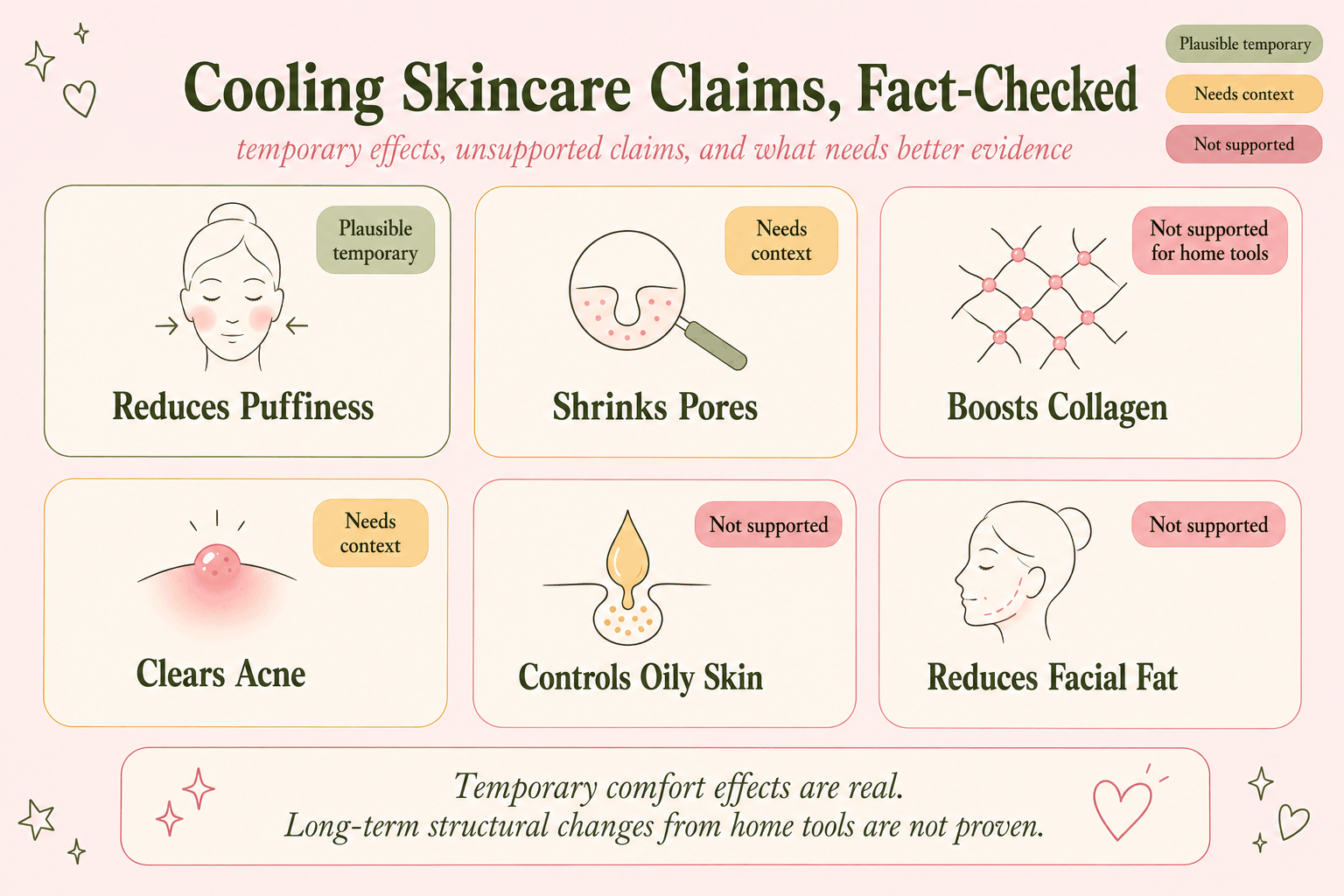
Cold does not permanently shrink pores.[3] A roller does not remodel facial fat.[4] A chilled mask does not force intact native collagen into the dermis.[5]
Menthol activates cold-sensitive TRPM8 receptors, so the intensity of the cold sensation does not necessarily reflect how much the skin's temperature or blood flow has changed. In controlled studies, topical menthol increased cutaneous blood flow.[6][7]
Useful for the moment, not a skin transformation
Most positive findings come from short-term cooling during medical procedures or after facial surgery. Direct trials of consumer cryo sticks and beauty-fridge routines are scarce. One small 2025 trial studied regular non-chilled facial-roller massage, not the added effect of cooling.[8]
Bottom line: use cooling for comfort, not correction.
Table of Contents
- What counts as cooling skincare?
- What cold actually does to skin
- Why menthol is different from physical cold
- Cryo sticks, mists, masks and eye patches
- Which benefits have evidence?
- Ice roller and cryo stick claims
- What the human studies found
- Should skincare go in the refrigerator?
- Who should be cautious?
- How to cool skin safely
- Final verdict
- FAQ
- Sources
What Counts as Cooling Skincare?
Products grouped under the cooling label do not all work in the same way. A frozen metal tool, a peppermint mist and a wet sheet mask can feel similar on the face, but the biology is different.
Heat leaves the skin
Cold rollers, chilled globes, gel masks and cool compresses absorb heat through direct contact. This can lower surface temperature and briefly narrow superficial blood vessels.
Nerves receive a cold signal
Menthol and other cooling agents activate cold-sensitive receptors such as TRPM8. The strength of the cold sensation does not reliably show how much skin temperature or blood flow has changed.
Liquid evaporates
Water or alcohol in a mist absorbs heat as it evaporates. The effect is usually short. In a small forearm study, concentrated alcohol exposure reduced measured skin hydration, but the study did not test cosmetic face mists and did not find significant barrier disruption or erythema from alcohol alone.[9] The effect of a finished mist depends on the alcohol type, concentration and complete formula.
The mask formula does the work
Sheet and hydrogel masks reduce evaporation while delivering water and humectants. Their hydrating effect should not be credited to cold alone.
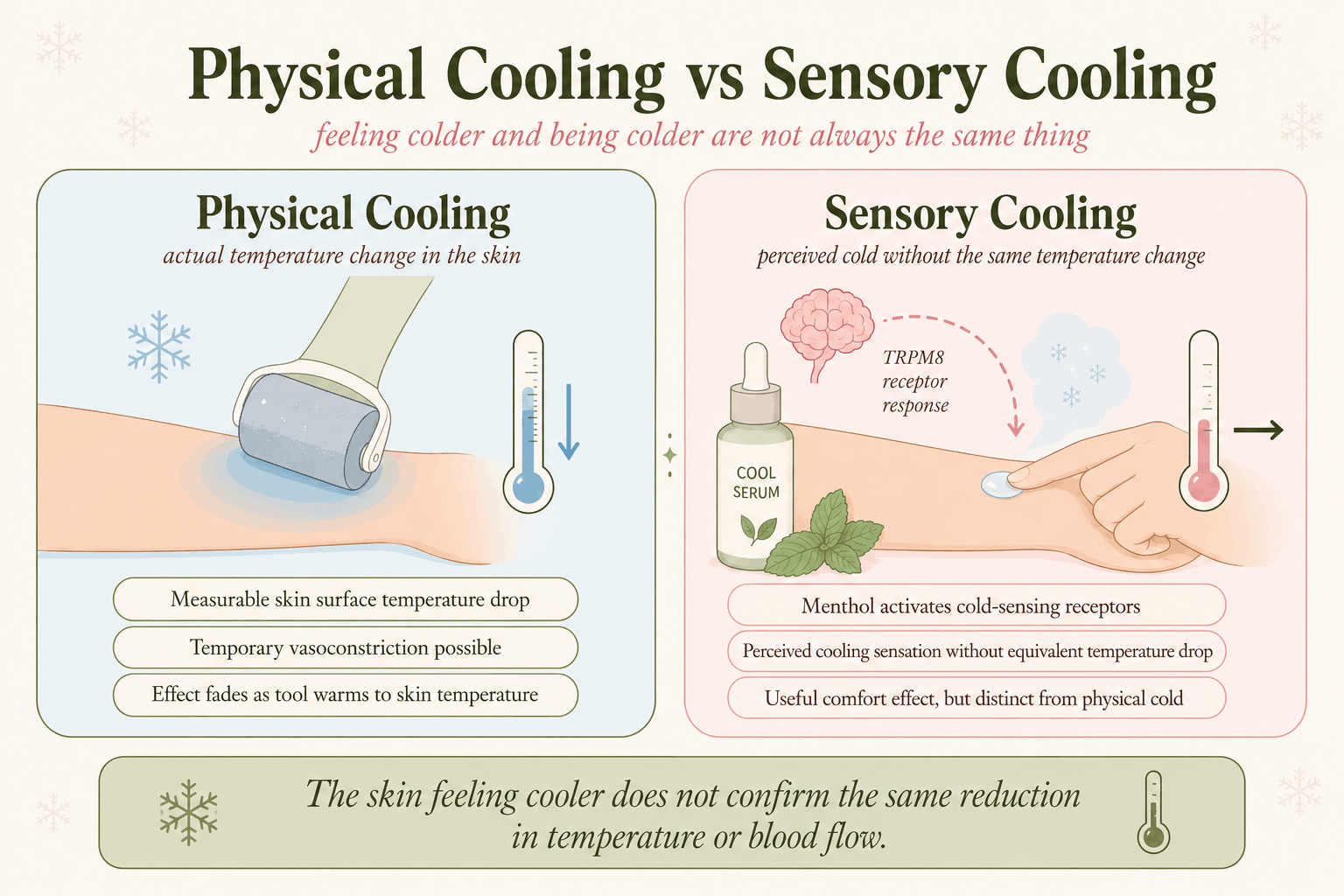
A product can feel cold without producing the same vascular effects as a chilled tool.
What Cold Actually Does to Skin
Skin blood flow responds quickly to temperature. With local physical cooling, superficial vessels generally constrict. This response involves sympathetic nerves, alpha-2C adrenoceptors and reduced nitric oxide signaling.[10] Less blood reaches the cooled area for a short period, which can make redness or swelling look reduced.
Cooling also slows sensory nerve activity. That is why a cold compress can dull pain, burning or tenderness. The effect is temporary. Once the skin warms again, circulation and sensation return.
This does not mean colder is better. Extreme or prolonged cold can injure skin and nerves. There is also a brief vasodilator response during rapid cooling in some circumstances, and blood flow may rebound while the area rewarmes.[10] The face is living tissue, not dough that becomes permanently tighter in a refrigerator.
Morning puffiness often reflects temporary fluid accumulation, although allergies, inflammation, anatomy, sleep position and medical conditions can also contribute. Cooling may temporarily reduce the appearance of mild puffiness, but direct consumer trials are limited and postoperative studies are mixed. It does not remove under-eye fat pads, correct skin laxity, erase pigmentation or treat the cause of persistent facial swelling.
Menthol Feels Cold, but It Does Not Behave Like an Ice Roller
Menthol activates TRPM8 receptors on sensory nerves, creating a cooling sensation. In a small human study, topical menthol produced a subjective cooling effect that lasted up to 70 minutes in some participants. It did not improve experimentally induced histamine itch and it increased transepidermal water loss at the tested site.[11] That finding indicates greater water loss or barrier perturbation, but transepidermal water loss alone does not prove visible clinical irritation.
The vascular result is even more surprising. Controlled studies found that topical menthol increased cutaneous microvascular blood flow in a dose-dependent manner.[6] Later work also found TRPM8-dependent changes beyond the directly treated skin area.[12]
So a minty gel can feel colder while producing vasodilation rather than the simple vasoconstriction people expect from ice. “Cooling” on a label describes a sensation. It does not automatically mean reduced inflammation or reduced blood flow.
Menthol, peppermint, eucalyptus and fragrant essential oils are not automatically soothing. They may burn or sting, and peppermint oil can cause allergic contact dermatitis in some users.[13] Barrier-damaged skin may react more strongly. If products regularly sting, read our guide to why moisturizer burns and check for signs of a damaged skin barrier.
Cryo Sticks, Ice Rollers, Mists, Masks and Eye Patches
Cryo sticks, rollers and globes
These tools are simple heat exchangers. Metal and glass conduct heat well, so a chilled tool can cool the skin faster than your hands. A roller may temporarily reduce the appearance of mild puffiness and provide massage, although direct consumer cooling trials are limited. Evidence that chilling a roller adds lifting, collagen stimulation or lasting structural benefits remains lacking. One small 2025 randomized study reported facial-contour and elasticity changes after eight weeks of regular non-chilled roller massage, but it had no untreated or sham group, did not isolate a cooling effect and did not measure collagen production.[8]
The massage itself may influence superficial fluid and tissue measurements, which makes it hard to separate pressure from temperature. Some effects from repeated massage could extend beyond one session, but the evidence is preliminary and does not establish a cryo-lifting effect.
Cooling face mists
A plain water mist feels refreshing because water evaporates. Humectants such as glycerin can add hydration. Concentrated alcohol exposure reduced measured hydration in one small forearm study, but that study did not test finished cosmetic face mists; the effect of a mist depends on the alcohol type, concentration and complete formula.[9] Fragrance may also irritate susceptible skin. A plain water mist does not lock in moisture by itself. Apply moisturizer over it if your goal is to reduce water loss.
Hypochlorous acid sprays are sometimes sold in the same refreshing format, but their purpose and evidence are different from cooling. Our hypochlorous acid face spray guide separates antimicrobial chemistry from the simple sensation of a cool mist.
Sheet masks and hydrogel masks
Masks can hydrate the outer skin because they hold a water-rich formula against the face and slow evaporation. A 2024 randomized study found that mask use under 25 minutes improved hydration and reduced redness, while longer wear was linked with more dryness and redness.[14] That study compared mask materials and wear times, not chilled versus room-temperature masks.
The study supports the importance of mask material, formula and wear time, but it did not determine whether refrigeration changes the result. Cooling may make a mask feel more pleasant. A collagen mask can also leave skin looking temporarily plumper through hydration and film formation without delivering intact native collagen into the dermis.[5] See our Biodance collagen mask claims review for a closer look at that distinction.
Cooling eye patches
Chilled eye patches may temporarily reduce the appearance of mild morning puffiness, although direct consumer trials are limited. Their humectants can temporarily smooth fine dehydration lines. They cannot remove hereditary dark circles, tear-trough hollows, protruding fat pads or true skin laxity.
Which Benefits Have Real Evidence?
1. Temporary comfort and pain relief
This is the strongest use. In a small side-by-side study during carbon dioxide laser resurfacing, cold air significantly lowered treatment pain. Average pain scores fell from 6.75 without cooling to 3.62 with cooling.[15] The study included only eight patients, so it supports immediate comfort more than broad claims about faster healing.
2. Short-term swelling after surgery
Results are mixed but often favorable. A randomized study of 50 rhinoplasty patients found less periorbital edema, bruising and pain on the cooled side during the first week.[16] A 2024 trial found that a cooling gel eye mask performed better than ice in gloves for some pain, edema and comfort measures after rhinoplasty.[17]
But cooling is not consistently impressive. In a randomized blepharoplasty study, cooled eyelids had slightly less pain one day later, while edema, redness and bruising did not differ from uncooled eyelids.[18] Another rhinoplasty trial found similar results whether cold packs were used for four hours or 48 hours, suggesting that extending the routine may add inconvenience without a better outcome.[19] This is why “cold reduces swelling” is reasonable as a short-term possibility, not a guaranteed cosmetic result.
3. Itch relief from specific cooling compounds
A four-week randomized pilot study in 70 people with dry, itchy skin found that a lotion containing two TRPM8 agonists reduced itch more than the vehicle lotion. Hydration and dryness improved in both groups, without a significant difference between them.[20] That finding supports a specific formulated treatment for chronic itch. It does not prove that any minty skincare product will calm sensitive skin.
4. Brief reduction in visible redness
Physical cooling can temporarily reduce blood flow and make redness look less intense. Evidence for longer-lasting control is thin. In the small laser study, redness resolved sooner on average with cooling, but the difference was not statistically significant.[15]
Redness caused by irritation, rosacea, allergy, sunburn or infection needs the cause addressed. Cooling may briefly change what you see without changing the process underneath.
5. A fresher look when skin is puffy or hot
A cool tool can make the face feel less hot and may temporarily soften the appearance of mild swelling around the eyes or cheeks. Direct consumer trials are limited, so this should be treated as a possible short-term cosmetic effect, not a structural treatment.
Related reading: Cooling does not replace barrier care. For tight, shiny or stingy skin, read oily but dehydrated skin and damaged barrier or acne?. For device marketing beyond cryo tools, see whether LED face masks work.
Ice Roller and Cryo Stick Claims: What the Evidence Says
Does an Ice Roller Shrink Pores?
Pores do not have muscles that open and close. Their visible size is influenced by sebum output, follicle volume, skin elasticity, age and acne-related changes.[3] Cold may reduce swelling or surface shine enough to make texture look tighter in the mirror. That is not the same as changing pore anatomy.
Do Cryo Sticks Boost Collagen?
Evidence that chilling a consumer roller stimulates meaningful collagen production remains lacking. One small 2025 study found changes in elasticity and facial measurements after repeated non-chilled roller massage, but it had no untreated control, did not isolate temperature and did not measure collagen production.[8] Procedures that remodel collagen use defined biological stimuli. A beauty-fridge roller has not been shown to reproduce them.
Can Ice Rolling Help Acne?
Ordinary ice rollers, chilled masks and cosmetic cooling products have not been shown to prevent or treat acne. A 2024 pilot study tested a specialized carbon-dioxide precision-cooling device in 20 volunteers, using a targeted protocol of 0°C for three seconds per lesion three times weekly, and reported substantial improvement over four weeks.[1] The study was small, uncontrolled and funded by the device manufacturer, a disclosure corrected in 2025.[2] It is early device research, not evidence that an ice roller or refrigerated mask clears acne. For breakouts that keep appearing in one area, see why acne keeps returning in the same spot.
Does Ice Rolling Reduce Oily Skin?
A cool face can feel less greasy, and reduced sweating may change surface shine. There is no good evidence that a home ice roller produces a lasting reduction in sebaceous gland activity.
Can Cryo Sticks Reduce Facial Fat?
At-home rollers and globes do not reproduce medical cryolipolysis. Medical cryolipolysis uses controlled, localized cooling of subcutaneous tissue with defined contact and exposure.[4] Briefly rolling a cold object over the face is not an equivalent treatment and should not be marketed as facial fat reduction.
Do Ice Rollers Improve Skincare Absorption?
An ordinary chilled roller or mask has not been shown to drive skincare ingredients deeper. A specialized cryogenic-particle device increased penetration depth and fluorescence intensity in ex vivo human-skin models, but it used micro-ice particles propelled by a carbon-dioxide jet.[21] That is different from consumer cooling tools, and it has not established better clinical results in living skin.
| Claim | Evidence-based reading |
|---|---|
| Instant de-puffing | May temporarily soften mild puffiness, but direct consumer trials are limited. |
| Reduced discomfort | Supported for some procedures and short-term uses. |
| Calmer-looking redness | Possible briefly with physical cooling. Menthol can increase blood flow. |
| Hydration from a cold mask | The formula and occlusion can hydrate. Refrigeration has not been directly compared well enough to rank its contribution. |
| Smaller pores | No permanent change in pore anatomy. |
| More collagen and lifted skin | No evidence that chilling adds collagen or lifting benefits. Preliminary non-chilled massage research does not prove a cryo effect. |
| Acne treatment | Ordinary cooling products are unproven. A specialized precision device has only preliminary pilot evidence. |
| Facial fat loss | Not comparable with controlled medical cryolipolysis. |
| Deeper product absorption | Not shown for ordinary chilled tools. Ex vivo evidence involves a specialized cryogenic-delivery device. |
What the Human Studies Actually Tested
A major limitation is obvious once the studies are placed side by side. Most research involves forearm physiology, chronic itch, laser treatment or postoperative care. Newer studies have examined non-chilled roller massage, a specialized acne device and cryogenic particle delivery, but none directly validates the ordinary beauty-fridge routine shown online.
| Study | Design | What was cooled | Main finding | Why it is limited |
|---|---|---|---|---|
| Craighead & Alexander, 2016 | Controlled physiology studies | Menthol gels on healthy forearm skin | Menthol increased cutaneous blood flow in a dose-dependent way. | Small samples, healthy skin, blood-flow outcome rather than cosmetic results. |
| Raulin & Grema, 2004 | Prospective split-face study, 8 patients | Cold air during carbon dioxide laser resurfacing | Pain was significantly lower. Healing and redness differences were not statistically significant. | Very small study and procedure-specific. |
| Kayiran & Calli, 2016 | Randomized split-face study, 50 patients | Periorbital cooling after rhinoplasty | Less swelling, bruising and pain on the cooled side. | Surgical swelling is not the same as everyday facial puffiness. |
| Pool et al., 2015 | Randomized split-eyelid study, 38 patients | Ice pack after blepharoplasty | Small pain difference after one day, with no difference in swelling, redness or bruising. | Postoperative setting and low pain scores. |
| Ständer et al., 2017 | Double-blind randomized trial, 70 patients | TRPM8 agonist lotion for dry itchy skin | Itch improved more than with vehicle after four weeks. | Specific formulated treatment, not proof for generic menthol skincare. |
| Wang et al., 2024 | Randomized facial mask study | Different masks and wear times | Under 25 minutes improved hydration; prolonged wear increased dryness and redness. | Did not compare chilled versus room-temperature masks. |
| Hong et al., 2024 | Uncontrolled pilot, 20 volunteers | Targeted carbon-dioxide precision cooling of acne lesions | Lesion counts and investigator scores improved over four weeks. | Small, no control group, manufacturer-funded and not equivalent to home cooling. |
| Ahn et al., 2025 | Randomized comparison, 34 women | Non-chilled facial roller versus gua sha for eight weeks | The roller group showed changes in facial measurements and elasticity parameters. | No untreated or sham group, no cooling comparison and no collagen measurement. |
| Yi et al., 2026 | Ex vivo human-skin study | Cryogenic micro-ice particle delivery | Penetration depth and fluorescence intensity increased. | Laboratory tissue study using a specialized jet device, not a chilled roller or mask. |
The mechanisms of skin cooling are well described, and evidence for short-term comfort is credible. Evidence that chilling ordinary consumer tools adds lifting, collagen stimulation, acne control or long-term rejuvenation remains poor. Preliminary studies of non-chilled massage and specialized medical or delivery devices should not be generalized to ice rollers, cryo globes or refrigerated masks.
Should You Put Skincare in the Refrigerator?
You can chill certain products for comfort, but a beauty fridge is not a treatment device. Store products within the manufacturer's specified range. Temperature can affect the microstructure and physical stability of emulsion-based topical products, so colder is not automatically better.[22] Refrigeration has not been shown to make ordinary skincare more effective.
Simple gel masks, reusable eye masks and tools that the manufacturer says may be refrigerated. Keep them clean and do not freeze them solid.
Water-based mists or eye gels may feel nicer chilled. The benefit is sensory unless the product has separate evidence.
Emulsions, suspensions and active formulas may change viscosity, texture or physical stability outside their tested storage range. Follow the manufacturer's directions.
Freezing may alter texture or packaging. Intense or prolonged contact with a very cold pack can also injure skin.[23]
Refrigeration also does not make an old or contaminated product safe. Close lids, avoid dipping unwashed fingers into jars and discard products that change smell, color or texture.
Who Should Be Cautious With Cooling Skincare?
Brief, gentle cooling is lower risk than intense or prolonged exposure, but it is not risk-free. Risk rises with extreme temperature, long contact, pressure on recently treated skin, reduced sensation or a medical condition triggered by cold.
- Cold urticaria: cold exposure can cause hives, swelling and, in some people, systemic reactions. A meta-analysis found a meaningful anaphylaxis risk among people with diagnosed cold urticaria.[24]
- Raynaud phenomenon or poor circulation: cold is a common trigger for Raynaud vasospasm.[25] Avoid DIY freezing treatments and ask a clinician about safe use.
- Reduced sensation or neuropathy: you may not notice an early cold injury.
- Very reactive, eczematous or barrier-damaged skin: menthol and fragrance may sting. Concentrated alcohol exposure reduced measured hydration in a small forearm study, but tolerance depends on the alcohol type, concentration and complete formula.[9]
- Rosacea: gentle cooling may feel helpful, but temperature changes can provoke symptoms in some people. Rosacea guidance recommends identifying and avoiding personal triggers.[26] Judge the response, not the trend.
- Fresh procedures, injections or surgery: use only the method approved by the treating clinician. Pressure, contamination and excessive cooling can interfere with aftercare.
The area becomes painful, hard, pale, intensely red, numb, blistered or swollen beyond the expected brief response. Hives, lip or throat swelling, breathing difficulty, faintness or widespread symptoms after cold exposure need urgent medical care.
How to Cool Your Skin Without Overdoing It
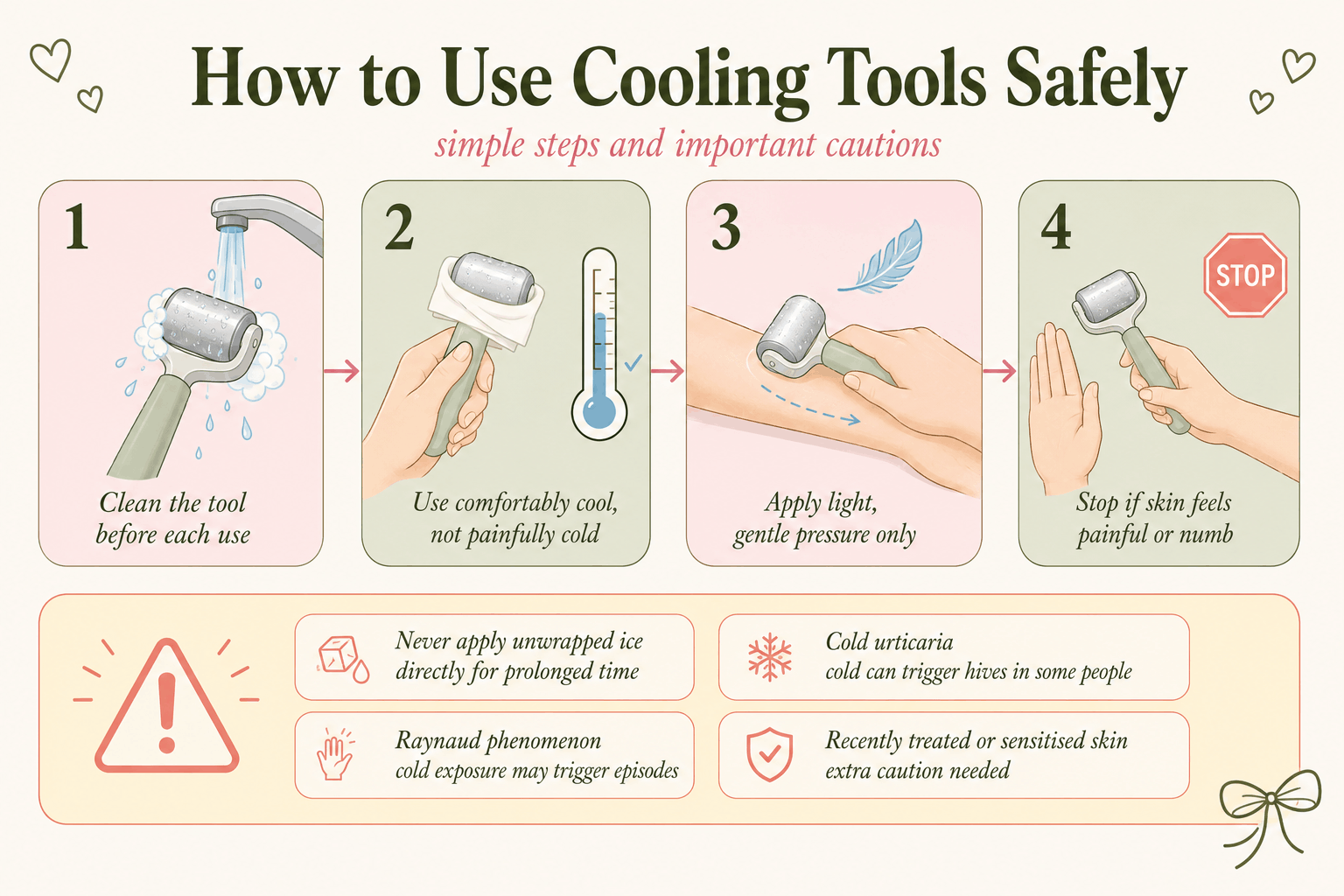
- Follow the product instructions. Use only comfortably cool temperatures and stop before the area becomes painful or numb. There is no standardized temperature for cosmetic facial cooling.
- Avoid intense direct cold. Use a clean cloth barrier when appropriate and follow the tool instructions. Misused cold packs have caused partial-thickness cold burns.[23]
- Use light pressure. Do not press hard over inflamed acne, fragile capillaries, recent filler, incisions or freshly treated skin.
- Keep the tool moving. Do not hold intense cold over one point until it becomes numb.
- Do not invent a dose. There is no standardized duration for cosmetic facial cooling. Follow the product or clinician instructions and stop before pain, persistent pallor or numbness develops.
- Clean reusable tools. Wash according to the material instructions, dry fully and store away from contamination.
- Follow with normal skincare. Cooling does not replace moisturizer, sunscreen or treatment for the condition causing redness or irritation.
Cleanse only if needed, use the cool roller or eye mask according to its instructions, then apply your regular hydrating product, moisturizer and sunscreen. Skip the tool when your skin feels raw, numb or unusually reactive.
Final Verdict: Is Cooling Skincare Worth It?
Yes, when the goal is realistic. A chilled eye mask can make a hot face feel better and may temporarily soften mild morning puffiness, although direct consumer research is limited. Cold air and compresses can reduce discomfort around some procedures. The thermal and sensory effects are temporary. Possible changes from repeated massage remain preliminary and have not been shown to depend on chilling.
The trouble starts when temporary or uncertain effects are presented as permanent pore correction, collagen production from chilling, facial-fat sculpting or proven acne treatment. One small non-chilled roller trial and one specialized acne-device pilot do not validate ordinary consumer cryo tools. Menthol adds another complication because the cold feeling does not necessarily mean the skin is physically cooler or less perfused.
Frequently Asked Questions
Can I use an ice roller every day?
There is no established evidence-based daily regimen. Follow the tool instructions, keep the temperature comfortable, stop before pain or numbness and clean it after use.
Does ice close or shrink pores?
No. Cold may make skin look temporarily tighter, but pores do not open and close like doors. Visible pore size is influenced more by sebum, follicle size and skin elasticity.
Can cooling skincare help acne?
Ordinary ice rollers, chilled masks and cosmetic cooling products have not been shown to prevent or treat acne. A specialized precision-cryotherapy device has preliminary pilot evidence, but it is not equivalent to at-home cooling and needs independent controlled trials.
Is cooling skincare good for rosacea?
Some people find gentle cooling soothing, while others flush with temperature changes. Avoid direct ice and stop if cooling causes burning, prolonged redness or rebound flushing.
Should skincare be stored in the refrigerator?
Only when the label recommends it or when you prefer the sensation and the formula remains stable. Refrigeration has not been shown to make ordinary skincare work better.
How long should I cool my face?
There is no standardized temperature or duration for cosmetic facial cooling. Follow the tool or product instructions, use only comfortably cool temperatures and stop before the area becomes painful or numb.
Do cooling eye patches reduce bags?
They may temporarily reduce the appearance of mild morning puffiness, although direct consumer trials are limited. They will not remove structural under-eye bags, fat pads, pigmentation or hollowness.
Can I cool my skin after a cosmetic procedure?
Sometimes, but follow the clinician's aftercare instructions. Cooling can reduce discomfort after certain procedures, while excessive pressure, contaminated tools or extreme cold may be inappropriate for freshly treated skin.
Sources
View the scientific references
References were checked against peer-reviewed publications and official records available through July 18, 2026.
- Hong JY, Kim KR, Kim HJ, Seok J, Park KY. Targeted precision cryotherapy for acne vulgaris. Skin Research and Technology. 2024;30(9):e70045. doi:10.1111/srt.70045. PubMed.
- Correction to targeted precision cryotherapy for acne vulgaris. Skin Research and Technology. 2025;31(12):e70313. doi:10.1111/srt.70313. PubMed.
- Lee SJ, Seok J, Jeong SY, Park KY, Li K, Seo SJ. Facial Pores: Definition, Causes, and Treatment Options. Dermatologic Surgery. 2016;42(3):277-285. doi:10.1097/DSS.0000000000000657. PubMed.
- Atiyeh BS, Fadul R Jr, Chahine F. Cryolipolysis (CLL) for Reduction of Localized Subcutaneous Fat: Review of the Literature and an Evidence-Based Analysis. Aesthetic Plastic Surgery. 2020;44(6):2163-2172. doi:10.1007/s00266-020-01869-x. PubMed.
- Jadach B, Mielcarek Z, Osmałek T. Use of Collagen in Cosmetic Products. Current Issues in Molecular Biology. 2024;46(3):2043-2070. doi:10.3390/cimb46030132. PubMed.
- Craighead DH, Alexander LM. Topical menthol increases cutaneous blood flow. Microvascular Research. 2016;107:39-45. doi:10.1016/j.mvr.2016.04.010. PubMed.
- Craighead DH, McCartney NB, Tumlinson JH, Alexander LM. Mechanisms and time course of menthol-induced cutaneous vasodilation. Microvascular Research. 2017;110:43-47. doi:10.1016/j.mvr.2016.11.008. PubMed.
- Ahn SH, Hwang UJ, Han HS, et al. Comparative Effects of Facial Roller and Gua Sha Massage on Facial Contour, Muscle Tone, and Skin Elasticity: Randomized Controlled Trial. Journal of Cosmetic Dermatology. 2025;24(6):e70236. doi:10.1111/jocd.70236. PubMed.
- Löffler H, Kampf G, Schmermund D, Maibach HI. How irritant is alcohol? British Journal of Dermatology. 2007;157(1):74-81. doi:10.1111/j.1365-2133.2007.07944.x. PubMed.
- Johnson JM, Kellogg DL Jr. Local thermal control of the human cutaneous circulation. Journal of Applied Physiology. 2010;109(4):1229-1238. doi:10.1152/japplphysiol.00407.2010. PubMed.
- Yosipovitch G, Szolar C, Hui XY, Maibach H. Effect of topically applied menthol on thermal, pain and itch sensations and biophysical properties of the skin. Archives of Dermatological Research. 1996;288(5-6):245-248. doi:10.1007/BF02530092. PubMed.
- Dillon GA, Lichter ZS, Alexander LM. Menthol-induced activation of TRPM8 receptors increases cutaneous blood flow across the dermatome. Microvascular Research. 2022;139:104271. doi:10.1016/j.mvr.2021.104271. PubMed.
- de Groot AC, Schmidt E. Essential Oils, Part V: Peppermint Oil, Lavender Oil, and Lemongrass Oil. Dermatitis. 2016;27(6):325-332. doi:10.1097/DER.0000000000000218. PubMed.
- Wang Y, Cao Y, Huang X, et al. Short-term skin reactions and changes in stratum corneum following different ways of facial sheet mask usage. Journal of Tissue Viability. 2024;33(4):831-839. doi:10.1016/j.jtv.2024.06.012. PubMed.
- Raulin C, Grema H. Single-Pass Carbon Dioxide Laser Skin Resurfacing Combined With Cold-Air Cooling: Efficacy and Patient Satisfaction of a Prospective Side-by-Side Study. Archives of Dermatology. 2004;140(11):1333-1336. doi:10.1001/archderm.140.11.1333. JAMA Dermatology.
- Kayiran O, Calli C. The effect of periorbital cooling on pain, edema and ecchymosis after rhinoplasty: a randomized, controlled, observer-blinded study. Rhinology. 2016;54(1):32-37. doi:10.4193/Rhino15.177. PubMed.
- Ilce A, Soysal GE, Koybasi Sanal S. Effects of Two Different Cold Application Methods After Rhinoplasty: A Randomized Clinical Trial. Plastic and Aesthetic Nursing. 2024;44(1):53-58. doi:10.1097/PSN.0000000000000536. PubMed.
- Pool SMW, van Exsel DCE, Melenhorst WBWH, Cromheecke M, van der Lei B. The effect of eyelid cooling on pain, edema, erythema, and hematoma after upper blepharoplasty: a randomized, controlled, observer-blinded evaluation study. Plastic and Reconstructive Surgery. 2015;135(2):277e-281e. doi:10.1097/PRS.0000000000000919. PubMed.
- Tekin YE, Iyigun E, Karakoc O. The Effects of Two Different Cold Application Times on Edema, Ecchymosis, and Pain After Rhinoplasty: A Randomized Clinical Trial. Journal of PeriAnesthesia Nursing. 2024;39(3):455-460. doi:10.1016/j.jopan.2023.10.003. PubMed.
- Ständer S, Augustin M, Roggenkamp D, et al. Novel TRPM8 agonist cooling compound against chronic itch: results from a randomized, double-blind, controlled, pilot study in dry skin. Journal of the European Academy of Dermatology and Venereology. 2017;31(6):1064-1068. doi:10.1111/jdv.14041. PubMed.
- Yi KH, Kim JH, Song JK, et al. Efficacy of Cryogenic Particle Delivery in Enhancing Skin Penetration and Absorption. Aesthetic Plastic Surgery. 2026;50(3):1269-1276. doi:10.1007/s00266-025-05228-6. PubMed.
- Badruddoza AZM, Yeoh T, Shah JC, Walsh T. Assessing and Predicting Physical Stability of Emulsion-Based Topical Semisolid Products: A Review. Journal of Pharmaceutical Sciences. 2023;112(7):1772-1793. doi:10.1016/j.xphs.2023.03.014. PubMed.
- O'Toole G, Rayatt S. Frostbite at the gym: a case report of an ice pack burn. British Journal of Sports Medicine. 1999;33(4):278-279. doi:10.1136/bjsm.33.4.278. PubMed.
- Prosty C, Gabrielli S, Le M, et al. Prevalence, Management, and Anaphylaxis Risk of Cold Urticaria: A Systematic Review and Meta-Analysis. Journal of Allergy and Clinical Immunology: In Practice. 2022;10(2):586-596.e4. doi:10.1016/j.jaip.2021.10.012. PubMed.
- Ture HY, Lee NY, Kim NR, Nam EJ. Raynaud's Phenomenon: A Current Update on Pathogenesis, Diagnostic Workup, and Treatment. Vascular Specialist International. 2024;40:26. doi:10.5758/vsi.240047. PubMed.
- Clanner-Engelshofen BM, Bernhard D, Dargatz S, et al. S2k guideline: Rosacea. Journal der Deutschen Dermatologischen Gesellschaft. 2022;20(8):1147-1165. doi:10.1111/ddg.14849. PubMed.
Medical disclaimer: This article is for general education and does not replace individualized medical advice. Seek professional guidance before using cold on recently treated skin or if you have cold urticaria, Raynaud phenomenon, poor circulation, reduced sensation, unexplained swelling or another condition affected by temperature.
Stay curious, stay evidence-based.