
LED face masks look futuristic, but the basic idea is simple. Small light-emitting diodes shine specific wavelengths of visible red light, blue light, or invisible near-infrared light onto the skin. The goal is not to heat, peel, or injure the face. The goal is to influence cell activity with a low dose of light.
They can, but the results are usually modest. Red and near-infrared light may slightly improve fine lines, texture, redness, and skin firmness when the device delivers an appropriate dose and is used consistently. Blue light may help some inflammatory acne, although the overall evidence is less reliable than the marketing suggests. An LED mask is best treated as an optional extra, not a replacement for sunscreen, retinoids, acne medicine, or professional care.
The same red glow can come from devices with very different wavelengths, power, fit, and evidence.
The Evidence-Based SPF Guide | Damaged Skin Barrier: Signs and Repair | The Ordinary Glycolic Acid 7% Review
What is in this article
What Is an LED Face Mask?
LED stands for light-emitting diode. Each diode produces light within a selected wavelength range. Wavelength is measured in nanometres, written as nm. It affects the colour of visible light and how deeply that light can travel into skin.
Most cosmetic masks use red light somewhere around the low to mid 600 nm range. Some add near-infrared light, often around the 800 nm range. Near-infrared is invisible to the eye, so a mask may be delivering it even when you only see red. Acne devices often add blue light near 415 nm.
| Type of light | Common purpose | What to know |
|---|---|---|
| Red light | Fine lines, texture, redness | Used for photobiomodulation. Results depend on dose, distance, and repeated use. |
| Near-infrared light | Deeper cell signalling and recovery claims | Invisible and longer in wavelength. More penetration does not automatically mean better results. |
| Blue light | Inflammatory acne | Can activate naturally occurring bacterial porphyrins. Evidence for home treatment is mixed and it may aggravate pigmentation in some people. |
| Green, purple, yellow, or seven-colour modes | Usually broad cosmetic claims | Often marketed far beyond the quality of available clinical evidence. |
Red and near-infrared masks do not work like tanning beds. They do not use ultraviolet light to damage DNA and create a tan. They are also not the same as a resurfacing laser, intense pulsed light, or photodynamic therapy with a prescription photosensitising drug.
How Does Red-Light Therapy Work?
The scientific name most often used is photobiomodulation. Photo means light. Bio refers to living tissue. Modulation means changing activity rather than destroying tissue.
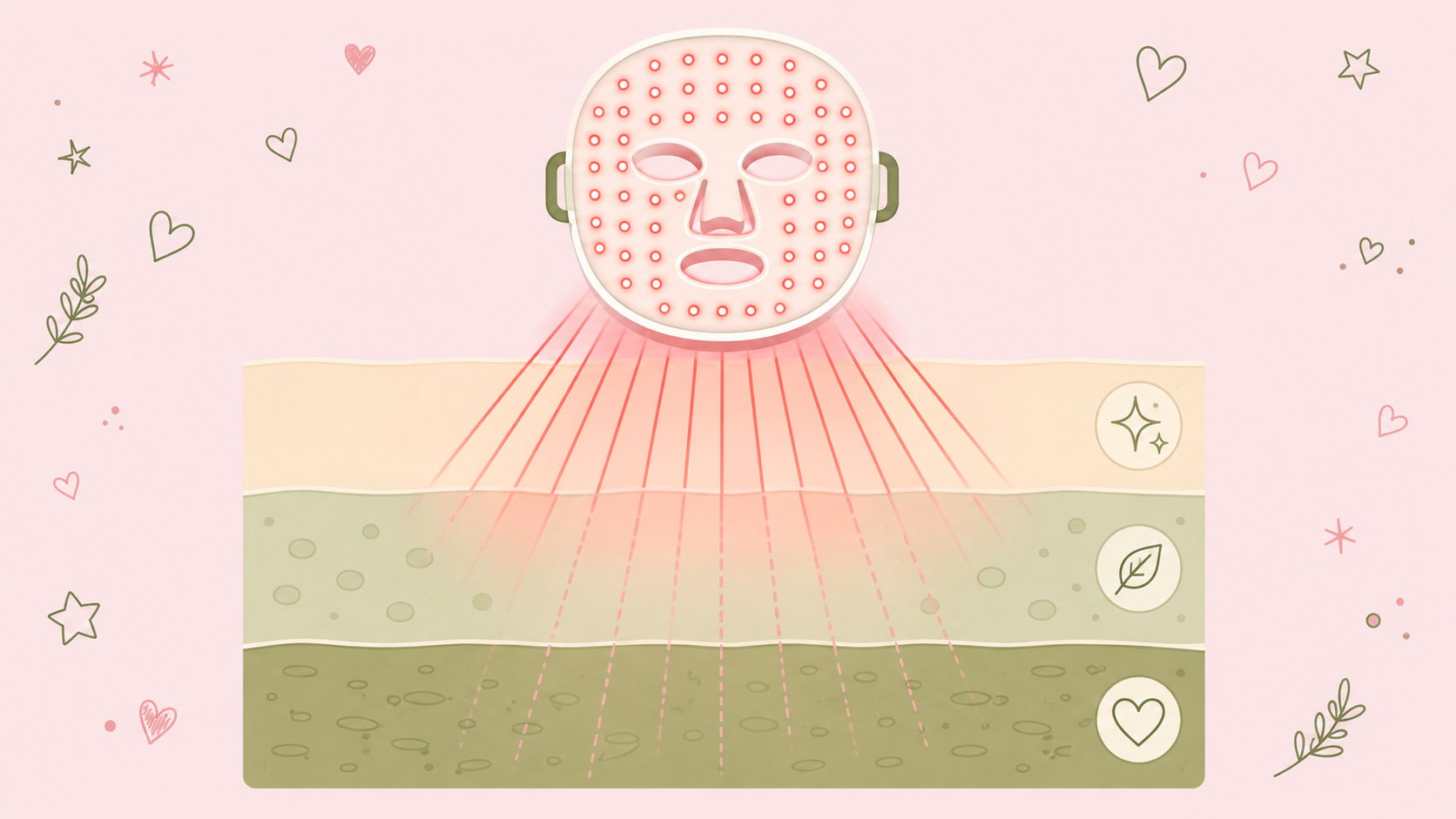
The main theory is that red and near-infrared photons are absorbed by light-sensitive molecules inside cells. Cytochrome c oxidase, an enzyme involved in mitochondrial energy production, is one proposed target. This may briefly alter nitric oxide, reactive oxygen species, and cell signalling. Those signals may influence inflammation, repair, and the activity of fibroblasts, the cells that make collagen and other parts of the skin's support structure.[2], [6]
That explanation is biologically plausible, but it is often oversimplified online. It does not mean that every red bulb boosts collagen. Cells respond to a dose range. Too little light may do nothing. More is not always better. Wavelength, power, treatment time, distance, pulse pattern, skin type, and the design of the mask all change the dose that reaches the skin.
What Does the Research Actually Show?
The honest answer is more encouraging than “it is a scam” and less exciting than most product pages.
A systematic review of randomised trials found that LEDs have shown benefits across several dermatology uses, but the studies differed heavily in wavelength, dose, schedule, treatment target, and how outcomes were measured.[1] That makes it hard to turn the literature into one universal rule for every mask.
Fine lines and skin texture
Small controlled studies report changes in wrinkle appearance, elasticity, roughness, or collagen-related measurements after repeated red or near-infrared treatments. The likely effect is subtle rather than facelift-level.[4]
Redness and recovery
Photobiomodulation may reduce short-term inflammation and can be used alongside some professional procedures. Evidence for treating a diagnosed condition such as rosacea is much less certain.
Acne
Blue light has a reasonable mechanism, but a systematic review found that study quality and reporting were too weak for confident conclusions. Red plus blue may help some inflammatory spots, but it should not replace proven acne treatment.
Large pores, scars, pigmentation, or a “face lift”
These claims are commonly stretched. Deep acne scars, strong laxity, and persistent pigmentation usually need a more targeted plan.
LED masks may improve skin quality. They do not rebuild a face in ten minutes.
The useful middle groundWhy the results are hard to compare
- Many trials are small, short, or test only one side of the face.
- Researchers use different wavelengths, doses, distances, and treatment schedules.
- Some studies measure photographs or user ratings instead of blinded clinical outcomes.
- A positive trial on one device does not prove that a cheaper device with unknown output will work the same way.
- Some cosmetic device research is connected to manufacturers or uses manufacturer-supplied equipment.
What Results Can You Realistically Expect?
Think gradual and modest. The American Academy of Dermatology says studies suggest red-light devices can produce subtle to noticeable changes in fine lines, roughness, discoloration, redness, and loose-looking skin, while also stressing that devices and studies are difficult to compare.[5]
You are more likely to notice smoother-looking texture, a calmer appearance, or a small softening of fine lines than a dramatic change in deep wrinkles. Results take repeated sessions. Some study schedules run several times per week for about one to three months, but your device's tested instructions matter more than a schedule copied from TikTok.
What About Red Light, Blue Light, and Acne?
Blue light can activate porphyrins made by Cutibacterium acnes, a bacterium involved in acne. That reaction can create molecules that damage the bacteria. Red light is sometimes added in an attempt to calm inflammation and support repair.
The mechanism makes sense, but clinical certainty is limited. A 2019 systematic review and meta-analysis found that trials of blue light for acne were affected by small samples, inconsistent methods, and a high risk of bias. The authors could not make a strong conclusion about effectiveness.[3]
For mild inflammatory spots, a properly designed red and blue device may be a useful add-on. It is less useful for blackheads, deep nodules, hormonal acne, or acne that is leaving scars. Benzoyl peroxide, topical retinoids, azelaic acid, and prescription treatment have clearer roles in standard acne care.
Visible light can affect pigment in some skin tones. Blue light is the bigger concern, and heat from a poorly designed device may also aggravate melasma. Stop if you notice new or worsening dark patches and speak with a dermatologist.
How to Use an LED Face Mask Properly.
- Start with the manual. Use the treatment time and frequency tested for that device. Do not double the session because you missed yesterday.
- Use it on clean, dry skin unless the manufacturer says otherwise. This keeps makeup, sunscreen, and unknown products from changing light delivery or irritating your skin under the mask.
- Fit matters. The mask should sit at the distance it was designed for. A rigid mask that leaves large gaps may deliver an uneven dose.
- Protect your eyes exactly as directed. Use the included eye inserts or recommended goggles. Sunglasses are not a substitute for device-specific protection.
- Apply skincare after the session. A simple moisturiser is enough. In the morning, finish with sunscreen.
- Track results in the same lighting. Take a photo before starting and again after 8 to 12 weeks. Daily mirror-checking makes tiny changes impossible to judge.
Can you use it with retinol, acids, or vitamin C?
Red light does not automatically “cancel out” normal skincare. The bigger issue is comfort and photosensitivity. If retinoids, acids, benzoyl peroxide, or a recent procedure have left your skin raw, a warm or tight mask may feel worse. Use LED on clean skin, apply products afterward, and pause strong actives if your barrier is irritated.
Check with a pharmacist or prescriber if you use medication that can increase light sensitivity. Do not guess based on an online list because risk depends on the drug, dose, wavelength, and your medical history.
What to Check Before Buying an LED Mask.
| Feature | Useful information | Marketing that needs context |
|---|---|---|
| Wavelength | Exact values in nm for red, near-infrared, or blue light | “Medical grade”, “deep red”, or “NASA technology” without technical details |
| Irradiance | Power reaching a surface, often written as mW/cm² | Higher power presented as automatically better |
| Fluence or dose | Total energy per area, often written as J/cm² | A single number without explaining where or how it was measured |
| Clinical evidence | A controlled trial on the exact finished device and intended use | A generic red-light paper placed next to an unrelated mask |
| Device documentation | Clear intended use, contraindications, warranty details, and technical specifications for the exact model | “Medical grade”, “clinically proven”, or similar phrases without verifiable details |
| Comfort and fit | Even facial coverage, safe eye design, low heat, manageable session time | More bulbs, more colours, heavier plastic, or a luxury app |
Are LED Face Masks Safe?
Short-term use appears reasonably safe for most healthy adults when a legitimate device is used as directed. Red and near-infrared therapy do not use ultraviolet radiation. A 2023 systematic review did not identify evidence that aesthetic photobiomodulation promotes cancer, although long-term evidence remains limited. Reported side effects are usually mild, such as temporary redness, warmth, dryness, discomfort, headache, or eye strain.[5], [7]
Long-term home use has not been studied as well as short-term treatment. Stop using the mask if you develop persistent redness, swelling, blistering, pain, worsening pigmentation, a rash, or vision symptoms.
Ask a clinician before using one if you:
- Have lupus or another condition that can be triggered by visible light.
- Take a medicine or supplement that may increase photosensitivity.
- Have melasma, a history of heat-triggered pigmentation, or easily darken after irritation.
- Have an eye condition, recent eye surgery, or cannot comfortably follow the eye-protection instructions.
- Have a suspicious mole, an undiagnosed rash, active skin cancer, or a condition that needs medical assessment.
- Are pregnant or breastfeeding and the device has not been assessed for your situation. The light is non-ionising, but direct pregnancy evidence is sparse.
LED Mask Myths That Need to Go.
| Claim | Verdict | What the evidence says |
|---|---|---|
| “Red light gives the same result as a facelift.” | Unsupported | It may improve surface texture or fine lines. It cannot remove significant loose skin or reposition facial tissue. |
| “More colours mean a better mask.” | Misleading | Red, near-infrared, and blue have the clearest rationale for common facial uses. Evidence for rainbow modes is much thinner. |
| “If it glows red, it works.” | Unsupported | Colour alone does not reveal wavelength accuracy, dose, beam spread, or whether enough light reaches the skin. |
| “You should feel heat for it to work.” | Contradicted | Photobiomodulation is intended to be non-thermal. Strong heat may increase irritation and can be a problem for melasma-prone skin. |
| “LED replaces retinol, sunscreen, or acne medicine.” | Unsupported | LED is usually an add-on. Proven basics still do more of the heavy lifting. |
| “Using it for twice as long gives twice the result.” | Unsupported | Light has a dose-response range. Extra exposure can be useless or more irritating. |
So, Is an LED Face Mask Worth It?
It can be worth it for someone who already has a solid routine, wants a gentle add-on, understands that results will be small, and can use the device several times a week without getting bored.
It is probably not the best use of your money if you are skipping daily sunscreen, cannot tolerate a retinoid you have not yet tried properly, have untreated moderate to severe acne, or expect a mask to fix deep scars, sagging, or persistent pigmentation.
Early fine lines, mild redness, a preference for non-irritating treatments, realistic expectations, and enough patience to use it consistently.
Melasma, a light-sensitive condition, photosensitising medication, a very tight budget, severe acne, or a promise of dramatic lifting.
Sunscreen first. A suitable cleanser and moisturiser next. Then proven treatment for your actual concern. LED comes after those basics, not before them.
LED Face Mask FAQ.
How often should I use an LED face mask?
Follow the tested schedule for your exact device. Many home masks are used several times per week, but session length and dose vary too much for one universal rule.
Should I use LED before or after skincare?
Clean, dry skin before the session is the simplest default. Apply moisturiser and other routine products afterward unless your device instructions say differently.
How long before red light therapy works?
Judge it over weeks, not days. Eight to twelve weeks of consistent use is a reasonable period for comparing photos and deciding whether the result matters to you.
Can red light make pigmentation worse?
It is possible, especially if a device creates heat or you have melasma or pigment-reactive skin. Blue visible light is a greater pigmentation concern than red light. Stop if dark patches worsen.
Does red light therapy build collagen?
Some human studies and laboratory work suggest collagen-related effects, but the amount of visible improvement from a home mask varies. The claim is partly supported, not guaranteed for every device.
Are cheap LED masks useless?
Price does not prove effectiveness, but very cheap devices often provide less technical information and less exact-device testing. Judge wavelengths, dose information, safety, fit, and evidence rather than price alone.
With love,
Stylishandhealthy
This article is for educational purposes and does not replace medical advice. Speak with a qualified clinician if you have a light-sensitive condition, use photosensitising medication, develop new pigmentation, or are treating persistent acne, a rash, or another diagnosed skin condition. Product specifications and regulatory status can change, so verify the current manufacturer documentation before buying.
Sources
Click to view all 7 sources
We prioritised systematic reviews, peer-reviewed clinical research, mechanistic reviews, and professional dermatology guidance.
- [1] Jagdeo J, Austin E, Mamalis A, Wong C, Ho D, Siegel DM. Light-emitting diodes in dermatology: A systematic review of randomized controlled trials. Lasers Surg Med. 2018 Jan 22;50(6):613-628. doi: 10.1002/lsm.22791. Epub ahead of print. PMID: 29356026; PMCID: PMC6099480.
- [2] de Freitas LF, Hamblin MR. Proposed Mechanisms of Photobiomodulation or Low-Level Light Therapy. IEEE J Sel Top Quantum Electron. 2016 May-Jun;22(3):7000417. doi: 10.1109/JSTQE.2016.2561201. PMID: 28070154; PMCID: PMC5215870.
- [3] Scott AM, Stehlik P, Clark J, Zhang D, Yang Z, Hoffmann T, Del Mar C, Glasziou P. Blue-light therapy for acne vulgaris: a systematic review and meta-analysis. Ann Fam Med. 2019 Nov;17(6):545-553. doi: 10.1370/afm.2445.
- [4] Barolet D, Roberge CJ, Auger FA, Boucher A, Germain L. Regulation of skin collagen metabolism in vitro using a pulsed 660 nm LED light source: clinical correlation with a single-blinded study. J Invest Dermatol. 2009 Dec;129(12):2751-2759. doi: 10.1038/jid.2009.186. Epub 2009 Jul 9. PMID: 19587693.
- [5] Ludmann P. Is red light therapy right for your skin? American Academy of Dermatology. Updated September 13, 2024. Accessed June 24, 2026. Official guidance.
- [6] Chung H, Dai T, Sharma SK, Huang YY, Carroll JD, Hamblin MR. The nuts and bolts of low-level laser (light) therapy. Ann Biomed Eng. 2012 Feb;40(2):516-533. doi: 10.1007/s10439-011-0454-7. Epub 2011 Nov 2. PMID: 22045511; PMCID: PMC3288797.
- [7] Glass GE. Photobiomodulation: A Systematic Review of the Oncologic Safety of Low-Level Light Therapy for Aesthetic Skin Rejuvenation. Aesthet Surg J. 2023 Apr 10;43(5):NP357-NP371. doi: 10.1093/asj/sjad018. PMID: 36722207; PMCID: PMC10309024.