
Sunscreen pills when material on the skin surface is pushed into little rolls or flakes during spreading, rubbing or layering. The strongest direct evidence comes from a 2024 study of 528 women: 41% experienced pilling somewhere in the test, sunscreen produced far more pilling events than foundation, and circular and linear rubbing techniques were associated with the most events. Skin physiology was also associated with pilling, and the product underneath changed pilling patterns.1 The best fix is not to use less sunscreen. Simplify the layers underneath, let them stop moving on the skin, apply your full sunscreen amount with minimal repeated rubbing, and change the product combination if the same pair always pills.
In cosmetic science, pilling describes a product that balls up into visible flakes, granules or rolls on the skin. It is different from a sunscreen simply leaving a white cast, and it is different from dry skin peeling by itself. The 2024 pilling study is important because the authors explicitly noted that, before their work, the causes of skincare pilling had not been studied in peer-reviewed research.1
Do not “solve” pilling by deliberately underapplying sunscreen. SPF testing uses a standardized application density of 2 mg/cm², and human studies show that reducing the amount reduces real protection—often substantially.9,12 If a formula only behaves when you use a tiny amount, it is the wrong formula for your routine.
In this guide
- Pilling vs dry-skin flaking
- What the first direct pilling study found
- 8 reasons sunscreen pills
- Serum, moisturizer & makeup pilling
- How to stop sunscreen pilling
- The 3-day troubleshooting test
- Common fixes: fact-checked
- Does pilling reduce SPF?
- Ingredients: what can we actually blame?
- Frequently asked questions
Sunscreen pilling vs dry-skin flaking: do not confuse them
Product pilling commonly becomes apparent during rubbing or layering: the material gathers into little grey, white or skin-coloured rolls that can resemble eraser crumbs. Dry-skin scale behaves differently. It may already be visible before sunscreen, can lift without much rubbing, and often comes with roughness, tightness, stinging or a damaged-feeling barrier.
| Clue | Product pilling | Dry-skin flaking / peeling |
|---|---|---|
| When it starts | Usually while spreading, rubbing, or adding the next layer. | Can be present before any product is applied. |
| What it looks like | Rolled balls, strings, crumbs or rubbery flakes. | Flat skin scales, peeling edges, rough patches. |
| What triggers it | Friction and a specific product or product combination. | Dryness, irritation, retinoids/acids, dermatitis, sunburn or barrier damage. |
| Useful test | Try the sunscreen alone on clean, dry skin. If it stops, the interaction underneath matters. | If scale is visible before sunscreen, treat the skin problem rather than chasing “SPF incompatibility.” |
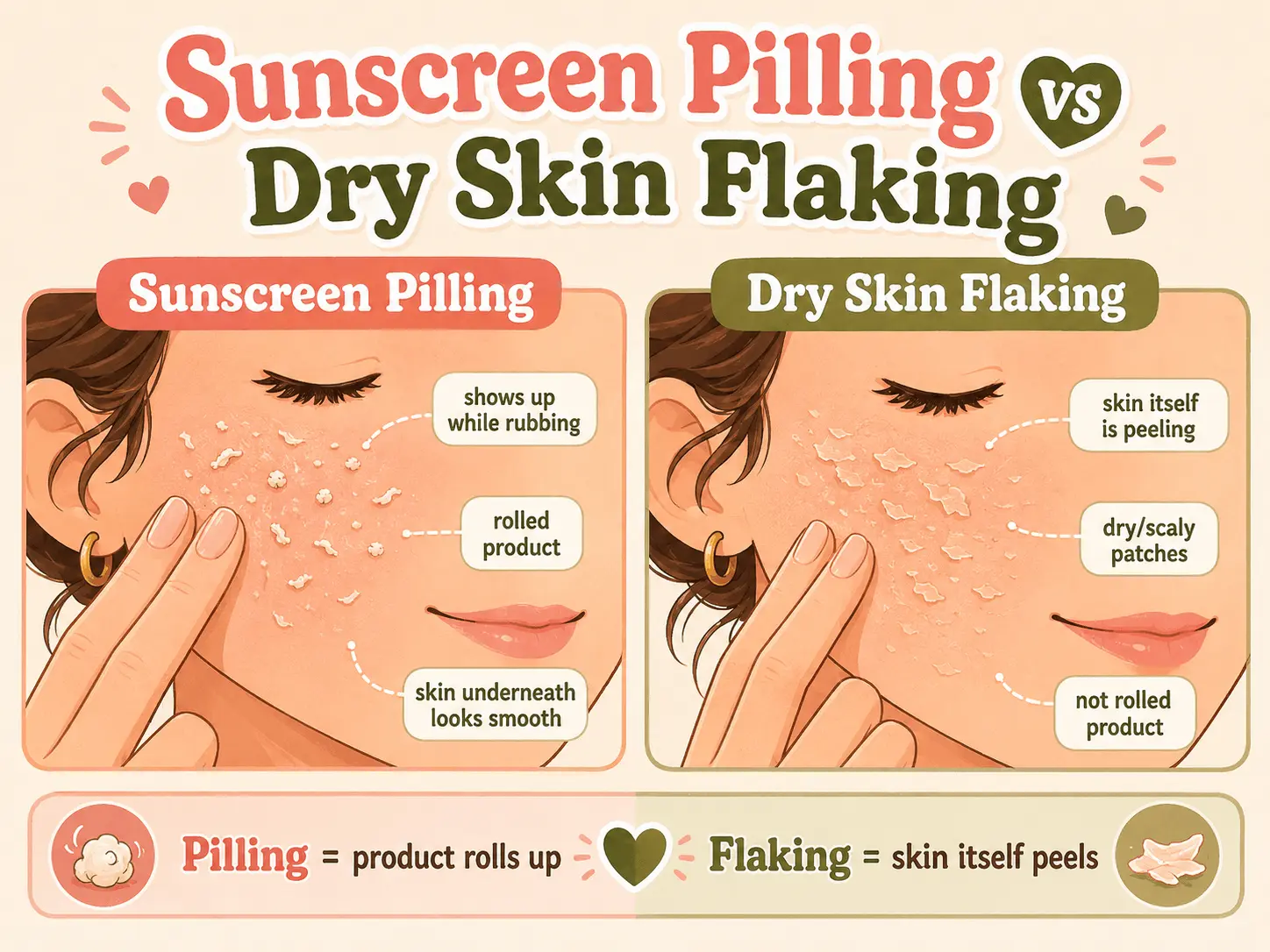
A useful correction: the direct pilling study did not find that visibly scaly skin was the defining pilling profile. In fact, participants who pilled with sunscreen alone had lower hydration and sebum, higher pH and smoother measured skin texture.1 So “you have dead skin—exfoliate more” is too simplistic.
What the first direct sunscreen-pilling study actually found
Lua and colleagues tested 528 women aged 20–49 in Guangzhou, China. Participants applied standardized amounts of simple base formulas, then sunscreen and/or foundation while researchers recorded pilling and measured skin physiology. This is the most directly relevant evidence we have.1
217 of 528 participants pilled
Pilling was common enough to study as a repeatable phenomenon.
Sunscreen was the main trigger
When sunscreen was layered over base products, researchers recorded 655 pilling events versus 35 after foundation over base products.
Linear rubbing produced the most events
Linear rubbing yielded 266 pilling events; combinations involving circular and linear rubbing were also high.
Hydration, sebum, pH and texture mattered
Pilling was associated with measurable differences in skin physiology, especially in people who pilled with sunscreen on clean skin.
The study also showed something important for “ingredient compatibility” claims: the same sunscreen behaved differently depending on which base formula was underneath. Some people pilled only when a base product was present; others pilled with sunscreen alone but stopped pilling when a base was used.1 Compatibility is therefore real, but it is not reducible to one internet rule such as “never mix silicone and water.”
Three findings worth remembering: pilling was common in the 528-person test; rubbing-heavy techniques produced many events; and changing the layer underneath changed whether the same sunscreen pilled.1
Why does sunscreen pill? 8 evidence-informed reasons
Here, “reasons” means evidence-informed contributors, not eight universal causes proven in isolation. The evidence strength differs by item, so each one is labeled below.
1. Too much rubbing and friction
Direct evidence · strongestThis is one of the strongest directly supported contributors. In the pilling study, participants used patting, pressing, circular rubbing and linear rubbing in different combinations. Linear rubbing produced the highest number of pilling events, and circular/linear rubbing combinations were also prominent.1
Mechanically, that makes sense. Sunscreen has to remain as a film over the skin. Repeated shear can move, gather or remove part of that film. Older sunscreen testing also found that application technique itself can change measured SPF; one study reported roughly a 25% deviation and concluded that rubbing could remove product from skin.3
How to recognize it: your sunscreen looks fine at first, then starts forming rolls only after you keep buffing a stubborn area or go back over it repeatedly.
Fix: distribute the product efficiently, spread it into coverage, then stop. If you need a second pass, let the first pass settle instead of scrubbing the same film over and over.
2. The product underneath changes how the sunscreen behaves
Direct evidence · strong“Layer incompatibility” is not just beauty lore. The direct pilling study used ten different base formulas under the same sunscreen and found different pilling patterns. Some participants pilled only with a base underneath, while some who pilled on clean skin actually stopped pilling when a base product was added.1
That means the relevant variable is the whole surface the sunscreen encounters: water, oils, humectants, emulsifiers, polymers, powders and the amount left on top of skin may each influence spreading or film formation depending on the finished formulation.
How to recognize it: the sunscreen behaves well alone but pills over one moisturizer, serum or primer—and not over another.
Fix: identify the specific pair. Do not throw out every silicone, oil or humectant in your routine. Test the sunscreen alone, then add products back one at a time.
3. You are stacking multiple wet, tacky or film-forming layers
Plausible · limited direct testingThe more material that remains mobile on the surface, the more material there is to be pushed around when sunscreen is added. The pilling study supports the broader idea that layering changes risk, but it did not establish a universal number of products or a universal waiting time.1
This is especially relevant with gel serums, tacky humectant layers, primers and moisturizers that leave a noticeable film. Two polymer-containing products can each work perfectly alone yet may, in principle, form a higher-friction or more rollable surface together.
How to recognize it: pilling becomes worse as you add more morning steps, or the sunscreen immediately mixes with a visibly wet/tacky layer.
Fix: simplify the morning routine. Use only what you need under sunscreen, and let the previous layer reach a stable, non-mobile feel before applying SPF. There is no evidence-based “wait exactly 10 minutes” rule.
4. Your skin physiology makes pilling more likely
Direct evidence · strongOne of the most interesting findings is that pilling is not only about products. Participants who pilled when sunscreen was applied to clean skin had lower facial hydration, lower sebum, higher skin pH and smoother skin texture than non-pillers.1
That does not mean “dry skin always pills” or “oily skin never pills.” It means the surface properties of your skin can change how a film spreads, adheres and responds to friction.
How to recognize it: several very different sunscreens pill even on clean skin, especially when your face feels tight or dehydrated.
Fix: if your skin is genuinely dry, do not aggressively exfoliate it. Try a light moisturizer that leaves a stable finish, then retest. Research on sunscreen distribution has found that moisturizer pretreatment can maintain or even improve sunscreen homogeneity rather than automatically ruining it.8,11 If your skin feels oily or sweaty, let it dry or gently blot excess surface moisture before application.
5. The sunscreen's own vehicle forms a film that is easy to disturb on you
Mechanistic evidence · moderateTwo sunscreens with the same nominal SPF can form very different films. Studies measuring film-thickness distribution show that the vehicle itself strongly affects the film that forms and therefore sunscreen performance.4 A 2026 study again emphasized deposit homogeneity as a key determinant of sunscreen efficacy.5
Pilling can therefore be an inherent compatibility problem between a particular sunscreen and your skin—even with no serum or moisturizer underneath. In the 2024 pilling study, 59 participants pilled when sunscreen was applied alone to clean skin.1
How to recognize it: the sunscreen pills on clean, dry skin using gentle application.
Fix: switch formulas rather than fighting it. A sunscreen that forms an even film on your actual skin is more useful than a technically impressive formula you can only wear at half the needed amount.
6. A high-solids, powdery or very matte formula may have less room for error
Hypothesis · not a class ruleMineral UV filters such as zinc oxide and titanium dioxide are dispersed particles. Matte sunscreens may also contain powders or high levels of structuring ingredients. One formulation-science hypothesis is that some high-solid films may be less tolerant of repeated rubbing, but this has not been demonstrated as a general pilling mechanism.
But this needs careful wording: the first pilling study did not isolate zinc oxide, titanium dioxide, silicones, carbomer, xanthan gum or any other single ingredient. Its authors proposed mineral filters as one possible contributor, but they explicitly said more work is needed to identify ingredients with pilling potential.1
How to recognize it: a powdery/matte sunscreen pills while a fluid sunscreen does not, especially after repeated rubbing.
Fix: choose a different texture. Do not assume all mineral sunscreens—or all organic-filter sunscreens—will behave the same.
7. Sweat and moisture can disturb the sunscreen film
Film evidence · moderatePerspiration research shows that sweat can weaken sunscreen substantivity and uniformity through both wash-off and redistribution.6 That study measured film behavior and SPF-related outcomes rather than consumer-visible “pills,” so calling sweat a direct proven pilling cause would be too strong. But a wet, mobile film is easier to disturb mechanically.
How to recognize it: sunscreen looks smooth indoors but starts rolling around the hairline, upper lip or forehead after sweating—or during a humid commute.
Fix: apply to dry skin before you are already sweating, choose a water-resistant formula for heat/exercise, and reapply after sweating as directed. Do not rub a sweaty sunscreen film aggressively back into place.
8. Makeup or reapplication is mechanically reworking a film that already set
Direct pilling + film inferenceOnce a sunscreen film has formed, adding another product introduces new shear, solvents, oils, powders and applicator pressure. In the 2024 study, foundation surprisingly reduced visible sunscreen pilling in most cases, which shows that the interaction can go either direction rather than “makeup always makes it worse.”1
Still, repeated rubbing after the sunscreen has set can redistribute coverage. Sunscreen efficacy is highly sensitive to film uniformity, and application technique matters.2,3
How to recognize it: sunscreen is smooth until foundation, concealer, a brush or a second sunscreen layer is worked over it.
Fix: use pressing/stippling motions where possible, minimize repeated buffing, and test whether your makeup base is the specific trigger.
Why does sunscreen pill after serum, moisturizer or makeup?
The most useful rule is to diagnose the finished product combination, not automatically blame one ingredient. The direct pilling study found that the same sunscreen could behave differently over different base formulas, which means the layer underneath can change whether pilling appears.1
Test the serum as a layer, not its headline ingredient
If sunscreen is smooth on clean skin but pills after a serum, retest with that serum as the only layer underneath. A tacky or mobile finished layer can be part of the interaction, but direct research does not prove that hyaluronic acid, niacinamide, vitamin C or another single serum ingredient is a universal pilling cause.
The specific moisturizer–SPF pair matters
Different base formulas changed pilling patterns in direct research. Moisturizer is not automatically the problem: other sunscreen-distribution studies found moisturizer pretreatment could maintain or improve film homogeneity.1,11
Minimize repeated buffing over the sunscreen film
Foundation reduced visible sunscreen pilling in most affected cases in the direct study, so makeup does not universally make pilling worse. But repeated rubbing can mechanically rework sunscreen, and coverage depends on film uniformity.1,2,3
Change one layer at a time
Start with sunscreen alone, then add one moisturizer or serum, then the rest of the routine. That isolates the product pair far better than following an ingredient blacklist.
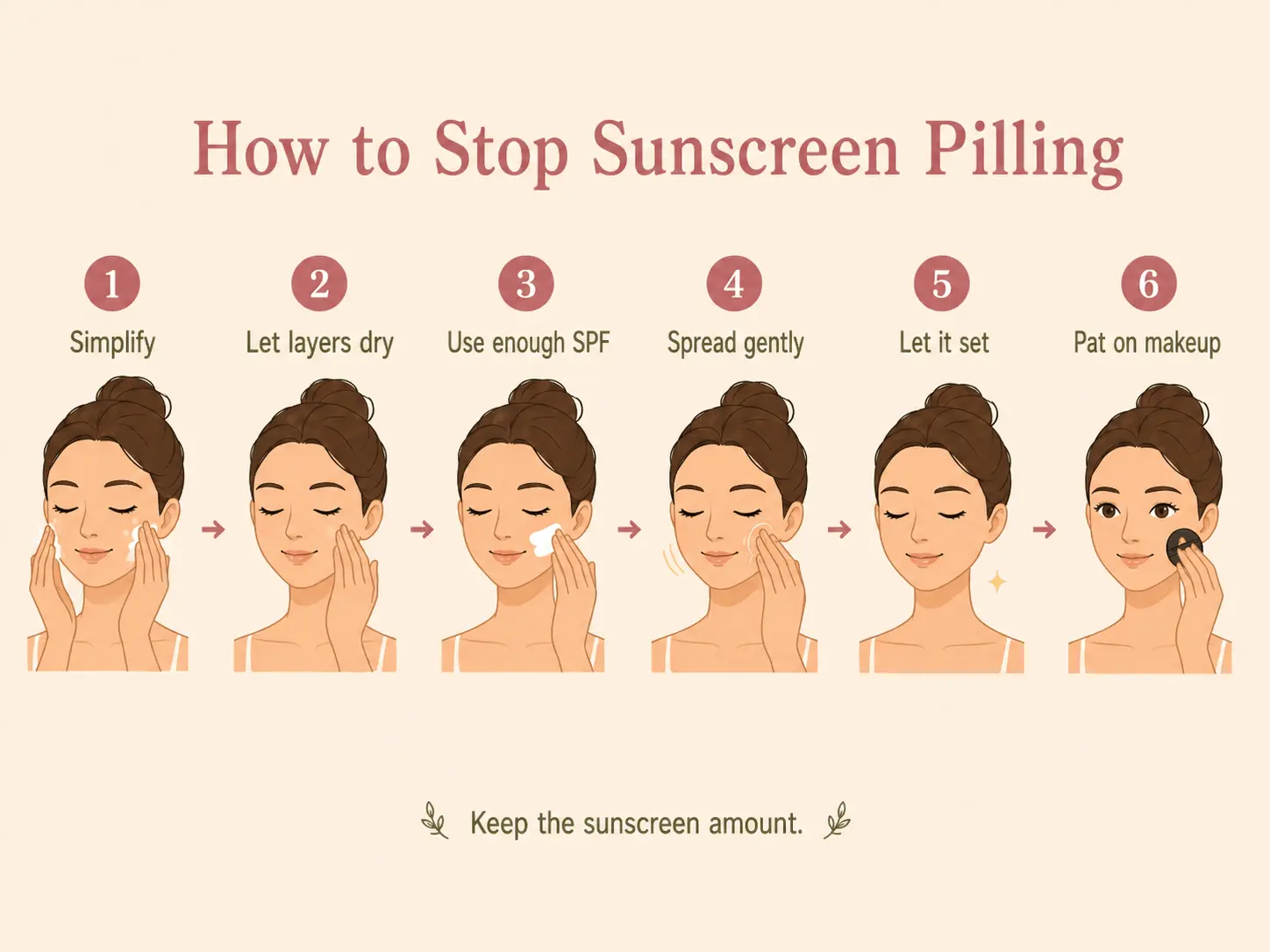
How to stop sunscreen pilling without sacrificing protection
Keep the sunscreen amount. Change everything around it first.
The label SPF is based on a standardized applied amount, and underapplication lowers protection.9 Your goal is not “the thinnest layer that looks pretty.” Your goal is an adequate, even film that you can actually wear.
- Make sunscreen the last skincare step. Dermatology guidance places sunscreen after other skincare and before makeup.13
- Simplify what sits underneath. If you use toner + essence + two serums + moisturizer + primer, remove non-essential morning layers while troubleshooting.
- Let the previous layer stop moving. You do not need a magic stopwatch. Wait until it no longer feels wet enough to smear when sunscreen touches it.
- Use the full amount your sunscreen directions require. Do not intentionally cut the dose to stop pilling.
- Consider two controlled passes. Research supports double application as a way to get closer to adequate sunscreen quantity; pilling-specific benefit is plausible but not directly tested.12
- Spread efficiently, then stop rubbing. The direct pilling study makes repeated linear/circular rubbing the most evidence-backed behavior to change.1
- Let sunscreen settle before makeup. There is no validated anti-pilling wait time. Separately, follow the product directions for sun exposure; FDA directions generally state to apply sunscreen 15 minutes before sun exposure.10
- If the same combo still pills, change one formula. Compatibility is pair-specific. The fastest fix can simply be a sunscreen with a different vehicle or finish.
A 3-day test to narrow down what may be triggering the pilling
If you keep guessing at ingredients, you can change five things and learn nothing. A controlled mini-test is much more useful. Keep the same sunscreen amount and the same gentle application technique each day.
Sunscreen alone
Clean, dry skin + sunscreen only. If it pills here, the sunscreen/skin combination itself is suspect.
One moisturizer
Use your lightest necessary moisturizer, let it settle, then sunscreen. If pilling appears now, that pair is likely incompatible.
Your full routine
Add the remaining serum/primer steps. If pilling appears only now, product buildup or one of the added layers is a likely trigger.
If pilling only starts after makeup, repeat your best non-pilling sunscreen routine and test makeup separately. This method mirrors the core logic of the clinical pilling study: change the layer, observe whether the same sunscreen behaves differently.1
Common sunscreen-pilling fixes: fact-checked
| Popular fix | Verdict | What the evidence supports |
|---|---|---|
| Use less sunscreen | No | Underapplication lowers protection. Change the formula or technique instead.9 |
| Pat/press instead of repeatedly rubbing | Yes, reasonable | Direct pilling research found the highest event counts with linear and circular rubbing.1 |
| Wait exactly 10 minutes between layers | Unproven number | Letting a wet layer settle is physically sensible; no validated universal pilling timer exists. |
| Avoid silicone over water-based products | Overstated | No direct study validates this as a universal rule. Whole-formula compatibility matters. |
| Exfoliate more | Not first-line | Pilling is not simply “dead skin.” If you have true dry scaling, moisturize and treat irritation; do not over-exfoliate. |
| Skip moisturizer | Sometimes, not always | Some base products increase pilling; others reduce it. Moisturizer has also been shown not to meaningfully impair sunscreen UV reflectance in a small human study.8 |
| Apply sunscreen in two passes | Useful option | Double application can help users reach an adequate amount; whether it specifically lowers pilling has not been tested.12 |
| Apply in sections | Reasonable | It may reduce the temptation to overwork one area. Keep the total dose adequate and coverage complete. |
Does sunscreen pilling reduce SPF?
I found no study in the literature reviewed for this article that quantifies SPF loss from visible pilling. That specific number would be made up.
But there is a strong reason to care about significant pilling: sunscreen protection depends on how much product is present and how uniformly it covers the skin. Film-uniformity studies show meaningful variation even under controlled application, and sunscreen vehicles differ in the thickness distribution they form.2,4,5 Application technique can also alter measured SPF.3
So if visible pills contain sunscreen that has been rolled off or moved into clumps, the remaining film is less predictable. Do not assume the labeled SPF is intact after obvious product loss. If pilling is substantial, restore an even sunscreen layer or rely on additional protection such as shade, a hat and UV-protective clothing until you can reapply properly.
Want the full sunscreen picture? Read our Evidence-Based SPF Guide for Face and Body for sunscreen amount, UVA/UVB protection, reapplication, testing and practical use.
Which ingredients cause sunscreen pilling?
This is where beauty content most often outruns the evidence. Lists commonly blame dimethicone, carbomer, xanthan gum, acrylates, hyaluronic acid, zinc oxide or titanium dioxide. Any of those can influence texture or film behavior in a specific formula, but the direct clinical pilling study did not isolate them one by one. The authors concluded that future work is still needed to identify ingredients with pilling potential.1
Silicone can alter slip and film feel, but dimethicone on an INCI list does not reliably predict whether the finished product will pill.
Carbomer is a common rheology modifier. Concentration, neutralization, the rest of the formula and the layer underneath all matter.
Powder-heavy films may be less forgiving when overworked, but mineral sunscreen as a category has not been shown to pill more in controlled comparative pilling trials.
If sunscreen A pills over moisturizer B but not moisturizer C, that real-world pair tells you more than a blacklist.
Formulation science does show that film formers, solvent evaporation, particle distribution and vehicle structure change how sunscreen films behave.4,7 That is why the finished formula matters more than spotting a single “bad” ingredient.
Keep reading: Start with our Evidence-Based SPF Guide for the sunscreen fundamentals. If your skin is tight, oily and still dehydrated, see Oily but Dehydrated Skin. If products sting as well as pill, compare skin-barrier damage vs acne and why moisturizer burns. For sunscreen-use questions, read Sunscreen or Bug Spray First? and What UV Index Can You Tan In?.
The bottom line
Sunscreen pilling is real. The ingredient folklore around it is much less settled.
Evidence first. Hype second.The strongest actionable finding is simple: reduce repeated friction and identify whether a particular layer combination triggers the problem. If your sunscreen pills on clean skin, switch the sunscreen. If it only pills over one product, change that pairing. If it only pills when you keep buffing, change your technique.
And do not trade cosmetic elegance for underprotection. The correct solution is a routine that lets you wear an adequate, even sunscreen layer comfortably.
Frequently asked questions
Why does my sunscreen pill?
Pilling happens when product on the skin surface is mechanically gathered into flakes or rolls. Direct research points to sunscreen itself, rubbing-based application methods, skin physiology and product-layer interactions as contributors.1
Does sunscreen pilling mean it is not working?
There is no validated percentage loss. But if sunscreen is visibly being removed or redistributed, the film is less predictable—and sunscreen efficacy depends on amount and uniformity.2,4
Should I use less sunscreen to stop pilling?
No. Lower application amount lowers protection. If the correct amount pills, change the routine or formula instead.9
Do silicones cause sunscreen pilling?
Not reliably. No direct pilling study has identified dimethicone or silicones as a universal culprit. Finished-formula compatibility matters more than a single ingredient.
Why does sunscreen pill over moisturizer?
The moisturizer changes the surface the sunscreen has to spread over. Different base formulas changed pilling risk in direct research, but moisturizer can also improve or preserve sunscreen distribution in other studies.1,11
Is mineral sunscreen more likely to pill?
It can happen with high-powder formulas, but there is not strong controlled evidence that mineral sunscreen as a class pills more than organic-filter sunscreen.
How long should I wait between moisturizer and sunscreen?
No universal pilling wait time has been validated. Let the previous layer stop feeling wet or mobile. The separate 15-minute recommendation is time before sun exposure, not a proven anti-pilling timer.10
Can I put makeup over sunscreen if it pills?
You can, and one study surprisingly found foundation reduced visible sunscreen pilling in most affected cases. But makeup should not be treated as a reliable way to restore sunscreen coverage after product has rolled off.1
Why does sunscreen pill after serum?
If the sunscreen is smooth on clean skin but pills after a serum, the specific layer combination is a likely trigger. Direct pilling research shows that changing the base underneath can change whether the same sunscreen pills; it does not prove that one serum ingredient is universally responsible.1
Can hyaluronic acid, niacinamide or vitamin C cause sunscreen pilling?
They can be part of a particular finished formula or routine that pills, but none has been established as a universal pilling culprit in direct controlled pilling research. Test the finished serum–sunscreen combination rather than blacklisting the ingredient.1
References
- Lua BL, Ruan L, Lyu Y, Liu S. Understanding the causes of skincare product pilling. Skin Research and Technology. 2024;30(8):e13828. doi:10.1111/srt.13828.
- Lott DL, Stanfield J, Sayre RM, Dowdy JC. Uniformity of sunscreen product application: a problem in testing, a problem for consumers. Photodermatology Photoimmunology & Photomedicine. 2003;19(1):17-20. doi:10.1034/j.1600-0781.2003.00007.x.
- Sayre RM, Powell J, Rheins LA. Product application technique alters the sun protection factor. Photodermatology Photoimmunology & Photomedicine. 1991;8(5):222-224.
- Sohn M, Herzog B, Osterwalder U, Imanidis G. Calculation of the sun protection factor of sunscreens with different vehicles using measured film thickness distribution—comparison with the SPF in vitro. Journal of Photochemistry and Photobiology B. 2016;159:74-81. doi:10.1016/j.jphotobiol.2016.02.038.
- Votte G, Bossiere A, Guyon G, et al. Impact of deposit homogeneity on sunscreen efficacy: A novel quantitative method using LC-OCT. Photochemistry and Photobiology. 2026. doi:10.1111/php.70068.
- Keshavarzi F, Knudsen NØ, Komjani NM, et al. Enhancing the sweat resistance of sunscreens. Skin Research and Technology. 2022;28(2):225-235. doi:10.1111/srt.13115.
- Binks BP, Brown J, Fletcher PDI, et al. Evaporation of Sunscreen Films: How the UV Protection Properties Change. ACS Applied Materials & Interfaces. 2016;8(21):13270-13281. doi:10.1021/acsami.6b02696.
- de Gálvez MV, Aguilera J, Leal M, Sánchez-Roldán C, Herrera-Ceballos E. Sunscreens effectiveness are not altered by concomitant use of moisturizing creams: An ultraviolet reflectance photography study. Photodermatology Photoimmunology & Photomedicine. 2022;38(3):250-258. doi:10.1111/phpp.12745.
- Schalka S, dos Reis VMS, Cucé LC. The influence of the amount of sunscreen applied and its sun protection factor (SPF). Photodermatology Photoimmunology & Photomedicine. 2009;25(4):175-180. doi:10.1111/j.1600-0781.2009.00408.x.
- U.S. Food and Drug Administration. Sunscreen: How to Help Protect Your Skin from the Sun. Current consumer directions include applying sunscreen 15 minutes before sun exposure and reapplying at least every two hours, more often after swimming or sweating.
- Weigmann HJ, Suisse de Sainte Claire M, Schanzer S, et al. Determination of the protection efficacy and homogeneity of the distribution of sunscreens applied onto skin pre-treated with cosmetic products. Skin Research and Technology. 2012;18(2):245-250. doi:10.1111/j.1600-0846.2011.00563.x.
- Teramura T, Mizuno M, Asano H, et al. Relationship between sun-protection factor and application thickness in high-performance sunscreen: double application of sunscreen is recommended. Clinical and Experimental Dermatology. 2012;37(8):904-908. doi:10.1111/j.1365-2230.2012.04388.x.
- American Academy of Dermatology. Dermatologist-recommended skin care for your 20s. Recommends sunscreen after other skincare products and beneath makeup.
Editorial note: Direct sunscreen-pilling research is still sparse. Where a section is labeled “plausible,” “mechanistic” or “hypothesis,” the explanation is inferred from sunscreen film, formulation or application science rather than a trial that directly counted visible pills. This article is educational and is not a substitute for medical evaluation of persistent peeling, rash, burning or dermatitis.
Research the claim. Keep the SPF. ♡