
Apply sunscreen first. When possible, let it set for at least 15 minutes, then apply bug spray or insect repellent second. Put repellent only on exposed skin and the outside of clothing as directed. Reapply sunscreen according to its own label; reapply repellent only as often as its label permits.14
In this guide
Bug spray or sunscreen first? Sunscreen goes first
If you are wondering whether bug spray or sunscreen goes on first, the answer is straightforward: apply sunscreen first and insect repellent second. CDC guidance recommends separate products in that order.12
- Apply sunscreen generously to dry, exposed skin. Use a broad-spectrum sunscreen and cover commonly missed areas such as the ears, neck, feet and backs of the hands.8
- Allow the sunscreen to set. When possible, wait at least 15 minutes before applying repellent, especially when the sunscreen label directs application before sun exposure.4
- Apply insect repellent second. Use only enough to cover exposed skin and the outside of clothing. Do not spray it directly into the face; apply it with the hands while avoiding the eyes and mouth.26
Sunscreen and repellent have different application amounts and reapplication schedules. Applying them separately lets you maintain sun protection without repeatedly applying more repellent than the label allows.
How long should you wait between sunscreen and bug spray?
When possible, wait at least 15 minutes after sunscreen before applying insect repellent. The exact instruction on the sunscreen label takes priority. Mineral-only products may not require a pre-sun delay, but they still need even coverage and should be allowed to settle before another product is placed over them.4
Apply the sunscreen as evenly as possible, let it stop feeling wet or easily movable, then apply the repellent gently rather than rubbing aggressively. Correct order and adequate sunscreen coverage matter more than chasing an exact minute.
How to reapply sunscreen and bug spray during a real outdoor day
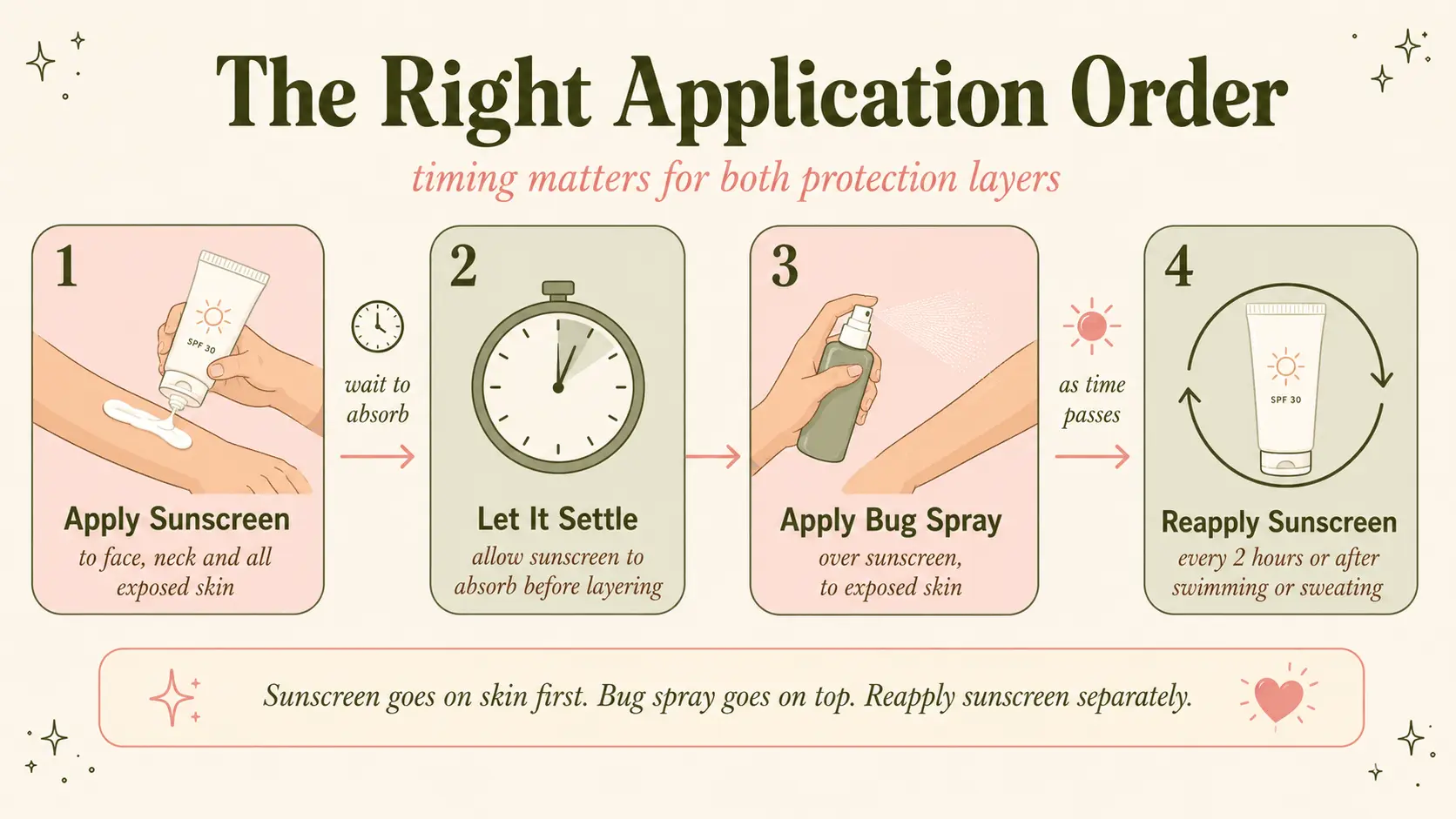
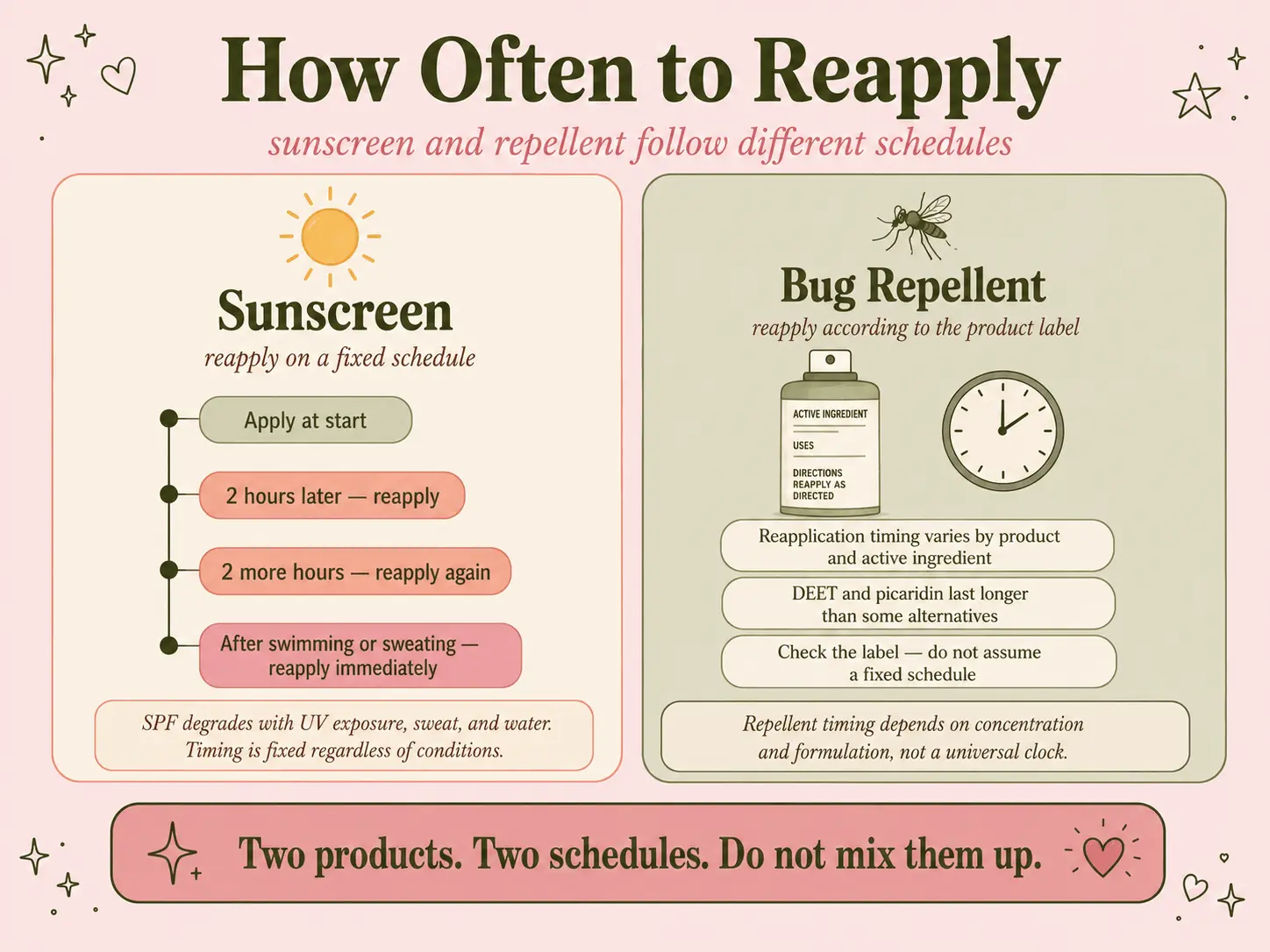
Sunscreen and insect repellent do not run on the same clock. During prolonged sun exposure, CDC guidance allows sunscreen to be reapplied over an earlier repellent layer. Repellent should then be reapplied only when the label permits it or when protection has ended.4
If you are outside for less than two hours
- Apply sunscreen.
- Wait at least 15 minutes when possible.
- Apply repellent to exposed skin and the outside of clothing.
- Wash treated skin after returning indoors.
If you are outside all afternoon
- Start with sunscreen first and repellent second.
- Reapply sunscreen at least every two hours, and according to the label after swimming, sweating or towel drying.8
- Do not automatically reapply repellent every time you reapply sunscreen.
- If the repellent needs reapplication, let the new sunscreen layer settle first and then apply repellent as directed.
If you are swimming or sweating
U.S. water-resistant sunscreen labels specify either 40 or 80 minutes of protection while swimming or sweating. Reapply after that period, immediately after towel drying and otherwise at least every two hours.9
- Use a water-resistant broad-spectrum sunscreen.
- Rebuild the sunscreen layer first after water exposure.
- Apply repellent afterward only if its label allows another application.
- Do not apply repellent to skin underneath clothing.
- Apply repellent to the outside of clothing only when the product label permits it.
Does DEET make sunscreen less effective?
DEET can reduce measured SPF, but it does not completely cancel sunscreen. CDC describes the evidence as limited and says DEET-containing repellent applied over sunscreen may reduce SPF by roughly one-third.2
A small 1997 study reported an approximately 33% reduction in measured SPF when DEET repellent and sunscreen were used sequentially.12 A later clinical trial primarily examined whether sunscreen affected repellent performance and referenced the earlier SPF finding.11 These studies do not prove that every modern sunscreen-DEET pairing loses exactly one-third of its protection.
| Question | Evidence-based answer | Practical move |
|---|---|---|
| Does DEET cancel sunscreen? | No. The concern is a reduction in measured SPF, not the disappearance of all protection. | Apply sunscreen first and reapply it on schedule. |
| Do all repellents reduce SPF? | The clearest public-health warning concerns DEET. Evidence for picaridin, IR3535 and PMD with different sunscreen formulas is less complete. | Use the same order for every repellent and add protective clothing. |
| Should I use SPF 50? | A higher SPF may retain more protection after ordinary application imperfections, but it cannot compensate reliably for missed areas or failure to reapply. | Use broad-spectrum SPF 30 or higher; consider SPF 50 for prolonged or intense exposure. |
DEET, picaridin, IR3535 and PMD with sunscreen
EPA-registered skin-applied repellents can contain DEET, picaridin, IR3535, oil of lemon eucalyptus, PMD or 2-undecanone. Registered repellents are evaluated for safety and effectiveness when used according to their labels.7
| Active ingredient | Useful for | Routine notes | Evidence caution |
|---|---|---|---|
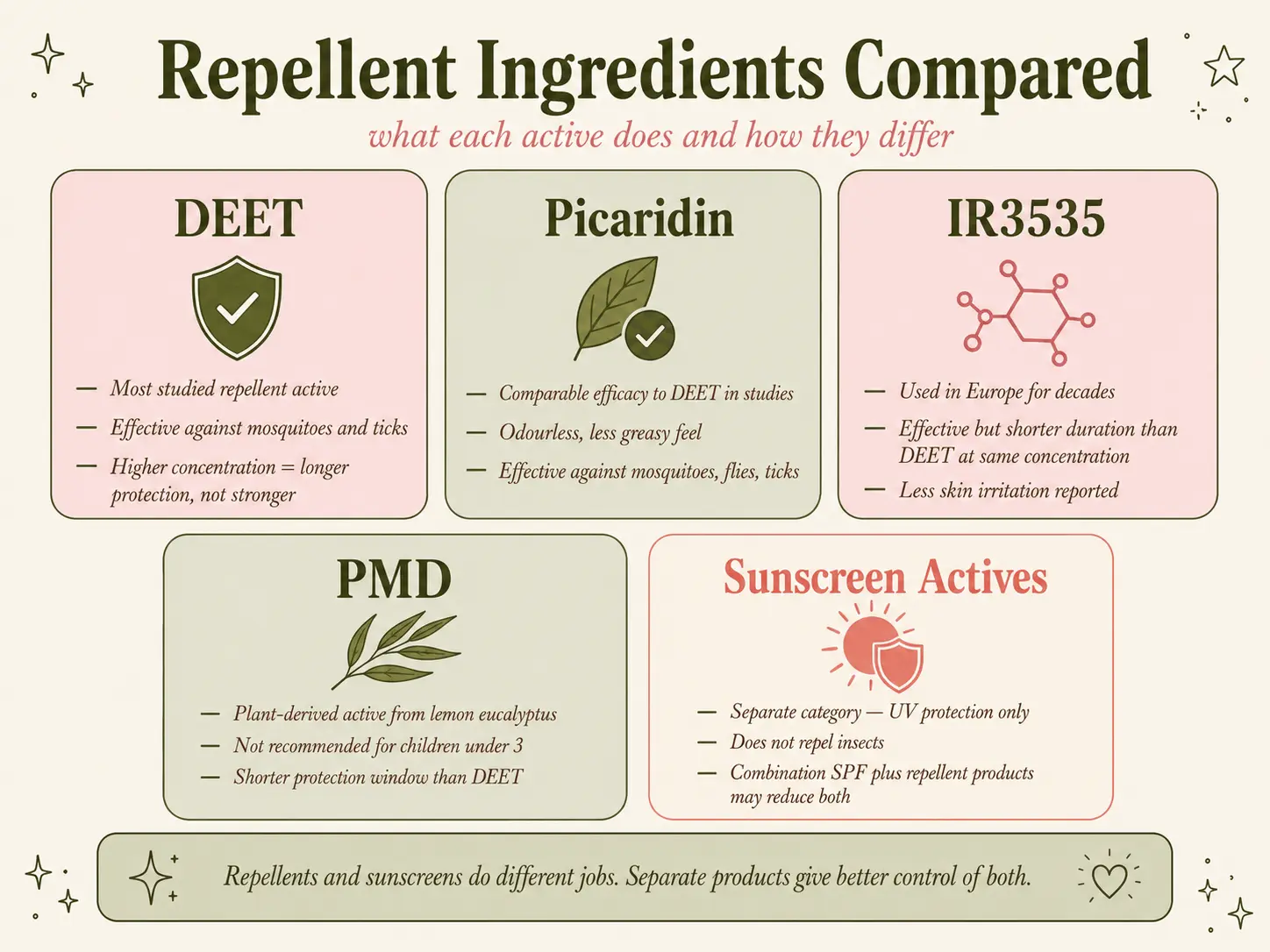
| DEET | Mosquito and tick protection with extensive use history. | Can feel oily and can damage some plastics, painted surfaces and synthetic materials. Use only enough to cover exposed areas. | It has the clearest evidence of reducing measured SPF when layered over sunscreen. |
| Picaridin / icaridin | A common alternative for mosquitoes and ticks. | Often reported as less greasy and less damaging to plastics than DEET. | There is less direct evidence about SPF interaction, so zero interaction should not be assumed. |
| IR3535 | An EPA-registered option available in some lotion and spray products. | A lotion format can make application easier to control than an aerosol. | Protection time depends on the concentration and specific label. |
| Oil of lemon eucalyptus / PMD | Registered repellent options derived from or related to refined eucalyptus chemistry. | OLE is a refined extract; PMD is its main repellent constituent and may also be made synthetically. Neither is ordinary lemon eucalyptus essential oil. | CDC recommends avoiding OLE and PMD in children younger than three; check the exact product label.2 |
| Unregistered essential-oil blends | May provide variable, short-duration nuisance-bite protection. | Fragrance components can irritate sensitive or eczematous skin. | Do not rely on unregistered products where mosquito- or tick-borne disease is a concern.2 |
Should you use a sunscreen and insect repellent combination product?
Separate products are usually the better choice. Sunscreen is applied liberally and frequently. Repellent is applied only in the amount and frequency specified on its label. FDA's 2021 proposed sunscreen order discussed this conflict and proposed that sunscreen-repellent combinations not be considered generally recognized as safe and effective because their directions for use are difficult to reconcile.10
Use one sunscreen and one insect repellent. This lets you reapply sunscreen without repeatedly dosing yourself with more repellent than necessary.
Kids, pregnancy, acne, eczema and sensitive skin
Children
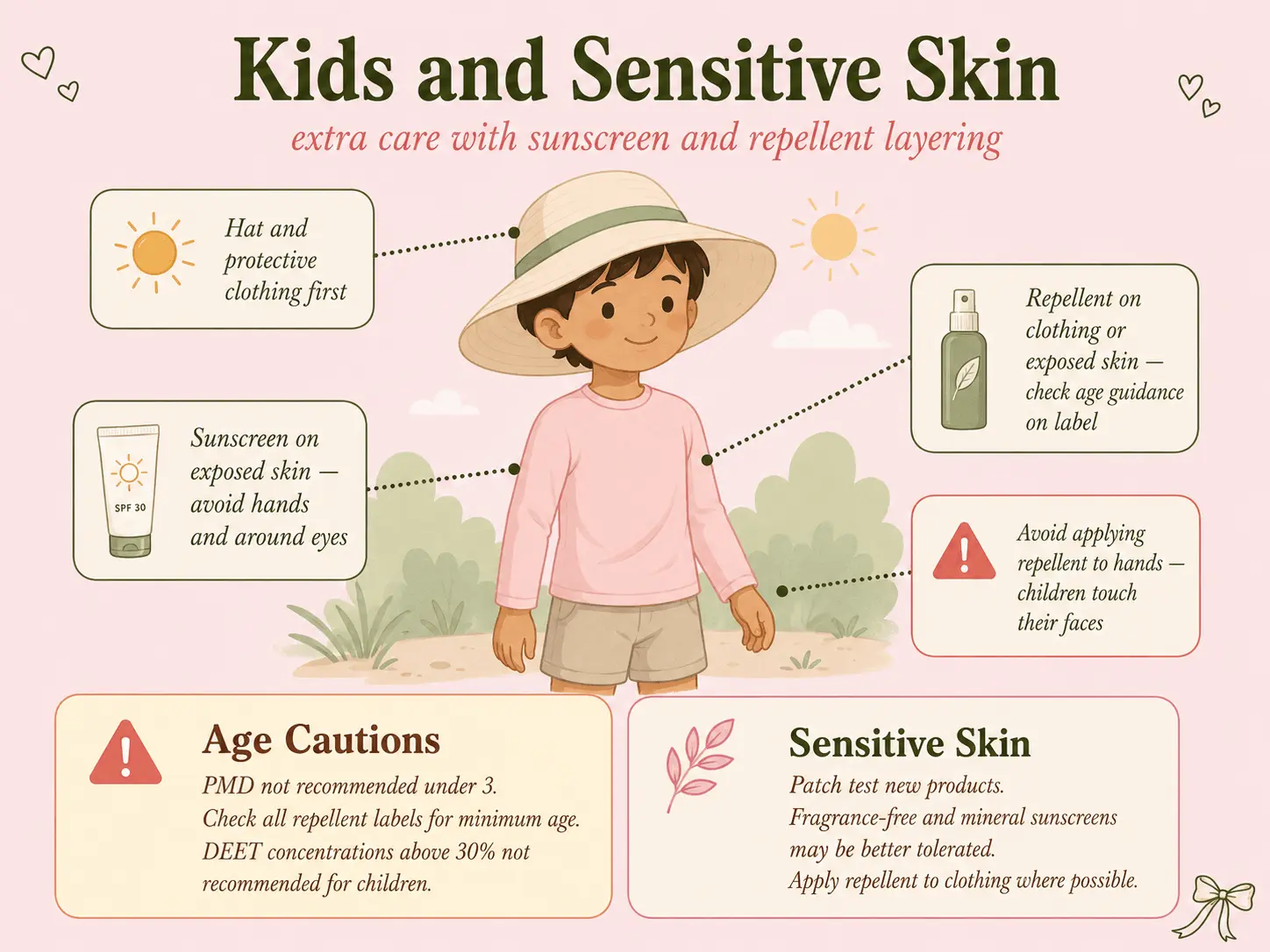
The American Academy of Pediatrics recommends sunscreen first and insect repellent second when separate products are used.16 Adults should apply repellent for young children and keep it away from children's hands, eyes, mouth, cuts and irritated skin.17
- Do not spray repellent directly on a child's face.
- Apply facial repellent to adult hands first, then spread it carefully.
- Do not apply repellent to a child's hands.
- CDC recommends no OLE or PMD for children under three.
- Use hats, long sleeves, stroller nets and shade to reduce product exposure.
Pregnancy and breastfeeding
CDC states that EPA-registered repellents are considered safe and effective for pregnant and breastfeeding people when used as directed.1 In areas with mosquito-borne disease, skipping effective protection can carry its own risk.
Acne-prone skin
Use repellent only where insect protection is needed. Favor exposed body skin and clothing when practical, avoid heavy facial application and cleanse gently after exposure.
Eczema, rosacea or sensitive skin
Do not apply repellent over cuts, wounds, active dermatitis, sunburn or other irritated skin.6 Fragrance-free products may be easier to tolerate than heavily fragranced alternatives, but no repellent is guaranteed not to irritate.
Use clothing first, sunscreen on exposed intact skin second and a fragrance-free EPA-registered repellent only where needed. A small-area test may identify immediate irritation, but it cannot guarantee tolerance during sweating, sunlight or repeated use.
Should bug spray go before or after makeup?
There is little direct evidence defining the ideal sequence with makeup. For substantial insect exposure, the most defensible order is sunscreen, wait, carefully applied facial repellent and then minimal makeup when practical. Makeup placed between or over the protective products may disturb either layer.
- Apply skincare and sunscreen.
- Allow the sunscreen to set.
- Apply repellent carefully to exposed facial areas. Spray into the hands first and avoid the eyes, lips and mucous membranes.2
- Keep makeup light when insect exposure is significant.
- For sunscreen reapplication, use lotion, cream or a properly applied stick. Do not rely on a light dusting of SPF powder or makeup alone to reproduce labeled protection.
Practical answer: in intense sun or heavy mosquito exposure, prioritize adequate sun and bite protection over preserving perfect makeup.
Can sunscreen and bug spray interact on the skin?
Laboratory studies have found that some DEET-and-oxybenzone combinations increased the in-vitro permeation of both ingredients. Results depended on the formulas, amounts and application sequence tested.13 A separate human-epidermis study found lower permeation with picaridin than DEET under the tested conditions.15
These experiments show that formulation interactions are possible. They do not establish that ordinary label-directed use causes clinical harm. EPA's review supports registered DEET products when used as directed.5
Use separate products, avoid overapplication, keep repellent off damaged skin and wash treated skin when protection is no longer needed. There is no basis for describing normal label-directed use as automatically toxic.
Does mineral or chemical sunscreen change the order?
No. Sunscreen still goes first and repellent second. Mineral and organic-filter sunscreens both need even coverage across exposed skin.
| Sunscreen type | What matters | Best practice |
|---|---|---|
| Mineral sunscreen | Rubbing repellent aggressively over a visible film can create streaks or missed areas. | Allow it to settle, then apply repellent gently. |
| Organic-filter sunscreen | Many labels direct application before sun exposure. | Use the full amount and wait at least 15 minutes when possible. |
| Water-resistant sunscreen | Protection is limited to the labeled 40 or 80 minutes while swimming or sweating. | Reapply according to the label and after towel drying. |
| Spray sunscreen | It is easy to miss areas or inhale spray. | For the face, spray into the hands and spread carefully.14 |
Common sunscreen and bug spray mistakes
| Mistake | What to do instead |
|---|---|
| Applying bug spray first | Apply sunscreen first, then repellent. |
| Mixing the products together in your hand | Use separate layers and follow each label. |
| Reapplying repellent every two hours automatically | Reapply only as often as the repellent label permits. |
| Applying repellent to skin beneath clothing | Use it on exposed skin and, when allowed, the outside of clothing. |
| Relying on SPF powder as the main reapplication method | Use lotion, cream or an adequately applied stick. |
| Assuming natural means non-irritating | Choose evidence-based registered products and stop use if irritation develops. |
| Using permethrin directly on skin | Use permethrin-treated gear or clothing only according to the product label.3 |
Sunscreen and bug spray routine by activity
Normal summer walk
- Broad-spectrum SPF 30 or higher on exposed skin.
- Wait at least 15 minutes when possible.
- EPA-registered repellent where insects are a problem.
- Wash treated skin when you return indoors.
Hiking, camping, travel or outdoor work
- Use water-resistant SPF 30 or higher.
- Add a hat, sunglasses, long sleeves and shade.
- Apply repellent after sunscreen has set.
- Reapply sunscreen on its schedule.
- Reapply repellent only according to its label.
- Consider correctly used permethrin-treated clothing in tick-heavy settings.3
Continue reading: Learn how to choose and apply SPF, check what the UV Index means for your skin, and see what to do when your skin barrier is damaged or skincare burns or stings.
Frequently asked questions
Should sunscreen or bug spray go first?
Apply sunscreen first. When possible, let it set for at least 15 minutes, then apply insect repellent.
Do you put bug spray or sunscreen on first?
Sunscreen goes on first and bug spray goes on second. Use separate products.
How long after sunscreen can I apply bug spray?
When possible, wait at least 15 minutes, while following both product labels.
Can you put bug spray over sunscreen?
Yes. That is the order recommended by public-health guidance.
Can you put sunscreen over bug spray?
Yes, when sunscreen needs reapplication during prolonged exposure. Reapply repellent afterward only when its label permits it.
Does DEET make sunscreen less effective?
Limited evidence indicates that DEET can reduce measured SPF. It does not eliminate all sunscreen protection.
Can kids use sunscreen and repellent together?
Yes, with age-appropriate products, adult application and avoidance of the hands, eyes, mouth, cuts and irritated skin.
Should I use a sunscreen-repellent combination?
Separate products are generally better because sunscreen usually needs more frequent application than repellent.
Sources
- Centers for Disease Control and Prevention. Preventing Mosquito Bites. CDC. Accessed July 25, 2026.
- Centers for Disease Control and Prevention. Mosquitoes, Ticks, and Other Arthropods. CDC Yellow Book. CDC. Accessed July 25, 2026.
- Centers for Disease Control and Prevention. Preventing Tick Bites. CDC. Accessed July 25, 2026.
- Centers for Disease Control and Prevention. Sun Exposure in Travelers. CDC Yellow Book. CDC. Accessed July 25, 2026.
- U.S. Environmental Protection Agency. DEET. EPA. Accessed July 25, 2026.
- U.S. Environmental Protection Agency. Using Insect Repellents Safely and Effectively. EPA. Accessed July 25, 2026.
- U.S. Environmental Protection Agency. Skin-Applied Repellent Ingredients. EPA. Accessed July 25, 2026.
- American Academy of Dermatology. How to Apply Sunscreen. AAD. Accessed July 25, 2026.
- 21 CFR § 201.327. Over-the-counter sunscreen drug products; required labeling based on effectiveness testing. e-CFR. Accessed July 25, 2026.
- U.S. Food and Drug Administration. Proposed Administrative Order OTC000008: Amending OTC Monograph M020, Sunscreen Drug Products for OTC Human Use. 2021. FDA PDF.
- Murphy ME, Montemarano AD, Debboun M, Gupta R. The effect of sunscreen on the efficacy of insect repellent: a clinical trial. Journal of the American Academy of Dermatology. 2000;43(2 Pt 1):219-222. PubMed.
- Montemarano AD, Gupta RK, Burge JR, Klein K. Insect repellents and the efficacy of sunscreens. The Lancet. 1997;349:1670-1671. PubMed.
- Gu X, Wang T, Collins DM, Kasichayanula S, Burczynski FJ. In vitro evaluation of concurrent use of commercially available insect repellent and sunscreen preparations. Skin Pharmacology and Physiology. 2005;18(5):220-225. PubMed.
- American Academy of Dermatology. Sunscreen FAQs and Application Guidance. AAD. Accessed July 25, 2026.
- Chen T, Burczynski FJ, Miller DW, Gu X. Percutaneous permeation comparison of repellents picaridin and DEET in concurrent use with sunscreen oxybenzone. Journal of Pharmaceutical Sciences. 2010. PubMed.
- American Academy of Pediatrics. Insect Repellents. AAP. Accessed July 25, 2026.
- HealthyChildren.org, American Academy of Pediatrics. How to Choose an Insect Repellent for Your Child. HealthyChildren. Accessed July 25, 2026.
Medical disclaimer: This article is for general education and does not replace individualized medical advice. Ask a clinician or pharmacist for advice when using products on infants or toddlers, when you have severe eczema or allergies, or when traveling to an area with malaria, dengue, Zika, Lyme disease or another vector-borne disease risk.
Stay curious, stay evidence-based.