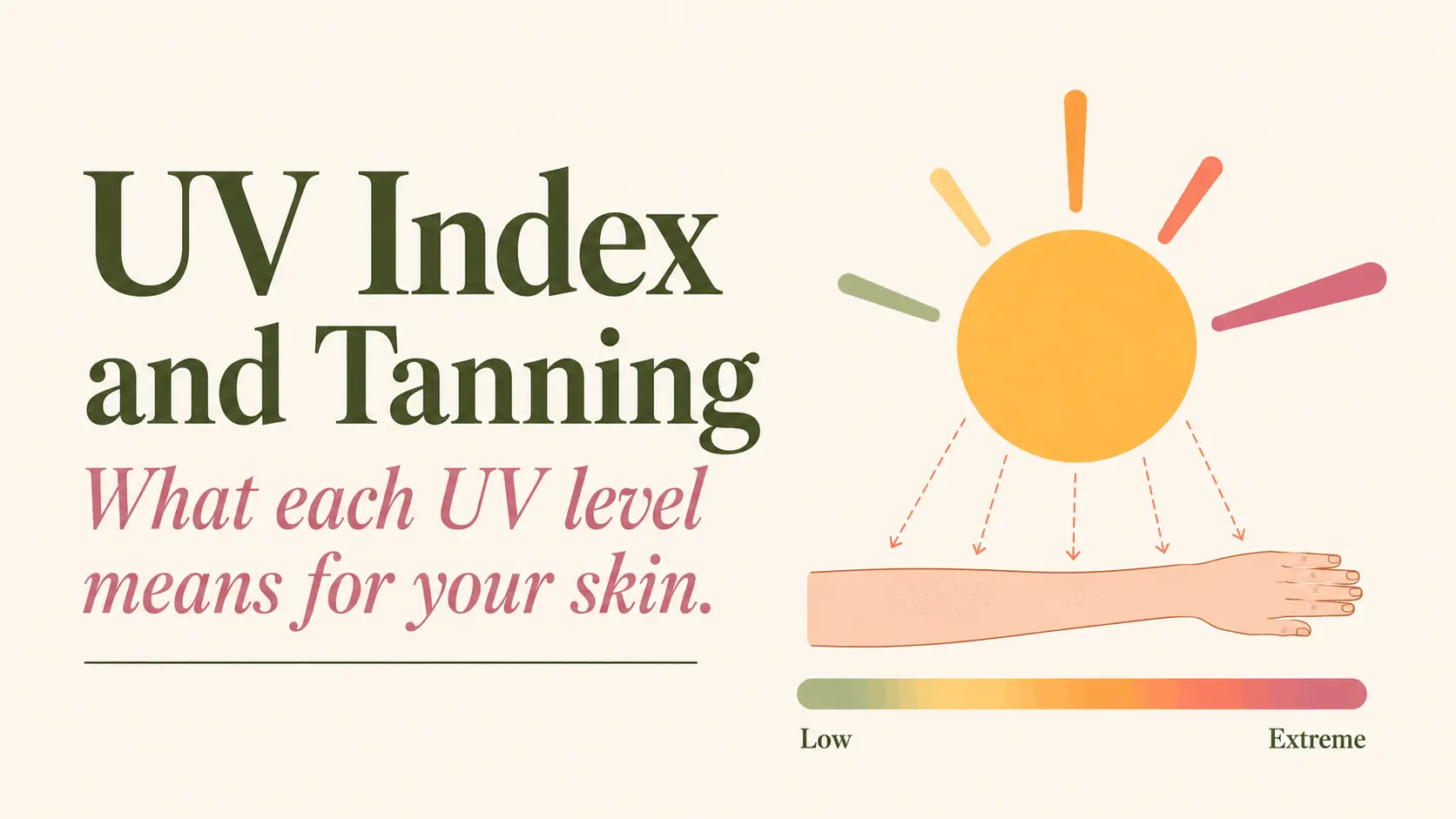
The UV Index is a warning, not a tanning timer
Higher numbers mean stronger ultraviolet radiation and faster potential damage to unprotected skin.
What UV Index can you tan in? Tanning may occur at UV 2, 3, 4, 5 or higher, depending on accumulated UVA and UVB exposure and individual skin response. No intentional UV-induced tan is safe or damage-free. A higher UV Index generally means sunburn and other UV injury can occur faster. It does not precisely predict how quickly an individual will tan. The World Health Organization recommends sun protection when the UV Index is 3 or above.[1][2][9]
People searching for the best UV Index for tanning usually want a simple number. The problem is that the number cannot tell you exactly when your skin will tan or burn.
Your result depends on your natural skin color, genetics, exposure time, sunscreen, medications, altitude, clouds and reflected UV from water, sand or snow. This is why online charts that say “tan for 20 minutes at UV 5” are not reliable.
Tanning is possible at different UV levels, but no UV tan is damage-free
A tan is your skin responding to ultraviolet exposure. It is not proof that your skin safely adapted to the sun.
Bottom line: use the UV Index to decide how much protection you need, not how long to tan.
In This Guide
Can You Tan at UV Index 1, 2, 3, 4, 5 and Higher?
Tanning is possible at more than one UV level, depending on total exposure and individual skin response. The UV Index describes erythema-weighted UV intensity, not a person's tanning speed.[3][9]
| UV Index | Can you tan? | What it means |
|---|---|---|
| UV 1-2 | Biologically possible with sufficient cumulative exposure | UV is low, not absent. The UV Index alone cannot predict whether or when an individual will visibly tan. |
| UV 3-5 | Possible, depending on accumulated UV exposure and individual skin response | This is moderate UV. Sun protection is recommended, and there is no universal safe tanning time. |
| UV 6-7 | Possible, depending on accumulated UV exposure and individual skin response | UV is high. Sunburn and other UV injury can occur faster, but the index does not precisely predict tanning speed. |
| UV 8-10 | Possible, depending on accumulated UV exposure and individual skin response | UV is very high. Deliberately targeting these levels to tan increases potential harm. |
| UV 11+ | Possible, depending on accumulated UV exposure and individual skin response | UV is extreme. This is not a better tanning opportunity. Extra protection is needed. |
UV dose depends on intensity and time. Lower UV over a longer period may still contribute to tanning and damage. A higher UV Index means erythema-weighted UV dose can build more quickly, but it does not tell you exactly how fast your skin will tan. Skin phototype changes the visible response, but it does not make UV exposure harmless.[3][4][9]
Why Does Skin Tan?
Ultraviolet radiation activates pigment pathways in the skin. UV exposure can cause DNA damage, and damage-related signaling helps increase melanin production and transfer.[5][6]
Melanin can provide some protection against later exposure, but that protection is limited and a new UV tan appears after the skin has already been exposed.[7] That is why dermatologists do not consider intentional sun tanning a safe skincare practice.[20]
UVA Versus UVB: Which One Tans You?
Fast pigment darkening and photoaging
UVA reaches deeper layers of skin, contributes to tanning and photoaging, and can pass through some window glass.[9][14][15]
Sunburn and delayed tanning
UVB is a major cause of sunburn and also triggers longer-lasting pigment production. Both UVA and UVB can contribute to skin cancer.[20]
The UV Index is weighted around sunburn-producing effects. It remains useful, but it is not a perfect measurement of every UVA-related effect on your skin.[3][9]
Does Sunscreen Prevent Tanning?
Sunscreen reduces the amount of UV reaching your skin, so it can reduce tanning. No sunscreen blocks all UV.[12] People also often apply less than the amount used during SPF testing.[10] Individual response can vary.[11]
You may still tan while wearing SPF 30 or SPF 50, especially if the layer is thin, uneven, rubbed off or not reapplied. That does not mean sunscreen created a safe tan. It means some UV still reached the skin.
Related guide: Read our complete evidence-based SPF guide for sunscreen amounts, reapplication, UVA protection and what SPF labels actually mean.
A tanning oil without a tested broad-spectrum SPF does not provide dependable sun protection.
Does a Base Tan Protect You?
Only slightly. A base tan provides very little protection, roughly equivalent to SPF 3 or less, and it does not replace sunscreen, clothing or shade.[13]
Getting a base tan also requires UV exposure first, so it is not a damage-free way to prepare for a holiday.
Can You Tan Through Clouds, Shade or a Window?
Can you tan when it is cloudy?
Yes. Clouds can reduce UV, but they do not remove it.[1][2]
Can you tan in the shade?
Possibly. Shade blocks direct sunlight, but scattered and reflected UV can still reach the skin. Shade works best with sunscreen, clothing and a hat.[1][2]
Can you tan through a window?
Ordinary glass blocks most UVB but may allow some UVA through. The amount varies by glass type, tint and coating.[14][15]
What Tanmaxxing Gets Wrong
Tanmaxxing turns the UV Index into a tanning schedule. Videos may encourage people to chase peak UV hours, minimize or skip SPF, or use tanning oils.[17][18]
The core mistake is simple: the UV Index was designed to help people avoid overexposure. A higher number means stronger erythema-weighted UV exposure, not a better-quality tan. Sunburn is an injury, not a stage you need to pass through before tanning.[3][4]
- Peak UV is not a shortcut without consequences. Seeking faster tanning through stronger UV also increases potential damage.
- Not burning does not mean no damage occurred. UVA exposure may cause damage without an obvious sunburn.[8][16]
- Skin tone changes the response, not the need for protection. Darker skin can still experience photoaging, UV-related pigment problems and skin cancer.[6][21]
Safer Ways to Look Tan
For color without intentional UV exposure, use a DHA self-tanner, professional spray tan, bronzing drops or wash-off body makeup. DHA reacts with amino acids in the outermost dead layer of skin to create temporary color.[19]
When using a spray-tan booth, protect your eyes, lips and mucous membranes and avoid inhaling the mist.[19]
Most self-tanners do not provide meaningful sun protection. Continue using broad-spectrum sunscreen unless the product separately carries a tested SPF claim.
How to Protect Your Skin When the UV Index Is High
- Use a broad-spectrum, water-resistant sunscreen with SPF 30 or higher.[20]
- Apply enough and reapply after swimming, sweating, toweling off or about every two hours outdoors.[20]
- Use shade, clothing, sunglasses and a wide-brimmed hat.
- Be more careful around water, sand, snow and high elevations.
- Check the UV Index even when the weather is cloudy or cool.[1]
Sunscreen review: Looking for a lightweight daily option? Read our Beauty of Joseon Relief Sun SPF50+ review, including its UV filters, finish and skin-type suitability.
Final Verdict: What UV Index Is Best for Tanning?
There is no best or safest UV Index for intentional tanning. Tanning may occur at UV 2, 3, 4, 5 or higher, depending on total exposure and individual skin response. A higher UV Index generally means sunburn and other UV injury can occur faster, but it does not precisely predict tanning speed.
Frequently Asked Questions
What UV Index can you tan in?
Tanning may be possible at several UV levels, including UV 2, 3, 4 and 5, depending on accumulated exposure and individual response. No level creates a damage-free UV tan.
Can you tan in UV 2?
At UV Index 1-2, tanning may be biologically possible with sufficient cumulative exposure, but the UV Index alone cannot predict whether or when an individual will visibly tan.
Can you tan in UV 3?
It is possible, depending on dose and individual response. UV 3 is also the level where public-health guidance recommends sun protection.
Is UV 4 good for tanning?
Tanning may occur at UV 4, depending on dose and individual response. It is a moderate UV level, not a scientifically defined tanning sweet spot.
Can you tan in UV 5?
It is possible, depending on dose and individual response. UV injury can also occur, and there is no universal safe number of minutes.
Can you tan in UV 6 or 7?
It is possible, depending on dose and individual response. UV is high, and these levels should not be tanning targets.
Can you tan in UV 8, 9 or 10?
It is possible, depending on dose and individual response. UV is very high, and deliberately seeking it to tan increases potential harm.
Does sunscreen prevent tanning?
It can reduce tanning by reducing UV exposure, but real-world application does not block all UV.
Can you tan when it is cloudy?
Tanning is possible because clouds may reduce UV but do not eliminate it.
Can you tan through a window?
Some UVA can pass through certain glass, while most UVB is blocked.
What is tanmaxxing?
It is a social-media trend that uses high UV periods and other tactics to pursue a darker tan.
Is there a safe way to tan?
There is no damage-free UV tan. Self-tanner and spray tanning create color without intentional UV exposure.
Sources
View the scientific references
References were checked against peer-reviewed publications and official records available through July 19, 2026.
- World Health Organization. Ultraviolet radiation. WHO fact sheet. 21 June 2022. WHO.
- World Health Organization. Radiation: The ultraviolet (UV) index. Questions and answers. June 20, 2022. WHO.
- United States Environmental Protection Agency. Learn About the UV Index. Updated January 27, 2026. US EPA.
- United States Environmental Protection Agency. UV Index Scale. Updated June 15, 2026. US EPA.
- Cui R, Widlund HR, Feige E, et al. Central role of p53 in the suntan response and pathologic hyperpigmentation. Cell. 2007;128(5):853-864. doi:10.1016/j.cell.2006.12.045. PubMed.
- Tadokoro T, Kobayashi N, Zmudzka BZ, et al. UV-induced DNA damage and melanin content in human skin differing in racial and ethnic origin. FASEB Journal. 2003;17(9):1177-1179. doi:10.1096/fj.02-0865fje. PubMed.
- Yamaguchi Y, Takahashi K, Zmudzka BZ, et al. Human skin responses to UV radiation: pigment in the upper epidermis protects against DNA damage in the lower epidermis and facilitates apoptosis. FASEB Journal. 2006;20(9):1486-1488. doi:10.1096/fj.06-5725fje. PubMed.
- Burren R, Scaletta C, Frenk E, Panizzon RG, Applegate LA. Sunlight and carcinogenesis: expression of p53 and pyrimidine dimers in human skin following UVA I, UVA I + II and solar simulating radiations. International Journal of Cancer. 1998;76(2):201-206. doi:10.1002/(SICI)1097-0215(19980413)76:2<201::AID-IJC6>3.0.CO;2-0. PubMed.
- Sklar LR, Almutawa F, Lim HW, Hamzavi I. Effects of ultraviolet radiation, visible light, and infrared radiation on erythema and pigmentation: a review. Photochemical & Photobiological Sciences. 2013;12(1):54-64. doi:10.1039/C2PP25152C. PubMed.
- Petersen B, Wulf HC. Application of sunscreen: theory and reality. Photodermatology, Photoimmunology & Photomedicine. 2014;30(2-3):96-101. doi:10.1111/phpp.12099. PubMed.
- Hacker E, Boyce Z, Kimlin MG, et al. The effect of MC1R variants and sunscreen on the response of human melanocytes in vivo to ultraviolet radiation and implications for melanoma. Pigment Cell & Melanoma Research. 2013;26(6):835-844. doi:10.1111/pcmr.12157. PubMed.
- US Food and Drug Administration. Tips to Stay Safe in the Sun: From Sunscreen to Sunglasses. Content current as of May 9, 2024. FDA.
- National Center for Chronic Disease Prevention and Health Promotion (U.S.), Division of Cancer Prevention and Control. A Base Tan Is Not a Safe Tan. March 20, 2014. CDC Stacks. CDC.
- Duarte I, Rotter A, Malvestiti A, Silva M. The role of glass as a barrier against the transmission of ultraviolet radiation: an experimental study. Photodermatology, Photoimmunology & Photomedicine. 2009;25(4):181-184. doi:10.1111/j.1600-0781.2009.00434.x. PubMed.
- Hampton PJ, Farr PM, Diffey BL, Lloyd JJ. Implication for photosensitive patients of ultraviolet A exposure in vehicles. British Journal of Dermatology. 2004;151(4):873-876. doi:10.1111/j.1365-2133.2004.06098.x. PubMed.
- de Winter S, Vink AA, Roza L, Pavel S. Solar-simulated skin adaptation and its effect on subsequent UV-induced epidermal DNA damage. Journal of Investigative Dermatology. 2001;117(3):678-682. doi:10.1046/j.0022-202x.2001.01478.x. PubMed.
- George Washington University Department of Dermatology. Dermatologists Are Warning Against The Viral ‘UV Maxxing’ Tanning Trend. June 24, 2026. GW Dermatology.
- Walker J. ‘Tanmaxxing’ and the Pursuit of the Perfect Tan. UConn Today. June 22, 2026. UConn Today.
- US Food and Drug Administration. Sunless Tanners & Bronzers. Content current as of October 15, 2024. FDA.
- American Academy of Dermatology. Sunscreen FAQs. Last updated February 11, 2025. AAD.
- Agbai ON, Buster K, Sanchez M, et al. Skin cancer and photoprotection in people of color: a review and recommendations for physicians and the public. Journal of the American Academy of Dermatology. 2014;70(4):748-762. doi:10.1016/j.jaad.2013.11.038. PubMed.
Medical disclaimer: This article is for general education and does not replace individualized medical advice. Seek professional guidance if you have a photosensitivity disorder, a history of skin cancer, unusual moles, severe sunburn, or use medication that may increase sensitivity to ultraviolet radiation.
Stay curious, stay evidence-based.