
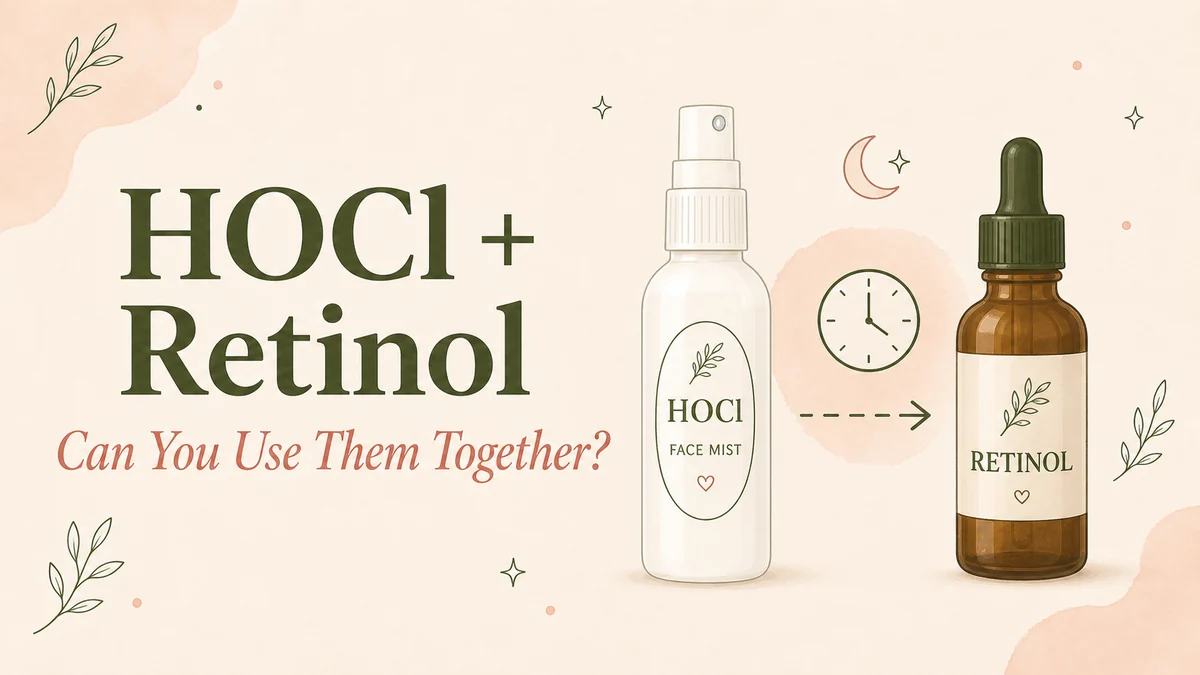
You can usually use a stabilized hypochlorous acid face spray and retinol in the same routine. Use HOCl after cleansing, let the skin dry fully, then apply your retinol as directed. There is no good clinical trial proving a special waiting period or showing that the pair works better together. If your skin is stinging, peeling, or unusually red, skip retinol until it settles.
Why combine HOCl and retinol?
Hypochlorous acid, usually shortened to HOCl, is an oxidizing molecule that immune cells naturally produce. Stabilized topical formulations are used for antimicrobial support and wound care. Reviews describe antimicrobial and anti-inflammatory activity, but results depend on concentration, pH, packaging, and stability.1
Retinol belongs to the retinoid family. Retinoids influence cell turnover and are used for acne, uneven pigmentation, texture, and photoaging. They also commonly cause dryness and irritation, especially when started too quickly.3
The logic behind using both is simple. HOCl may be a gentle cleansing-adjacent step, while retinol is the treatment step. That does not make HOCl a retinol booster, nor does it prove that HOCl prevents retinoid irritation.
We found research on stabilized HOCl formulations and separate research on topical retinoids. We did not find a controlled human trial designed to test a leave-on HOCl facial spray directly before retinol or tretinoin. The routine below is a conservative practical approach, not a proven chemical rule.
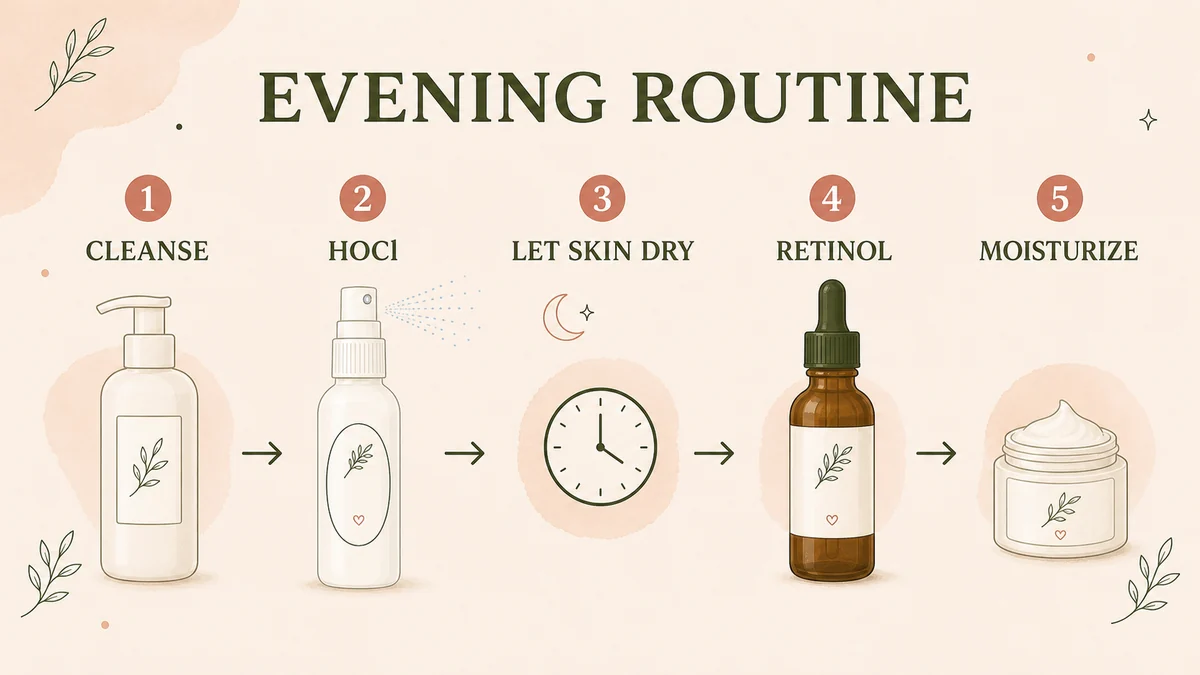
The simplest routine order
- Cleanse gently. Remove makeup and sunscreen without scrubbing.
- Spray HOCl. Use the amount directed on the product label.
- Let your face dry fully. This avoids diluting the retinoid and makes application more predictable.
- Apply a pea-size amount of retinoid. Follow the instructions for your specific retinol, adapalene, or prescription product.
- Moisturize. If you are irritation-prone, your dermatologist may recommend moisturizer before the retinoid instead.3
How long should you wait?
You do not need to set a 20-minute timer because of HOCl. Wait until the skin is comfortably dry. That may take one or two minutes. A longer pause can make sense if your prescription instructions say to apply tretinoin to completely dry skin, or if applying any retinoid to damp skin makes you sting.
What about tretinoin?
The same order is reasonable, but prescription directions win. Tretinoin has much stronger clinical evidence than cosmetic HOCl spray and can be more irritating. Do not change the frequency or strength of a prescription just to fit another product into the routine.
Can HOCl deactivate retinol?
HOCl is reactive and can oxidize biological material. That fact often becomes an internet claim that it must destroy every antioxidant or active placed nearby. Real formulations are more complicated. Concentration, pH, contact time, drying, and the finished retinol vehicle all matter.
There is not enough direct testing to promise perfect compatibility inside the same wet layer. This is why allowing the spray to dry is sensible. It reduces immediate mixing without turning skincare into a laboratory protocol.
| Claim | What we can actually say |
|---|---|
| HOCl makes retinol work better | Not established in human trials. |
| HOCl and retinol are always incompatible | Not established. Separate the wet layers and monitor tolerance. |
| HOCl prevents purging | No. Retinoid-related breakouts and irritation have different causes. |
| More frequent spraying is better | No. Follow the product directions and keep the routine simple. |
When should you separate them?
Use HOCl in the morning and retinol at night if you prefer fewer layers or cannot tell which product is causing a reaction. Alternate routines are also useful during the first weeks of retinoid use.
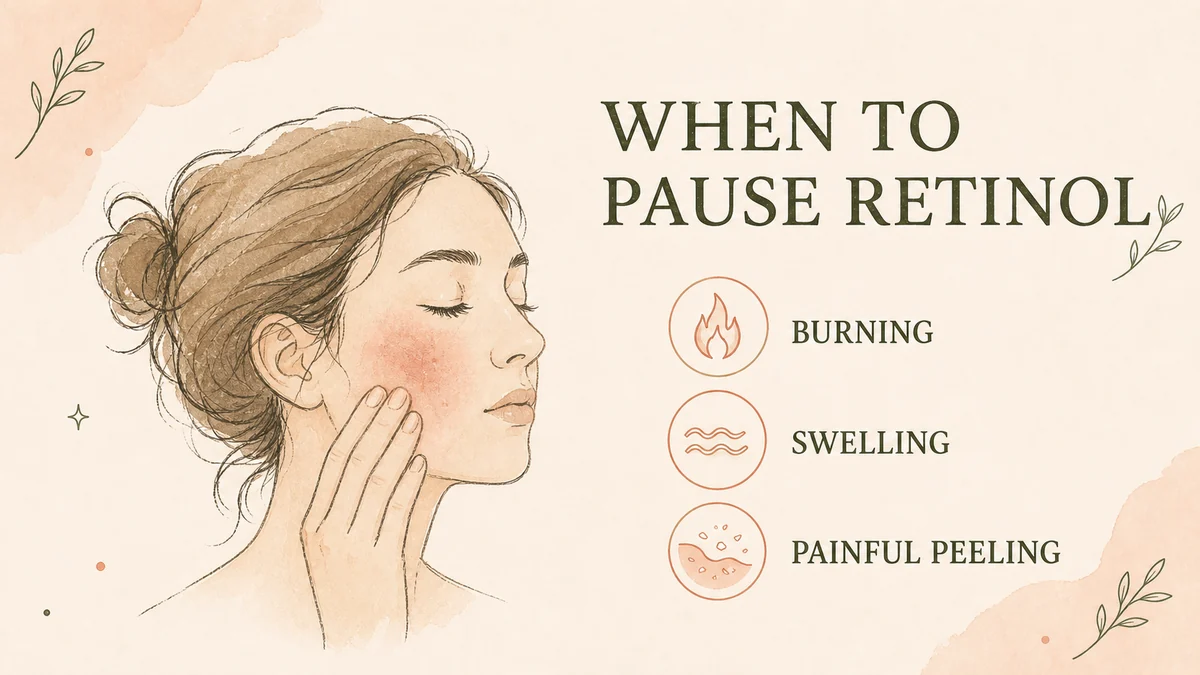
Persistent burning, swelling, blistering, crusting, or a rash that spreads is not a normal sign that skincare is working. Stop the newest products and seek medical advice. Retinoids should not be used during pregnancy unless your clinician gives specific guidance.4
A low-irritation start
- Begin retinol two nights per week, not nightly.
- Use a bland moisturizer and daily broad-spectrum sunscreen.
- Avoid adding acids, scrubs, and benzoyl peroxide on the same night unless your clinician designed that routine.
- Choose HOCl in opaque or UV-protective packaging and follow its storage directions because stability matters.1
Frequently asked questions
Do I use hypochlorous acid before or after retinol?
Use it before. Spray after cleansing, let the skin dry, then apply retinol and moisturizer.
Can I use HOCl with adapalene?
Usually, yes. The same dry-between-steps approach is reasonable. Adapalene can still irritate, so start slowly.
Can I spray HOCl over retinol later?
That may disturb the dried skincare film and has not been directly studied. If you want another spray, use it at a different time of day.
Can HOCl repair a damaged skin barrier?
It is not a replacement for moisturizer or for removing the irritant. If even water and moisturizer sting, simplify your routine and pause retinoids.
Build the cluster
Sources
- Del Rosso JQ, Bhatia N. Status Report on Topical Hypochlorous Acid. J Clin Aesthet Dermatol. 2018;11(11):36-39. PubMed.
- Gold MH, et al. Topical stabilized hypochlorous acid for wound care and scar management. J Cosmet Dermatol. 2020;19(2):270-277. PubMed.
- American Academy of Dermatology. Acne: diagnosis and treatment. AAD.
- American Academy of Dermatology. Retinoid or retinol? AAD.
- Sitohang IBS, et al. Topical tretinoin for treating photoaging: a systematic review of randomized controlled trials. Int J Womens Dermatol. 2022;8(1):e003. PubMed.
Medical note: This guide is educational. Ask your prescriber about tretinoin, adapalene, pregnancy, severe acne, eczema, rosacea, or persistent irritation.
Research first. Panic never. ♡