
You can lightly mist a facial hypochlorous-acid product over sunscreen, but research has not proven that every HOCl spray leaves every SPF film unchanged. A fine mist allowed to air-dry is less mechanically disruptive than soaking, rubbing or wiping, but that is a practical inference, not a direct clinical finding. If your face becomes visibly wet, you wipe it, or you have been sweating, reapply sunscreen according to its label.68
What Hypochlorous Acid Actually Does
Hypochlorous acid, shortened to HOCl, is a reactive chlorine species that immune cells can produce as part of the body's antimicrobial defense. Stabilized topical solutions have been studied mainly in wound care, antisepsis and several inflammatory skin settings. Reviews describe antimicrobial and possible anti-inflammatory activity, but also stress that performance is formulation-specific.12
This matters because “contains hypochlorous acid” does not make every bottle interchangeable. Concentration, pH, purity, packaging, storage and stability affect how much active HOCl reaches the surface. Evidence from a wound solution or laboratory preparation cannot automatically validate a cosmetic face mist, and wound evidence does not automatically prove acne treatment.13
Known Versus Not Directly Tested
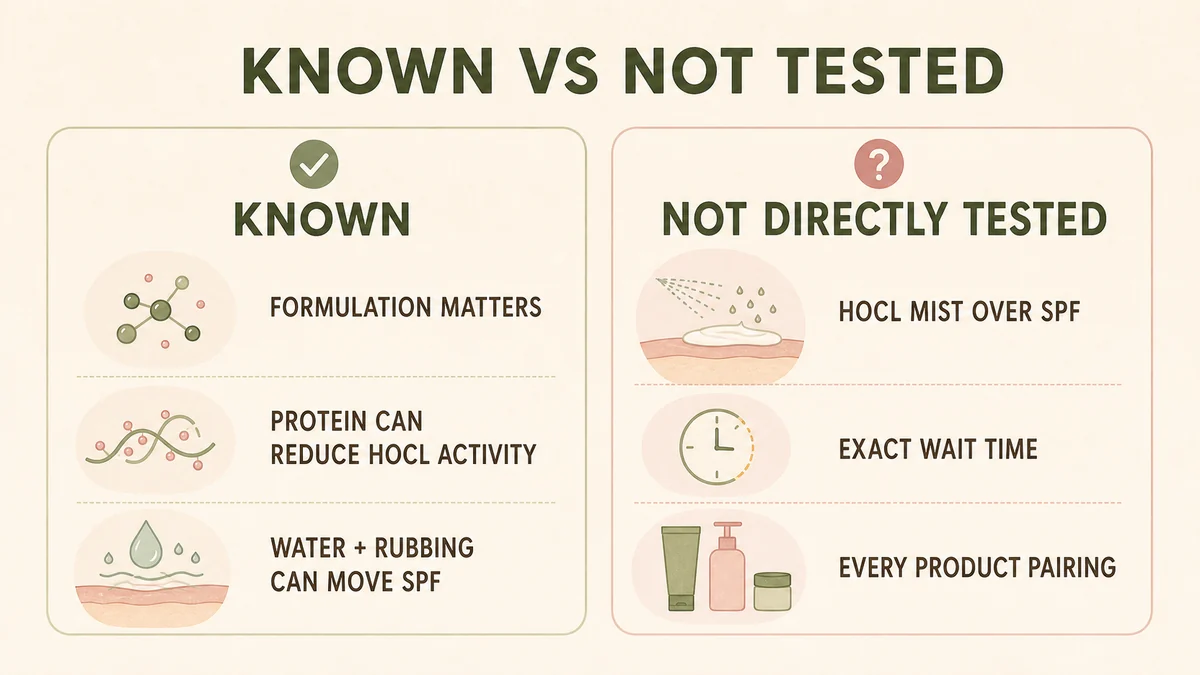
| Question | What evidence supports | Confidence |
|---|---|---|
| Does HOCl activity depend on formula? | Yes. pH and stability materially affect activity, and commercial products are not interchangeable. | Supported by reviews and laboratory work |
| Can organic material reduce HOCl activity? | Yes in laboratory and wound-solution testing. Proteins and other reactive compounds can consume available HOCl. | Direct laboratory evidence |
| Can water or sweat change sunscreen films? | Yes. Water exposure and perspiration can wash off or redistribute filters, with performance varying by formula. | Direct film and water-resistance evidence |
| Does one fine HOCl mist ruin SPF? | No direct product-pair study was found. A universal yes or no would overstate the evidence. | Unknown |
| Is there one exact wait time? | No clinical study establishes a universal interval. Letting each layer dry is practical technique, not a magic scientifically proven minute count. | Unknown |
| Does spraying over makeup treat acne? | No direct clinical trial establishes acne-treatment benefit through makeup and sunscreen. | Not established |
Will HOCl Deactivate or Wash Off Sunscreen?
“Deactivate” is too confident. HOCl is chemically reactive, but the real-world effect would depend on the exact HOCl concentration, pH, sunscreen filters, film formers, other ingredients, dose, droplet size and contact time. We did not find a direct study measuring SPF before and after a cosmetic HOCl face mist.
The better-supported concern is physical film disturbance. Sunscreen works best as a continuous, adequately thick layer. Water can stress sunscreen films, and sweat can reduce uniformity through wash-off and redistribution. Friction and towel drying add another removal force.679
A barely damp fine mist that dries untouched is not the same exposure as soaking your face, rubbing the liquid in, wiping with a towel or sweating through the sunscreen. The first is probably less disruptive, but “probably less” is a calibrated inference. It is not a measured SPF guarantee.
What about water-resistant sunscreen?
Water-resistant does not mean waterproof. In the United States, the label must state whether tested protection is retained after 40 or 80 minutes of swimming or sweating, and directions still require reapplication after that activity, immediately after towel drying, and at least every two hours.8 A water-resistant formula may tolerate moisture better, but the claim does not specifically test HOCl face mist over makeup.
The Best Order: HOCl Before Sunscreen
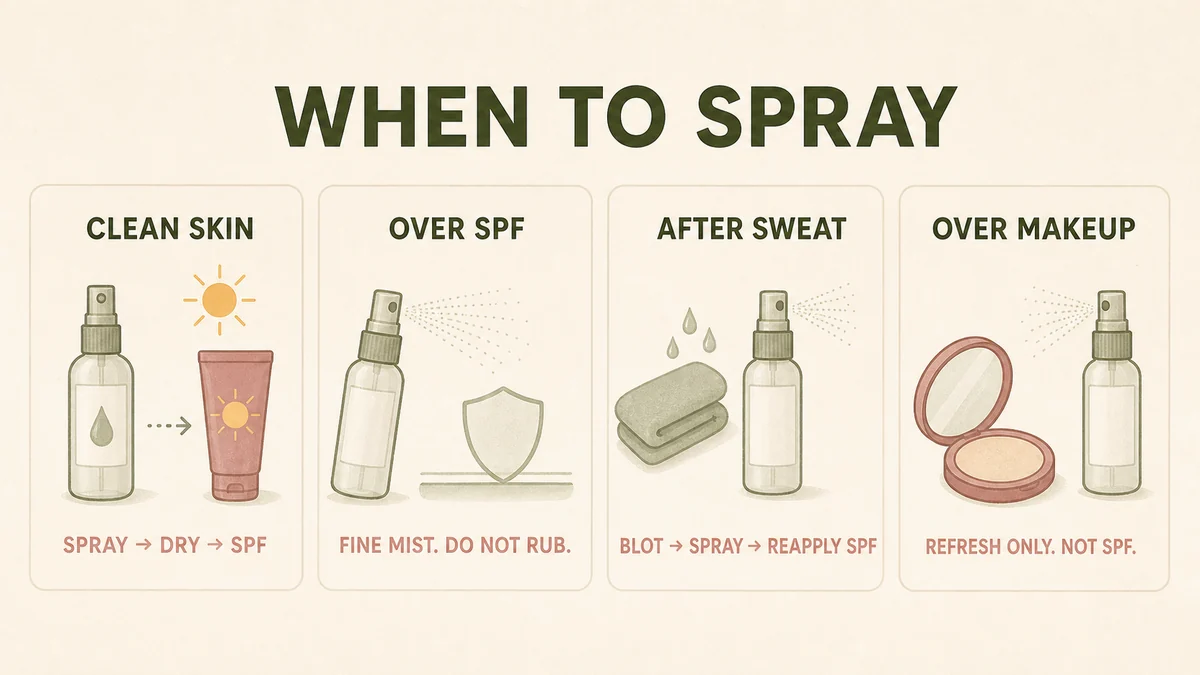
If you want the most evidence-aligned routine, place HOCl close to clean skin and sunscreen last. Clean skin gives the spray less sweat, sebum, makeup and skincare residue to react with. Laboratory work shows that proteins and other organic compounds can consume HOCl and reduce measured antimicrobial activity, although wound-test conditions are not identical to an everyday face.45
- Cleanse or rinse. Remove sweat, makeup and surface residue when practical.
- Use a finished HOCl product labeled for facial or human-skin use. Follow its directions rather than copying another brand's routine.
- Let the mist air-dry. Do not rub it around. There is no universal evidence-based wait time.
- Apply treatment and moisturizer if needed. If a prescription gives different directions, follow the prescription.
- Apply sunscreen as the final skincare step. Use a generous, even amount and follow its reapplication directions.8
Can You Spray Hypochlorous Acid Over Makeup?
If the product label allows facial misting, you can use a light spray over makeup for a temporary fresh feeling. Three limits matter:
- It is not cleansing. Makeup, sunscreen, sebum and sweat remain on the skin.
- It is not proven acne treatment through makeup. The spray meets the outer product layer first, and organic material can consume HOCl.45
- It is not sunscreen reapplication. A clear HOCl mist has no SPF unless the product separately carries a tested sunscreen claim.
Use the smallest mist that does the job, keep your eyes closed unless the exact product is labeled for ocular use, and let it dry without pressing a sponge or brush over the sunscreen. If the makeup becomes wet enough to streak or needs blotting, assume the SPF film may also have moved and restore sunscreen.
How to Use HOCl After a Workout
Sweat is the situation where “just mist over everything” makes the least sense. Sunscreen-film research shows that perspiration can cause wash-off and redistribution.7 Sweat, sebum and protein also create more material for HOCl to react with.
- Best option: cleanse or rinse the face.
- Apply HOCl: mist according to the label and allow it to dry.
- Moisturize if needed: especially if repeated cleansing feels drying.
- Reapply sunscreen: before returning outdoors.
If you cannot wash, gently blot sweat instead of rubbing, use the mist, let it dry and reapply sunscreen. Do not treat HOCl as permission to leave a visibly disrupted sunscreen film in place.
Choose and Store the Product Safely
Skin product, not surface disinfectant
Choose a finished product specifically labeled for use on human skin or the face. An EPA hard-surface disinfectant and household bleach are not skincare, even when related chlorine chemistry appears on the label.10
Concentration and pH matter
Home mixing cannot reliably reproduce a tested cosmetic or medical formulation. Do not acidify bleach, add fragrance or essential oils, or repurpose a household chemical for your face.
Heat, light and air can matter
A laboratory solution at 200 ppm and pH 6 lost stability with UV light, sunlight, air and elevated temperature. That does not create one storage rule for every commercial formula, so follow the package and keep it closed and away from unnecessary heat and direct light.4
Face-safe is not automatically eye-safe
Avoid direct inhalation and eye exposure unless the exact product is labeled for that route. Different topical, wound and ophthalmic preparations have different intended uses.
What About Vitamin C, Retinoids and Benzoyl Peroxide?
There are good chemical reasons not to mix an oxidizing HOCl solution directly into other products, but we found no clinical trial that establishes a universal forbidden skincare pairing or exact wait time. The simplest routine is to use HOCl first on clean skin, let it dry, then continue. Do not pour products together or add actives to the HOCl bottle.
If a routine burns, dries or reddens your skin, simplify. HOCl should not be used to push through irritation from an overloaded routine. Our damaged skin-barrier guide explains the signs that call for fewer actives rather than another spray.
Use HOCl before sunscreen when you can. A light mist over SPF is not proven to destroy protection, but it has not been directly tested across product pairs either. Let it air-dry, avoid rubbing, and reapply sunscreen after visible wetting, sweat, wiping or towel drying. Over makeup, treat HOCl as a surface refresh, not cleansing, acne treatment or SPF.
Frequently Asked Questions
Can you spray hypochlorous acid over sunscreen?
You can apply a fine mist without rubbing, but direct studies have not established that every HOCl spray leaves every sunscreen unchanged. Reapply SPF after visible wetting, wiping or sweating.
Does hypochlorous acid deactivate sunscreen?
There is no evidence that a normal facial mist universally deactivates sunscreen. There is also no product-pair evidence guaranteeing zero effect. Water and friction can disturb SPF films, so avoid soaking and rubbing.
Should hypochlorous acid go before or after sunscreen?
Before is the cleaner, lower-uncertainty order: apply HOCl to clean skin, let it dry, continue your routine and use sunscreen last.
Can you spray hypochlorous acid over makeup?
A facial product may be lightly misted over makeup if its label allows. It is a surface refresh, not cleansing, proven acne treatment or sunscreen reapplication.
How should I use hypochlorous acid after a workout?
Cleanse or rinse if possible, use the spray, let it dry, then reapply sunscreen before returning outdoors. If you cannot cleanse, blot rather than rub and still restore SPF.
How long should HOCl dry before sunscreen?
No study establishes one universal number of minutes. Wait until the skin is dry enough that sunscreen can spread evenly without mixing into visible droplets.
Can I make hypochlorous acid face spray from household bleach?
No. Use a finished product labeled for human skin. Household bleach and hard-surface disinfectants are not facial products, and unsafe mixing can create harmful exposures.
Can HOCl replace cleansing after sweating?
No. Misting does not remove sweat, sunscreen, sebum or makeup. Cleansing or rinsing is the better reset when available.
References
Official guidanceLaboratory studyReview No direct HOCl-over-SPF clinical study was found, so the article does not present an untested product pairing as settled fact.
- Del Rosso JQ, Bhatia N. Status report on topical hypochlorous acid: clinical relevance of specific formulations, potential modes of action, and study outcomes. J Clin Aesthet Dermatol. 2018;11(11):36-39. PubMed.
- Boecker D, Zhang Z, Breves R, Herth F, Kramer A, Bulitta C. Antimicrobial efficacy, mode of action and in vivo use of hypochlorous acid for prevention or therapeutic support of infections. GMS Hyg Infect Control. 2023;18:Doc07. doi:10.3205/dgkh000433. PubMed.
- Chang CH, Devine M, Woo D, Hopkins T, Torres T, Chovatiya R. Past, present, and future of sodium hypochlorite in dermatology: a scoping review. Am J Clin Dermatol. 2026;27(3):415-463. doi:10.1007/s40257-025-00999-9. PubMed.
- Ishihara M, Murakami K, Fukuda K, et al. Stability of weakly acidic hypochlorous acid solution with microbicidal activity. Biocontrol Sci. 2017;22(4):223-227. doi:10.4265/bio.22.223. PubMed.
- Yap JW, Ismail NI, Lee CS, Oh DY. Impact of interfering substances on the bactericidal efficacy of different commercially available hypochlorous acid-based wound irrigation solutions. Antibiotics. 2024;13(4):309. doi:10.3390/antibiotics13040309. PubMed.
- Puccetti G. Water-resistant sunscreens for skin protection: an in vivo approach to the two sources of sunscreen failure to maintain UV protection on consumer skin. Int J Cosmet Sci. 2015;37(6):613-619. doi:10.1111/ics.12238. PubMed.
- Keshavarzi F, Knudsen NØ, Komjani NM, et al. Enhancing the sweat resistance of sunscreens. Skin Res Technol. 2022;28(2):225-235. doi:10.1111/srt.13115. PubMed.
- U.S. Food and Drug Administration. Labeling and effectiveness testing: sunscreen drug products for over-the-counter human use. FDA.
- Agin PP. Water resistance and extended wear sunscreens. Dermatol Clin. 2006;24(1):75-79. doi:10.1016/j.det.2005.08.002. PubMed.
- Health Resources and Services Administration, Poison Help. Household cleaners and disinfectants safety fact sheet. Poison Help PDF.
Medical note: This article is general education. Stop using a product that causes significant burning, swelling, breathing symptoms or eye injury, and seek appropriate medical or poison-control help.
Separate the routine from the research claim. ♡