
The best acne treatment depends on what your breakouts look like, how severe they are and whether they are leaving scars. For many people, the foundation is a topical retinoid to prevent clogged pores plus benzoyl peroxide to control inflamed breakouts. Antibiotics are sometimes useful, but they should not be used alone or kept going indefinitely. Hormonal treatments can be effective for eligible women after individual medical screening. Lower-face involvement is common in adult female acne, but treatment decisions should not be based on location alone. Isotretinoin is the most effective option for severe, scarring or treatment-resistant acne.[2, 3, 4, 5, 15]
This guide covers the major acne patterns. Not every acne-like bump is acne. An atypical, painful, itchy or persistent eruption may need an in-person diagnosis instead of another acne product.
Painful deep nodules, new scars, widespread acne or breakouts causing major emotional distress deserve medical care sooner. Repeating weak over-the-counter routines for months while scars are forming is not the safer option.
In this guide
- Why acne happens
- How to identify the type of breakout
- Which acne treatments actually work
- A practical plan for each acne pattern
- How to build a simple acne routine
- When results usually appear
- Pregnancy, skin of color, teens and body acne
- Dark marks, red marks and acne scars
- Common treatment mistakes
- When to see a dermatologist
- Frequently asked questions
Start with the biology
Why acne happens
Acne is not proof that your face is dirty, and it is not one single problem with one miracle fix. It is a chronic inflammatory disorder of the hair follicle and oil gland. Four major processes overlap: excess sebum, sticky skin cells that block the follicle, changes involving Cutibacterium acnes, and inflammation that can start before a pimple is visible.[1, 2] Acne also remains highly common among adolescents and young adults worldwide.[6]
Hormones can increase sebum, especially during puberty and in hormonal-pattern adult acne.
Abnormal shedding creates microcomedones, the tiny blocked pores that later become visible acne.
Redness and swelling are not only late reactions. Inflammatory signaling can begin early.
This is why harshly drying the skin often fails. Dryness does not correct every pathway, and irritation can make a routine impossible to stick with. When you are unsure whether bumps are acne or signs of an irritated barrier, our guide to skin barrier damage versus acne can help you compare common clues. It cannot diagnose overlapping or persistent rashes, so get medical advice when the pattern is unclear or not improving.
Science note: why combination treatment often wins
A topical retinoid targets microcomedones and follicular turnover. Benzoyl peroxide targets inflammatory lesions and helps reduce the resistance problem that comes with antibiotics. For many patients, combining treatments can cover more of the biology than repeatedly spot-treating whatever appeared that morning.[2, 4, 8]
The part that changes the plan
How to identify the type of breakout
Do not choose treatment by ingredient popularity alone. First look at the lesion pattern, severity, location, scarring risk and your life stage. Acne can contain more than one type at the same time.
- Comedonal acne: mainly blackheads and whiteheads, with little redness.
- Inflammatory acne: red papules and pus-filled pustules.
- Nodular or nodulocystic acne: deep, painful lumps with a higher risk of scarring.
- Possible hormonal influence: cyclic flares and lower-face involvement are common clues in adult female acne, but location alone should not determine treatment.[15]
- Truncal acne: acne on the chest, shoulders or back, which may be harder to treat with topicals alone.
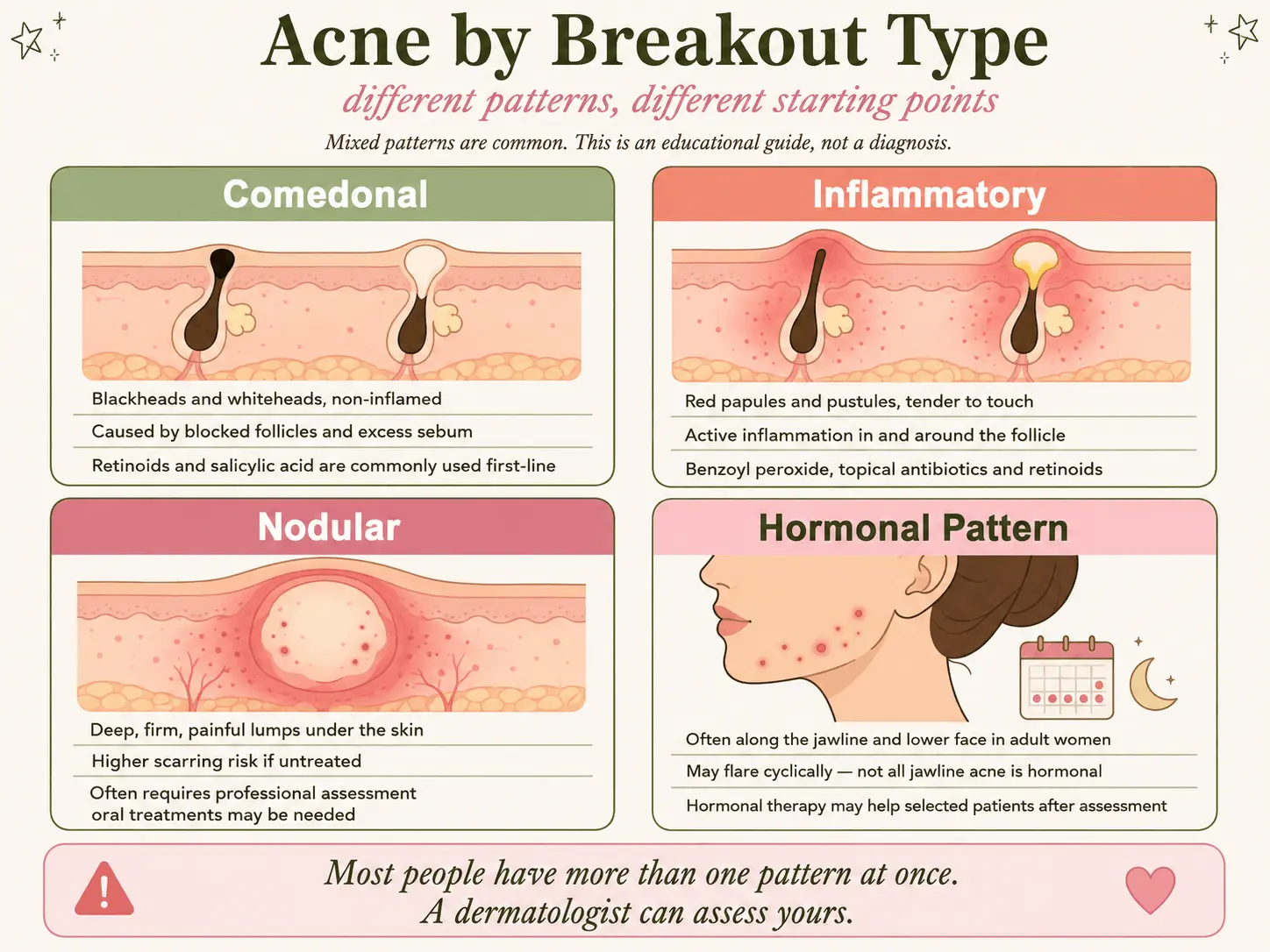
This is a treatment map, not a diagnosis. Mixed patterns are common.
After an acne lesion has healed, flat brown or gray marks are often post-inflammatory hyperpigmentation, while flat red or pink marks are often post-inflammatory erythema. Mixed marks can occur, and color alone is not a diagnosis. Persistent or changing marks need assessment. Persistent indentations or elevations after healing can be scar patterns, although other raised lesions can look similar. The PIH vs PIE vs acne scars guide shows how to check texture first and color second.[7, 19, 20]
Evidence over product hype
Which acne treatments actually work?
The strongest modern guidelines agree on the broad hierarchy. Topical retinoids and benzoyl peroxide are foundational. Fixed combinations are useful. Antibiotics should be paired with non-antibiotic treatment and limited in duration. Hormonal therapy has a real role for selected patients. Isotretinoin should be considered earlier when acne is severe, scarring or repeatedly failing treatment, according to local prescribing rules.[2, 3, 4, 9]
| Treatment | Best fit | Common review point | Main drawbacks |
|---|---|---|---|
| Topical retinoids | Blackheads, whiteheads, mixed acne and maintenance for frequent relapsers | Usually reviewed around 12 weeks | Dryness, peeling, redness and irritation |
| Benzoyl peroxide | Inflamed pimples and antibiotic-resistance prevention | Usually reviewed around 12 weeks | Dryness and bleaching of hair or fabric |
| Azelaic acid | Mild acne and post-inflammatory discoloration, especially brown marks, plus some pregnancy-compatible plans | Usually reviewed around 12 weeks | Stinging, burning or dryness |
| Salicylic acid | Over-the-counter add-on or alternative when retinoids are not tolerated | A practical reassessment after about 8 to 12 weeks | Dryness and modest evidence compared with retinoids |
| Topical or oral antibiotics | Inflammatory acne. Topical antibiotics should be paired with benzoyl peroxide; oral antibiotics should be used with effective topical therapy | Common review at 12 weeks. Many guidelines aim for about 3 months, while selected courses may continue longer under medical review | Resistance, irritation and oral side effects |
| Hormonal treatment | Eligible women after individual medical screening | Often slower, with clearer change by several months | Not suitable for everyone |
| Isotretinoin | Severe, scarring, relapsing or resistant acne | Managed across a full medical course | Common lip, skin and eye dryness, pregnancy prevention and monitoring requirements |
Topical retinoids
Retinoids are the anchor for comedonal acne because they suppress microcomedones, the precursor to visible clogged pores. They are also used in mixed acne. Maintenance can be useful for people who relapse frequently, but it is not automatically necessary for everyone. They work preventively, so they are normally applied as a thin layer across the acne-prone area rather than used as emergency spot treatments.[2, 3, 4]
The catch is irritation. Starting every night is not automatically better if it leaves your face raw and makes you quit. Depending on the product and medical directions, a slower introduction and moisturizer can improve tolerability. For some prescribed formulations, a clinician may recommend short-contact use, but this is not a universal instruction for every retinoid.
Benzoyl peroxide
Benzoyl peroxide is one of the most dependable treatments for inflammatory acne. It is also important when an antibiotic is used because it lowers the risk of encouraging antibiotic-resistant bacteria. Lower strengths can still work, and more is not always better if the only result is more irritation.[2, 5, 9, 21]
Benzoyl peroxide can bleach towels, pillowcases, clothing and hair. White fabrics are the least stressful option.
Topical and oral antibiotics
Antibiotics can calm inflammatory acne, especially when it is moderate, widespread or affecting the trunk. They are a bridge, not a permanent routine. Guidelines advise against antibiotic monotherapy and recommend limiting exposure. Topical antibiotics should generally be paired with benzoyl peroxide, while oral antibiotics should be combined with an effective topical regimen. Many guidelines aim for about three months, although selected courses may continue longer under medical review.[2, 3, 4]
Azelaic acid, salicylic acid and clascoterone
Azelaic acid is a useful option for mild comedonal or inflammatory acne, especially when post-inflammatory hyperpigmentation is also a concern. It is also one of the treatments commonly considered during pregnancy, although pregnancy routines should still be discussed with a clinician. Our full azelaic acid guide covers 10%, 15% and 20% products, irritation and realistic timelines.
Salicylic acid can help unclog pores and may be useful when a retinoid is not tolerated, but its evidence is more modest. The salicylic acid 2% guide explains what it can and cannot reasonably do. Clascoterone is a prescription topical antiandrogen for acne vulgaris in patients aged 12 years and older where approved. It can be considered when androgen signaling is a treatment target.[2, 9, 14]
Hormonal treatment
Combined oral contraceptives and spironolactone are evidence-based treatments for appropriate women with hormonal or adult acne. They are not weak backup options. They target androgen-driven oil production, which a cleanser cannot fix. In the SAFA randomized trial, spironolactone performed better than placebo, with a larger difference at 24 weeks than at 12 weeks.[2, 11]
These treatments need medical screening. They are not appropriate for everyone, and spironolactone is avoided during pregnancy.
Isotretinoin
Isotretinoin is the most effective overall treatment for severe nodulocystic acne. It is also used when acne is scarring, causing major psychosocial harm or failing standard treatment. Repeated ineffective antibiotic courses should trigger reassessment rather than continuing while permanent scars accumulate.[2, 3, 4, 5]
It requires clinician-led pregnancy prevention where relevant. Common side effects include dryness of the lips, skin and eyes, and laboratory values can change in some patients. Monitoring should be individualized, while still following local prescribing rules, rather than copied blindly from someone else's prescription.[18]
Peels, lasers and light devices
Procedures are where acne marketing tends to outrun the evidence. Some chemical peels show promise, while evidence for light and laser devices varies widely by the exact technology and is generally less certain than the evidence for standard medication. Major guidelines do not place most devices, peels or lasers as routine first-line treatment for active acne.[2, 3, 4, 10]
Red and blue light devices may still interest you, but outcomes vary by device and the evidence is less certain than it is for standard acne medicines. See our evidence review of LED face masks for acne and redness before spending heavily.
Put the pieces together
A practical plan for each acne pattern
This is a general map based on guideline logic. Prescription treatment, pregnancy, allergies, other health conditions and age can change the safest choice.
| Acne pattern | Common starting approach | If it is not enough |
|---|---|---|
| Mostly blackheads and whiteheads | Topical retinoid, or a retinoid plus benzoyl peroxide when inflamed lesions are also present | Check adherence and irritation, then consider a fixed combination or professional review |
| Mild inflammatory acne | Retinoid plus benzoyl peroxide, often in a fixed combination | Switch or strengthen the non-antibiotic topical plan after a proper trial, with a pharmacist or clinician when prescription treatment is involved |
| Moderate to severe inflammatory or body acne | Topical retinoid plus benzoyl peroxide, sometimes with a time-limited oral antibiotic | Stop ineffective antibiotic cycling and escalate care |
| Deep nodules, scars or repeated relapse | Early dermatology assessment and isotretinoin discussion | Specialist-led treatment rather than more random over-the-counter products |
| Hormonal-pattern adult female acne | Standard topical backbone plus consideration of hormonal treatment | Allow a slower hormonal timeline, then reassess with the prescriber |
A blemish that returns in exactly the same spot may involve repeated blockage, friction, picking, folliculitis, an epidermoid cyst, hidradenitis or another condition. Persistent same-site lesions should be professionally identified before aggressive treatment. Read why acne keeps returning in the same spot for a closer look at the possibilities.
Keep the routine boring
How to build a simple acne skincare routine
Good supportive skincare does not replace treatment, but it can make treatment easier to tolerate. NICE advises a pH-neutral or slightly acidic syndet cleanser and, when using moisturizers or sunscreen, avoiding oil-based or comedogenic formulas. It also advises avoiding persistent picking or scratching because this can increase scarring risk.[4, 13]
1. Gentle cleanser. Some people find an occasional water-only rinse more comfortable when a second cleanse feels drying, but this is individual comfort advice rather than a NICE requirement.
2. Prescribed morning treatment, if applicable.
3. Non-comedogenic moisturizer.
4. Broad-spectrum SPF 30 or higher.
1. Gentle cleanser.
2. Retinoid, benzoyl peroxide or prescribed combination as directed.
3. Moisturizer, before or after the active depending on tolerance, while following the exact product directions or prescription advice.
Moisturizer is not the enemy of acne. A bland non-comedogenic moisturizer, including ceramide-containing options, can reduce treatment dryness. For product ideas, see the guide to moisturizers for oily, acne-prone skin. Oily skin can still feel dry, tight or barrier-impaired, which is covered in our oily but dehydrated skin guide.
Sunscreen matters because ultraviolet and visible-light exposure can contribute to persistent hyperpigmentation. A broad-spectrum sunscreen is a reasonable routine target, and tinted iron-oxide formulas can add visible-light protection for pigment-prone skin. The evidence-based SPF guide explains how much to apply and what labels mean.[17]
The calendar matters
When acne treatment results usually appear
Acne treatment is frustrating because irritation can arrive before improvement. Formal guideline review commonly happens at about 12 weeks, not after one weekend. Hormonal treatments may take longer, and post-acne marks often fade more slowly than active pimples.[4, 7, 11, 19]
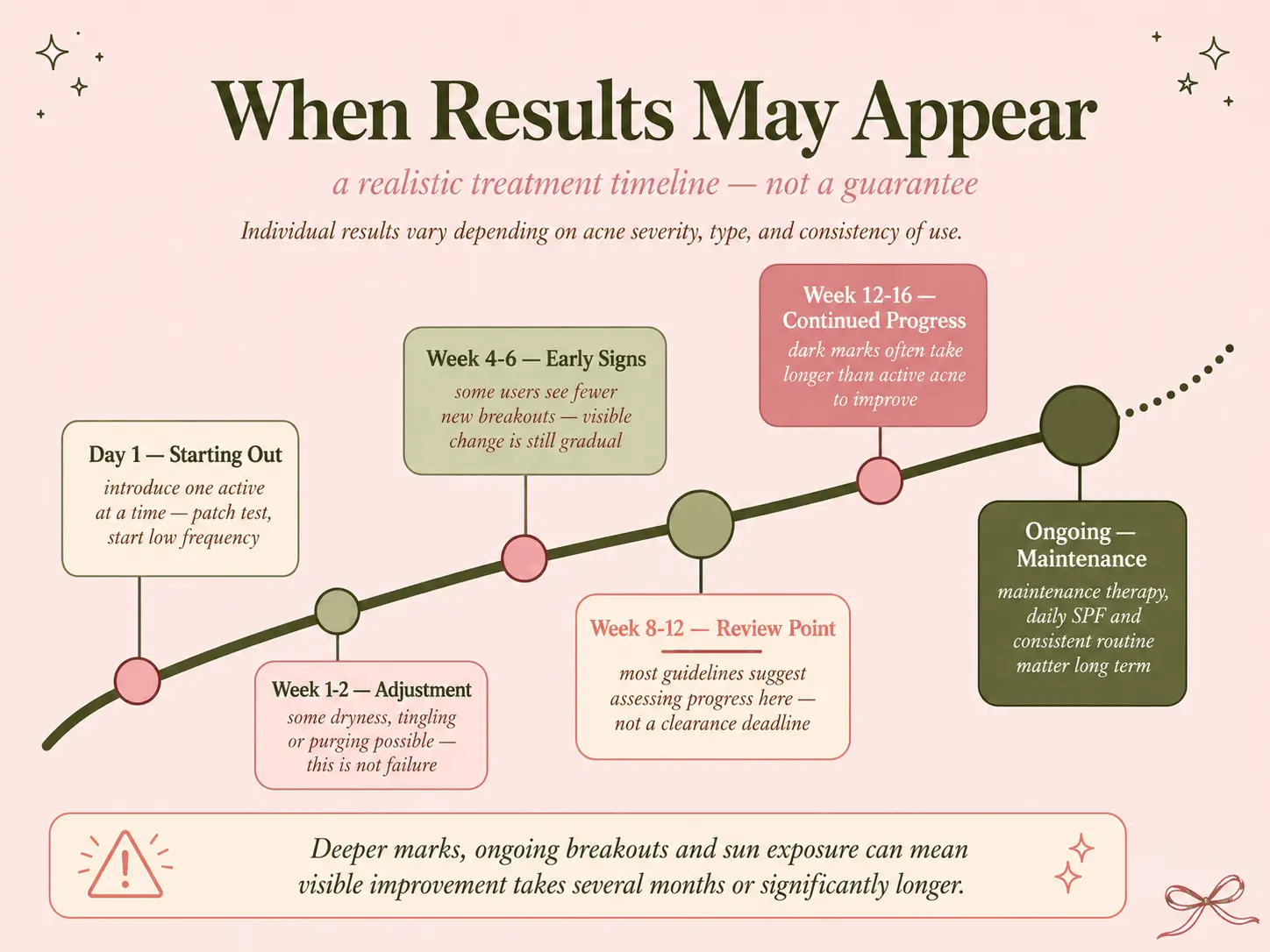
A 12-week review is a checkpoint, not a promise that every mark will be gone.
- Consider baseline photos. Using the same lighting, angle and distance every few weeks can make slow trends easier to notice. The interval is optional.
- Expect some adjustment. Dryness and peeling can happen with retinoids and benzoyl peroxide. Severe burning is not a badge of progress. Stop and seek advice for blistering, swelling, severe pain or breathing difficulty.
- Judge trends, not single days. Look for fewer new lesions and less inflammation across several weeks.
- Escalate when necessary. New scars, deep pain or no meaningful improvement after correct use are reasons to review the plan.
The same routine is not safe for everyone
Pregnancy, skin of color, teens and body acne
Pregnancy
Pregnancy changes the risk calculation. Benzoyl peroxide and azelaic acid are among the more commonly accepted topical options. Oral isotretinoin, spironolactone and topical retinoids are avoided. Oral tetracyclines are generally avoided, with exact restrictions depending on the medicine and stage of pregnancy. Severe acne during pregnancy should be managed with a clinician rather than by escalating over-the-counter products alone.[12]
Breastfeeding
Breastfeeding is not identical to pregnancy. Safety depends on the medicine, dose, treated area and whether infant skin can contact the product. Do not apply acne medication on or near the nipple or where the infant can touch it, and wash your hands after application. Oral isotretinoin should not be used while breastfeeding. Ask a clinician or pharmacist before using prescription retinoids, spironolactone or oral antibiotics.[12]
Skin of color
In darker skin tones, the mark left after acne may be more persistent than the pimple itself. An overly aggressive routine can reduce pimples while making discoloration and irritation worse. Retinoids and azelaic acid can be useful because they address acne and some pigment concerns, but gradual use, sunscreen and avoiding picking are central parts of the plan.[7]
Children and teens
Most preteen and teen acne can be treated with age-appropriate standard therapy. Mid-childhood acne, roughly from ages 1 to 6 or 7, is unusual enough to prompt assessment for early puberty or androgen excess. Preadolescent acne from about age 7 onward can be a normal first sign of puberty and does not automatically require an endocrine workup.[4, 16]
Body and truncal acne
Chest and back acne can cover a larger area and may be harder to reach with leave-on treatment. Moderate or severe truncal disease is one reason clinicians may consider oral therapy alongside a topical backbone. Sweaty clothing, friction and oily hair products can also make some areas worse, but body acne is not simply a hygiene failure.
Prevent the next mark
Dark marks, red marks and acne scars
Scarring risk rises with acne severity and duration. The most effective scar prevention starts before a scar exists: control inflammatory acne, do not pick and escalate treatment when deep nodules or scars appear.[4]
After acne has healed, flat brown or gray marks are usually PIH and flat red or pink marks are often PIE. This is a useful guide, not a diagnosis, and mixed marks can occur. Persistent or changing lesions need assessment. Neither type of flat mark is the same as a persistent indented or raised scar. Our guide on fading post-acne dark spots without damaging your skin covers sunscreen, azelaic acid, retinoids and irritation control.[7, 19, 20]
Procedures such as microneedling, subcision, fillers and resurfacing should be selected by an experienced clinician according to scar shape, skin type and active acne status. Treating active acne first is usually more important than buying a scar device while new lesions are still appearing.
What quietly ruins good treatment
Common acne treatment mistakes
- Spot-treating a preventive treatment. Retinoids are normally used across the acne-prone area, not only on today's pimple.
- Using an antibiotic alone. This increases resistance risk and ignores the clogged-pore side of acne.
- Changing routines every week. You never give one plan enough time to work or learn what is causing irritation.
- Trying to burn acne away. More acids, scrubs and alcohol do not automatically mean faster clearing.
- Stopping without a plan. People who relapse frequently may benefit from maintenance treatment. Do not stop prescribed treatment without discussing what comes next.
- Ignoring scars and emotional impact. These are valid reasons to escalate care, not cosmetic complaints to dismiss.
Do not wait for a crisis
When to see a dermatologist
- Painful nodules, cysts or widespread inflammatory acne.
- New indented or raised scars.
- Acne that is not improving after a consistent, correctly used treatment course.
- Acne causing major anxiety, low mood, social withdrawal or distress.
- Possible hormonal symptoms such as irregular periods, excess facial hair or sudden severe adult acne.
- Pregnancy, breastfeeding or plans to conceive while using acne medication.
- Acne from roughly ages 1 to 6 or 7, or signs of unusually early puberty. Preadolescent acne from about age 7 onward can be a normal first sign of puberty.
- A rash, swelling, blistering or severe reaction that may not be ordinary acne irritation. Breathing difficulty, facial swelling or a widespread severe reaction needs urgent medical help.
The goal is not to prove you can tolerate the harshest routine. The goal is fewer breakouts, fewer scars and a plan you can keep using.
Evidence over punishmentFrequently asked questions
What is the best treatment for acne?
There is no universal winner. Topical retinoids and benzoyl peroxide form the foundation for many acne types. Hormonal treatment and isotretinoin are stronger fits for specific patterns and severity levels.
How long should acne treatment take to work?
Some change may appear within several weeks, but most plans deserve a proper 12-week review unless pain, scars or a severe reaction require earlier action.
Should I treat only visible pimples?
Usually not with preventive topicals. A thin layer across the acne-prone area helps stop future lesions. Follow the directions for your exact product or prescription.
Can benzoyl peroxide and a retinoid be used together?
Yes. This is a common evidence-based combination, including fixed-dose products. A gradual start and moisturizer can reduce irritation, but follow the directions for the exact formulation because compatibility can differ.
Can antibiotics treat acne on their own?
They generally should not. Guidelines recommend combining them with benzoyl peroxide or another non-antibiotic topical plan and keeping the course limited.
Is salicylic acid enough?
It can help mild clogged pores or work as an add-on, but the evidence is more modest than it is for retinoids and benzoyl peroxide.
When should I see a dermatologist?
Go sooner for painful deep acne, scars, widespread disease, major emotional distress, pregnancy questions or a correctly used routine that is not working.
Can acne scars be prevented?
Not every scar can be prevented, but early control of inflammatory acne, avoiding picking and escalating care when nodules appear can reduce the risk.
Sources
- Acne vulgaris: A review of the pathophysiology, treatment, and recent nanotechnology based advances. Full text.
- American Academy of Dermatology. Acne clinical guideline. AAD guideline.
- European Dermatology Forum. EuroGuiDerm Guideline for the Treatment of Acne Vulgaris, Update 2025, long version. Guideline PDF.
- National Institute for Health and Care Excellence. Acne vulgaris: management, NG198. NICE guidance.
- American Academy of Dermatology. Updated guidelines for acne management. AAD summary.
- Global, regional and national burdens of acne vulgaris in adolescents and young adults, 1990 to 2021. PubMed.
- Chiang C, Ward M, Gooderham M. Dermatology: how to manage acne in skin of colour. Drugs in Context. 2022;11:2021-10-9. Full text.
- Mavranezouli I, et al. A systematic review and network meta-analysis of topical pharmacological, oral pharmacological, physical and combined treatments for acne vulgaris. British Journal of Dermatology. 2022;187(5):639-649. PubMed.
- Reynolds RV, et al. Guidelines of care for the management of acne vulgaris. Journal of the American Academy of Dermatology. 2024. PubMed.
- Chen X, Wang S, Yang M, Li L. Chemical peels for acne vulgaris: a systematic review of randomised controlled trials. BMJ Open. 2018;8(4):e019607. PubMed.
- Santer M, et al. Effectiveness of spironolactone for women with acne vulgaris, SAFA randomized controlled trial. BMJ. 2023;381:e074349. Full text.
- Ly S, et al. Treatment of Acne Vulgaris During Pregnancy and Lactation: A Narrative Review. Dermatology and Therapy. 2023;13(1):115-130. Full text.
- National Institute for Health and Care Excellence. Skin care advice for people with acne vulgaris. Evidence review.
- European Medicines Agency. Winlevi, clascoterone product authorization and indication information. EMA product information.
- Tan AU, Schlosser BJ, Paller AS. A review of diagnosis and treatment of acne in adult female patients. International Journal of Women's Dermatology. 2018;4(2):56-71. Full text.
- Palmieri SA. Acne Vulgaris in Children and Adolescents: What’s the Cause and How to Combat It. Journal of Pediatric Pharmacology and Therapeutics. 2025;30(3):401-406. Full text.
- Zhou C, Lee C, Salas J, Luke J. Guide to tinted sunscreens in skin of color. International Journal of Dermatology. 2024;63(3):272-276. PubMed.
- Landis MN. Optimizing Isotretinoin Treatment of Acne: Update on Current Recommendations for Monitoring, Dosing, Safety, Adverse Effects, Compliance, and Outcomes. American Journal of Clinical Dermatology. 2020;21(3):411-419. PubMed.
- Concha JSS, Afarideh M, Werth VP. Postinflammatory hyperpigmentation and erythema: new insights into the pathogenesis. British Journal of Dermatology. 2022;186(3):390-391. PubMed.
- Fabbrocini G, et al. Acne Scars: Pathogenesis, Classification and Treatment. Dermatology Research and Practice. 2010;2010:893080. Full text.
- Mills OH Jr, Kligman AM, Pochi P, Comite H. Comparing 2.5%, 5%, and 10% benzoyl peroxide on inflammatory acne vulgaris. International Journal of Dermatology. 1986;25(10):664-667. PubMed.
Important: This article is for education only. It cannot diagnose acne, choose medication for you or replace medical care. Product availability, approved uses, pregnancy guidance and breastfeeding guidance vary by country. Follow the directions for your product and speak with a qualified clinician or pharmacist when treatment is prescription-only, severe, painful, scarring or uncertain.
clear skin advice, without the miracle claims
Filip