
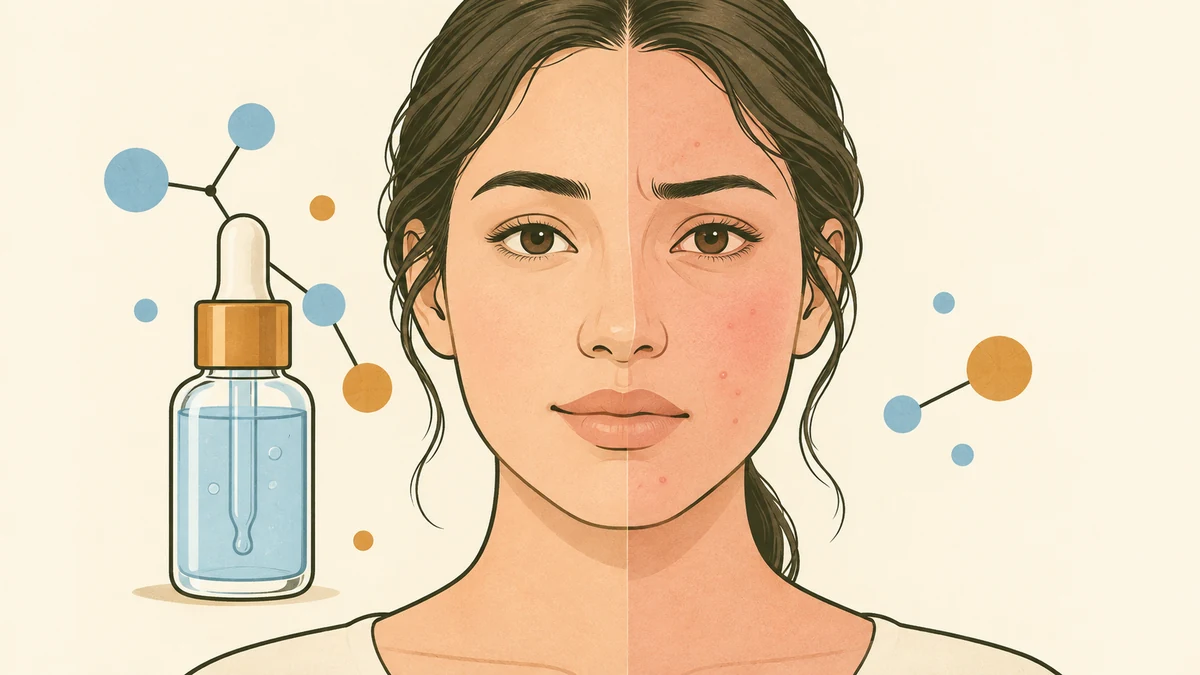
Niacinamide does not have an established "purging" phase. Human studies generally describe topical niacinamide as well tolerated, including formulas containing 2% to 5%. A product that burns, causes persistent redness, or produces an itchy rash should not be treated as proof that it is working. Stop the new product, let your skin settle, and test products one at a time. If you develop swelling, hives, blistering, eye involvement, or trouble breathing, seek medical help.
What does the research actually say about niacinamide?
Niacinamide, also called nicotinamide, is the amide form of vitamin B3. In skin research it has been studied for barrier support, pigmentation, signs of aging, and inflammatory acne. Laboratory and human work suggests that it can support the production of ceramides and other barrier lipids, reduce transepidermal water loss, and improve hydration.12
In a small left-right comparison involving 28 people with atopic dry skin, a moisturizer containing 2% nicotinamide improved hydration and reduced water loss over four or eight weeks. It performed better than white petrolatum on those measured outcomes, although the products were not identical vehicles and the study was small.3
A double-blind trial of 76 people with moderate inflammatory acne compared 4% nicotinamide gel with 1% clindamycin gel for eight weeks. Both groups improved, with no statistically significant difference between them on the reported acne outcomes. This older study supports possible anti-inflammatory benefit, but it does not prove that niacinamide alone can replace a modern acne treatment plan.4
A separate 12-week, split-face trial in 50 women compared a moisturizer containing 5% niacinamide with its control moisturizer. The niacinamide side showed improvements in fine lines, pigmentation spots, texture, red blotchiness, and yellowing, and the researchers described the product as well tolerated.5
Niacinamide has credible evidence at modest concentrations, especially around 2% to 5%. It does not mean every 10% serum is harmful, every 5% product is effective, or every person will tolerate every formula. Results belong to the specific finished products and study populations that were tested.
Can niacinamide cause skin purging?
There is no good clinical evidence that niacinamide creates a predictable purge. The term "purging" is commonly used for an early acne flare after treatments that change follicular cell turnover, especially retinoids and some exfoliating acids. Niacinamide is not an exfoliating acid or a retinoid, and published niacinamide trials do not identify an initial acne purge as a required stage before improvement.14
If new bumps appear after starting a niacinamide serum, the timing is useful evidence that the product may be involved. It does not identify which ingredient caused the problem. The vehicle, emollients, film formers, fragrance, preservatives, another active ingredient, or a change elsewhere in the routine may matter. Acne also fluctuates naturally, so a single flare cannot prove causation.
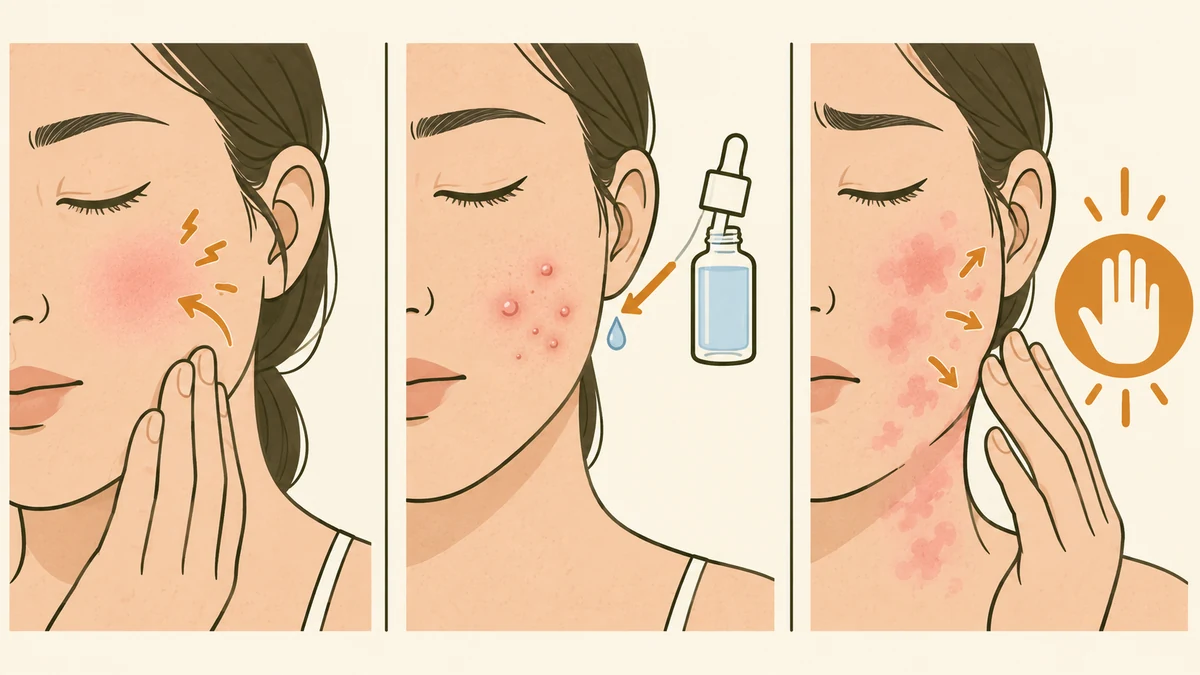
Do not use "purging" to explain away burning, intense itching, swelling, hives, or a spreading rash. Those symptoms fit irritation or contact dermatitis more closely than acne. The American Academy of Dermatology lists burning, stinging, intense itch, swelling, hives, cracking, and blisters among possible signs of contact dermatitis.8
Why can a niacinamide product burn or turn skin red?
1. The complete formula irritates your skin
A serum is a mixture, not a single ingredient test. Solvents, preservatives, fragrance, botanical extracts, acids, and other actives can all change tolerability. The AAD specifically notes that a preservative or another ingredient in a skincare product can trigger allergic contact dermatitis.7 Unless the product is compared with an otherwise identical formula, you cannot know that niacinamide was the culprit.
2. Your barrier is already stressed
Recently irritated skin allows products to feel much harsher. Retinoids, exfoliating acids, benzoyl peroxide, over-cleansing, shaving, sunburn, eczema, and cold dry weather can all contribute to a damaged surface. This is consistent with barrier research showing that the condition of the stratum corneum changes water loss and permeability.2 If water and a plain moisturizer also sting, the bigger problem may be the barrier rather than niacinamide.
3. A high-strength serum adds exposure without proven extra benefit
Most of the better-known facial studies used roughly 2% to 5% niacinamide.35 A 2023 analysis of commercial vitamin B cosmetics found several products around 10%, while noting that the claimed benefits of those high concentrations had not been investigated in the literature it reviewed.6 This does not prove that 10% is unsafe. It means that "twice as much" should not be read as "twice as effective."
4. Niacin and niacinamide are being confused
Niacin, or nicotinic acid, is well known for causing flushing. Niacinamide is a related but different molecule and is not expected to produce the same classic flush under normal cosmetic use. A safety review found no stinging in clinical tests up to 10% niacinamide and no irritation in use tests up to 5%.9 A real reaction is still possible, but redness alone does not prove that niacinamide "turned into niacin" on your face.
5. Irritant or allergic contact dermatitis is possible
Irritant contact dermatitis can appear soon after exposure and often feels burning, stinging, dry, or painful. Allergic contact dermatitis may take hours or days and is often intensely itchy, swollen, or rash-like. The pattern cannot reliably identify the exact ingredient at home. Persistent or recurring reactions may require medical patch testing.810
What do bumps after niacinamide mean?
They do not automatically mean purging, allergy, or pore clogging. A few familiar pimples may be ordinary acne variation. Many small itchy bumps can point toward irritation or another skin condition. Closed comedones that repeatedly return with one finished product suggest that the product is a poor fit, but they still do not identify niacinamide as the cause.
The cosmetic safety review included a four-week test in people prone to comedones. A cream containing 2% niacinamide did not increase microcomedones under the study's occlusive conditions.9 Combined with the acne trial, this argues against calling niacinamide inherently comedogenic.4 It does not guarantee that every serum, cream, or sunscreen containing it will suit acne-prone skin.
| What you notice | What it may suggest | Best next step |
|---|---|---|
| Brief, mild tingling without visible change | Transient sensory irritation | Use less and avoid applying to freshly irritated skin |
| Persistent burning, redness, dryness, or peeling | Irritant reaction or damaged barrier | Stop the product and simplify the routine |
| Intense itch, swelling, hives, or spreading rash | Possible allergic contact dermatitis | Stop and seek medical advice, urgently if severe |
| New whiteheads or inflamed pimples | Finished formula, routine change, or ordinary acne fluctuation | Pause the newest product and observe |
| Nearly every product suddenly stings | Compromised barrier or active dermatitis | Use a bland routine and arrange assessment if it persists |
How to find out whether the product is responsible
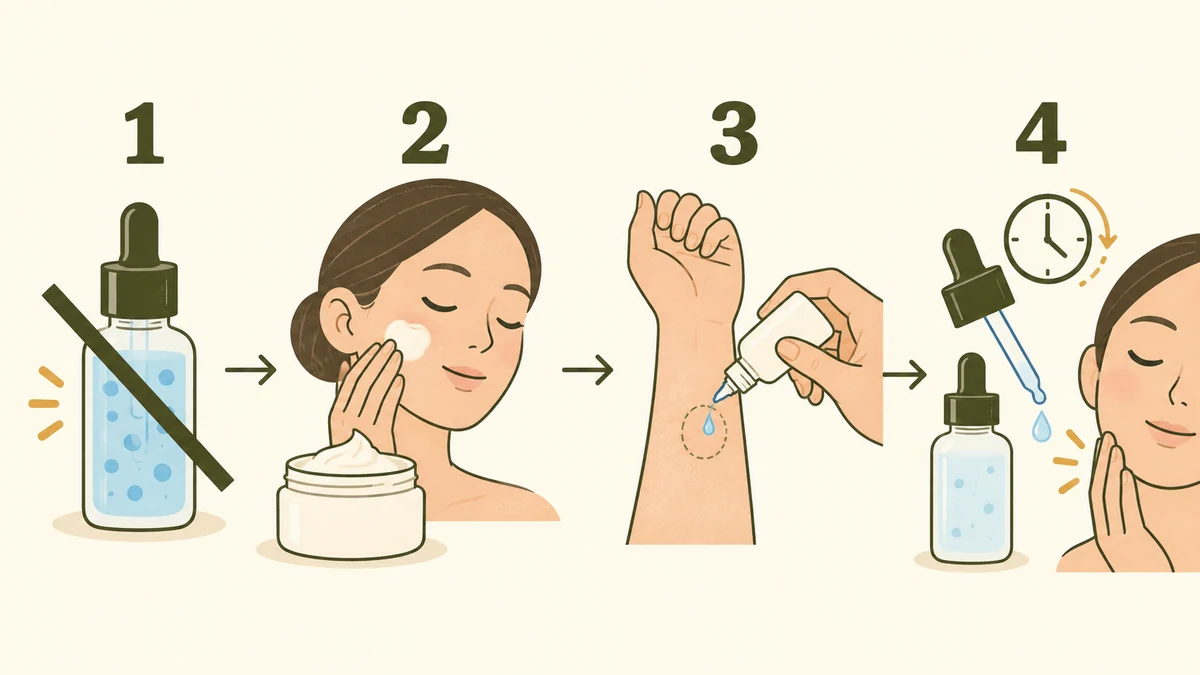
- Stop the newest suspect product. Do not push through ongoing burning or a rash.
- Return to a simple routine. Use a gentle cleanser, a moisturizer you already tolerate, and sunscreen during the day.
- Wait for your skin to return to baseline. Do not test another new active while the reaction is still present.
- Test one product on a small area. The AAD recommends applying a skincare product to a quarter-sized test spot twice daily for seven to ten days.7
- Reintroduce cautiously only if the reaction was mild. A 2% to 5% formula used every other day is a conservative option, but this exact schedule has not been validated as a clinical desensitization protocol.
If the same product recreates the reaction, stop using it. That result tells you the finished product is a poor fit. It still does not prove that niacinamide was the specific trigger. If you react to several unrelated products, a dermatologist can assess for eczema, rosacea, perioral dermatitis, acne, or contact allergy and may recommend formal patch testing.10
Seek urgent medical care for trouble breathing, facial or throat swelling, faintness, or a rapidly worsening widespread reaction. Arrange non-urgent medical assessment for persistent rash, painful cracking, blistering, oozing, eye involvement, or acne that is scarring.
Frequently asked questions
Does niacinamide cause purging?
There is no established clinical niacinamide purge. New bumps may be related to the finished formula, irritation, another routine change, or ordinary acne fluctuation.
Is 10% niacinamide too much?
Not automatically. Safety testing has found niacinamide generally well tolerated, including some testing at 10%. However, much of the benefit evidence uses 2% to 5%, and there is no good reason to assume 10% works twice as well.
Why does niacinamide suddenly burn when it used to be fine?
Your barrier may be more irritated, the product may have been reformulated or degraded, another active may have been added, or you may have developed contact sensitivity. Stop and reassess the whole routine instead of assuming your skin is adjusting.
Can niacinamide cause closed comedones?
Niacinamide itself is not established as comedogenic. A particular finished product can still be unsuitable for you. Track one product at a time rather than blaming an ingredient from the label alone.
Can I use niacinamide again after a reaction?
After a mild reaction has fully settled, you may choose to test a simpler, lower-concentration formula on a small area. Do not deliberately retry after hives, swelling, blistering, or a severe reaction without medical advice.
Continue reading
Sources
- Gehring W. Nicotinic acid/niacinamide and the skin. Journal of Cosmetic Dermatology. 2004;3(2):88-93. PubMed.
- Tanno O, Ota Y, Kitamura N, Katsube T, Inoue S. Nicotinamide increases biosynthesis of ceramides as well as other stratum corneum lipids to improve the epidermal permeability barrier. British Journal of Dermatology. 2000;143(3):524-531. PubMed.
- Soma Y, Kashima M, Imaizumi A, et al. Moisturizing effects of topical nicotinamide on atopic dry skin. International Journal of Dermatology. 2005;44(3):197-202. PubMed.
- Shalita AR, Smith JG, Parish LC, Sofman MS, Chalker DK. Topical nicotinamide compared with clindamycin gel in the treatment of inflammatory acne vulgaris. International Journal of Dermatology. 1995;34(6):434-437. PubMed.
- Bissett DL, Miyamoto K, Sun P, Li J, Berge CA. Topical niacinamide reduces yellowing, wrinkling, red blotchiness, and hyperpigmented spots in aging facial skin. International Journal of Cosmetic Science. 2004;26(5):231-238. PubMed.
- Temova Rakuša Ž, Šenk A, Roškar R. Content and stability of B complex vitamins in commercial cosmetic products. Journal of Cosmetic Dermatology. 2023;22(2):628-636. PubMed.
- American Academy of Dermatology. How to test skin care products. Accessed September 11, 2026. AAD.
- American Academy of Dermatology. Contact dermatitis: Signs and symptoms. Accessed September 11, 2026. AAD.
- Cosmetic Ingredient Review Expert Panel. Final report of the safety assessment of niacinamide and niacin. International Journal of Toxicology. 2005;24(Suppl 5):1-31. PubMed.
- American Academy of Dermatology. Patch testing can find what's causing your rash. Accessed September 11, 2026. AAD.
Medical note: This article is educational and cannot diagnose acne, rosacea, eczema, perioral dermatitis, irritant contact dermatitis, or an allergy. Seek professional care for severe, persistent, or worsening symptoms.
Hot girls read the research. ♡