
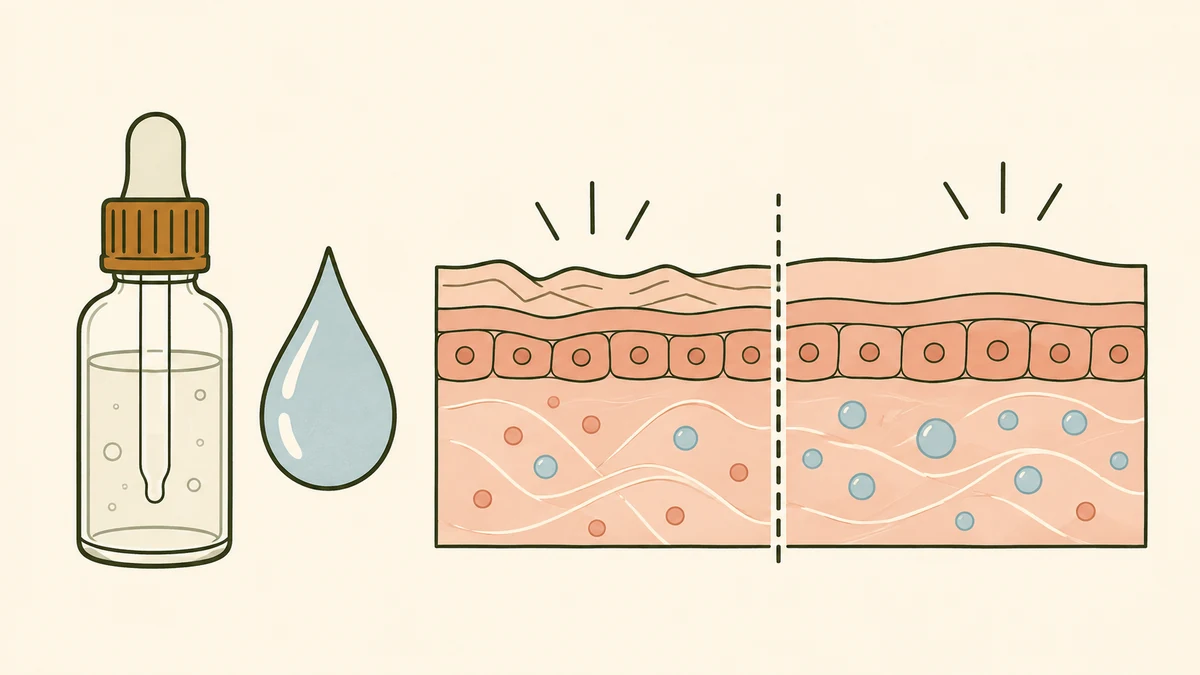
Hyaluronic acid is not expected to dry healthy skin, and human studies generally show improved hydration. If an HA serum makes your skin feel dry or tight, the more likely explanations are a film-forming serum texture, an incomplete routine, an already damaged barrier, or irritation from another ingredient in the formula. Try less serum, apply it to slightly damp skin, and follow with a suitable moisturizer. Stop if the product repeatedly burns, itches, or causes a rash.
Can hyaluronic acid actually dry out your skin?
Topical hyaluronic acid, also called HA, is used as a humectant. It binds water and can help increase water content in the outer skin. Larger forms mostly remain near the surface and form a hydrating film. Smaller forms may reach farther into the epidermis, although penetration and biological effects depend on molecular weight and formulation.1
The best available human evidence does not show that HA routinely dehydrates skin. A 2024 randomized controlled trial in older adults with dry skin found that moisturizers containing both low and high molecular weight HA increased skin hydration. The low molecular weight formula produced a larger hydration increase than the vehicle, and the researchers reported no treatment-related side effects.2
Another controlled trial tested 0.1% sodium hyaluronate creams with different molecular weights. All of the HA formulas improved measured skin hydration and elasticity after 60 days.3 Those studies do not prove that every serum will feel comfortable. They do show why the blanket statement "HA dries your skin" is too simple.
There is good reason to call HA a hydrating ingredient. There is not good human evidence that it pulls so much water out of the skin in dry weather that it becomes a general cause of dehydration. Dry air can worsen dry skin, but that does not prove HA reversed direction and caused it.
Why can an HA serum make skin feel tight?
1. The serum leaves a firm or sticky film
High molecular weight HA is a film former. That surface film can make skin feel smooth and temporarily plump, but some formulas dry down with a tacky or slightly contracted sensation. Sensory tightness is not the same measurement as low skin hydration. If your skin looks comfortable and there is no redness, flaking, or burning, the problem may simply be product feel.
2. A watery serum is not a complete moisturizer
A thin HA serum may provide humectancy without much emollient or occlusive support. Well-designed moisturizers often combine humectants, which attract and hold water, with emollients that smooth rough spaces and occlusives that slow evaporation.4 Dry skin may still need a cream containing ingredients such as dimethicone, petrolatum, squalane, fatty alcohols, ceramides, or other lipids.
3. Your skin barrier was already irritated
Over-cleansing, retinoids, exfoliating acids, benzoyl peroxide, cold weather, low humidity, sunburn, shaving, eczema, and contact dermatitis can all leave skin feeling tight. On a stressed barrier, even a product you once tolerated may sting. HA can be present when the reaction happens without being the ingredient that caused it.
4. Another ingredient is the problem
HA serums are not bottles of pure hyaluronic acid. They also contain solvents, preservatives, texture agents, botanical extracts, fragrance, and sometimes exfoliating or brightening ingredients. A reaction belongs to the finished formula until testing shows otherwise. Burning, itching, swelling, or an eczema-like rash should not be dismissed as normal HA tightness.
5. You are applying more than the formula needs
Several layers of a polymer-rich serum can create a heavy film, increase tackiness, and encourage pilling under moisturizer or sunscreen. More product does not guarantee more hydration. One or two drops may feel better than a full dropper.
| What you notice | More likely explanation | What to try |
|---|---|---|
| Tight but not red or flaky | Film feel or too much serum | Use less or switch to a cream containing HA |
| Dry again within an hour | Not enough emollient or occlusive support | Follow with a richer moisturizer |
| Burning with many products | Compromised barrier | Pause actives and simplify the routine |
| Itchy rash or swelling | Possible irritant or allergic reaction | Stop the formula and seek medical advice if persistent |
| Flakes or rolls under sunscreen | Too many layers or incompatible product films | Use less and allow each layer to settle |
Does hyaluronic acid pull water from your skin in dry air?
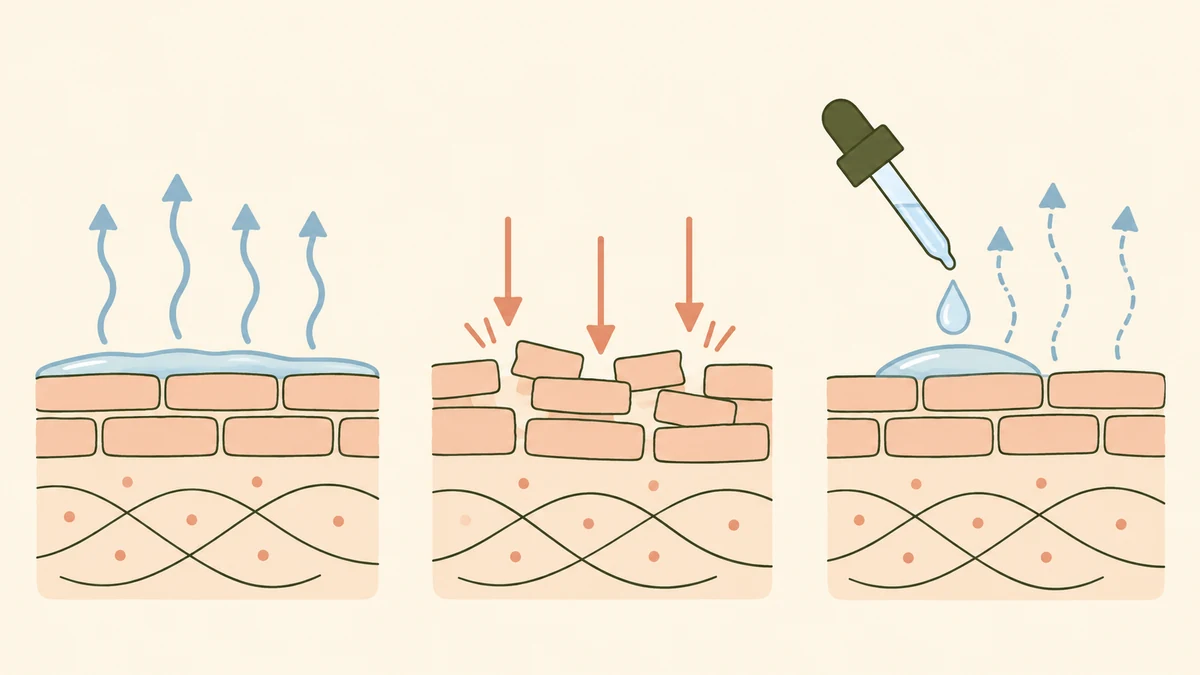
This claim is repeated far more confidently than it has been tested. Humectants can attract water from the deeper epidermis and, when humidity is high, from the surrounding environment. Reviews of moisturizer science often recommend pairing humectants with occlusive ingredients because the combination supports water retention better than either category alone.45
That mechanism is not direct proof that an HA serum steals water, reverses its benefit, or makes every person drier in winter. Clinical studies usually report improved hydration. A more careful conclusion is that low humidity can make skin drier, and a lightweight humectant serum may not be enough to solve that dryness by itself.
You do not need to steam the bathroom or keep misting your face all day. Applying serum to slightly damp skin can feel pleasant, but the useful final step is a moisturizer that suits your skin. Constant misting without a protective layer can become another source of evaporation and routine fuss.
How to use hyaluronic acid without the tight feeling
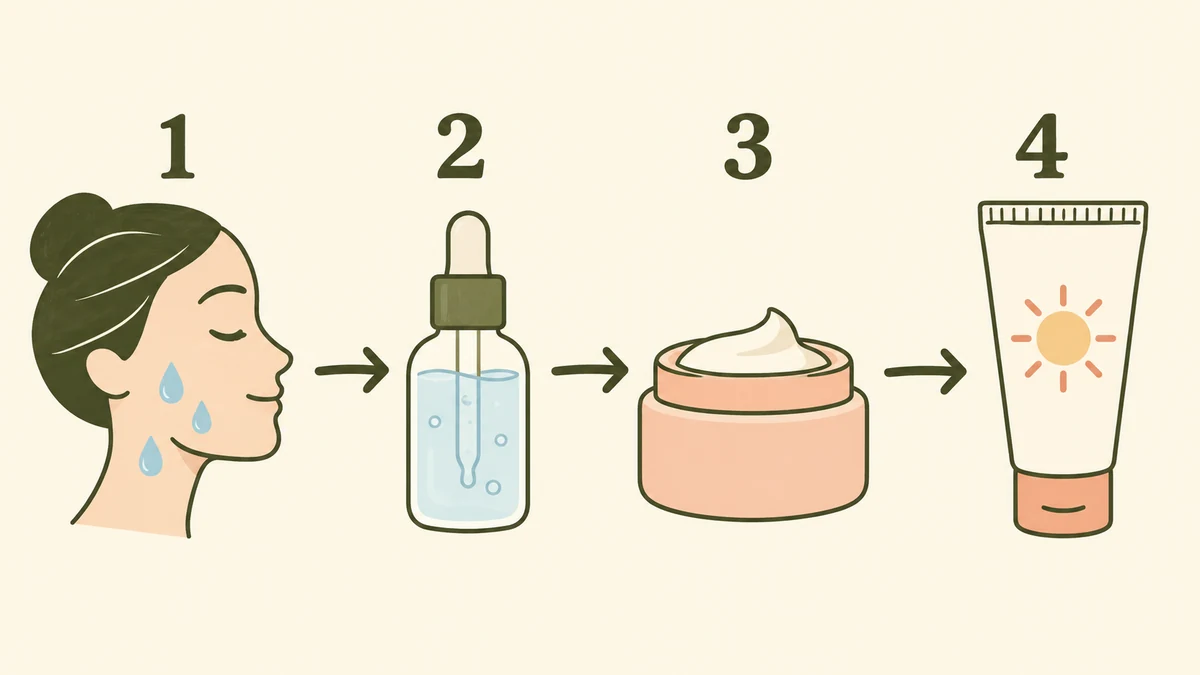
- Cleanse gently. Avoid hot water and harsh scrubbing.
- Leave the skin slightly damp. It should not be dripping wet.
- Apply a small amount of HA serum. More is not automatically better.
- Follow with moisturizer. Use a cream or ointment if your skin is truly dry.
- Add sunscreen in the morning. Let the moisturizer settle before applying the full sunscreen amount.
A useful seven-day test
For one week, keep the rest of your routine stable. Use half as much HA serum and always follow it with moisturizer. If the tightness disappears, the problem was probably amount or routine design. If it remains, stop the serum for another week. Improvement during the break suggests the finished formula is not a good fit, even if HA itself is not the culprit.
If nearly everything stings, move away from ingredient experiments and follow a damaged skin barrier routine. Persistent redness, cracking, rash, or pain deserves medical assessment.
How to choose a better HA product
- Choose a complete moisturizer if you are dry. A cream with humectants, emollients, and occlusives may work better than a separate watery serum.
- Avoid unnecessary fragrance. A short, boring formula is easier to troubleshoot.
- Do not chase the highest percentage. HA can affect texture at low levels, and a bigger number does not guarantee a better result.
- Treat "eight types of HA" as formulation information, not eight proven benefits. Molecular weight can change behavior, but the finished product still needs testing.
- Judge comfort over marketing. A hydrating ingredient is not useful to you if its formula repeatedly burns, pills, or feels unpleasant.
Frequently asked questions
Should I apply hyaluronic acid to wet or dry skin?
Slightly damp skin is a practical choice, especially if the serum feels tight on dry skin. Do not leave it as the final step if your skin needs a cream.
Can I use hyaluronic acid every day?
Yes, if the finished product is comfortable. There is no requirement to use a separate HA serum, since many moisturizers already contain HA or other humectants.
Can hyaluronic acid damage the skin barrier?
Topical HA is not generally considered a barrier-damaging ingredient. A complete formula can still irritate you, and an existing damaged barrier can make almost any product sting.
Is low molecular weight HA irritating?
Different molecular weights can behave differently in laboratory models, but that does not let you predict irritation from an ingredient list alone. Product concentration, purity, vehicle, and your skin all matter.
Why does HA pill under moisturizer or sunscreen?
Polymer-rich layers can roll when too much is applied or when products are rubbed together before setting. Use less serum, press rather than rub, and allow a brief drying period between layers.
Continue reading
Sources
- Bravo B, Correia P, Gonçalves Junior JE, Sant'Anna B, Kerob D. Benefits of topical hyaluronic acid for skin quality and signs of skin aging: From literature review to clinical evidence. Dermatologic Therapy. 2022;35(12):e15903. PubMed Central.
- Muhammad P, et al. Effectiveness of topical hyaluronic acid of different molecular weights in xerosis cutis treatment in elderly: a double-blind, randomized controlled trial. Archives of Dermatological Research. 2024;316(6):329. PubMed.
- Pavicic T, et al. Efficacy of cream-based novel formulations of hyaluronic acid of different molecular weights in anti-wrinkle treatment. Journal of Drugs in Dermatology. 2011;10(9):990-1000. PubMed.
- Purnamawati S, et al. The role of moisturizers in addressing various kinds of dermatitis: a review. Clinical Medicine & Research. 2017;15(3-4):75-87. PubMed Central.
- Del Rosso JQ, et al. Skin 101: Understanding the fundamentals of skin barrier physiology. Journal of Clinical and Aesthetic Dermatology. 2025. PubMed Central.
- American Academy of Dermatology. Dermatologists' top tips for relieving dry skin. Accessed September 8, 2026. AAD.
Medical note: This article is educational and does not diagnose dry skin, eczema, contact dermatitis, or an allergy. Seek medical advice for persistent pain, swelling, blistering, spreading rash, or symptoms near the eyes.
Hot girls read the research. ♡