
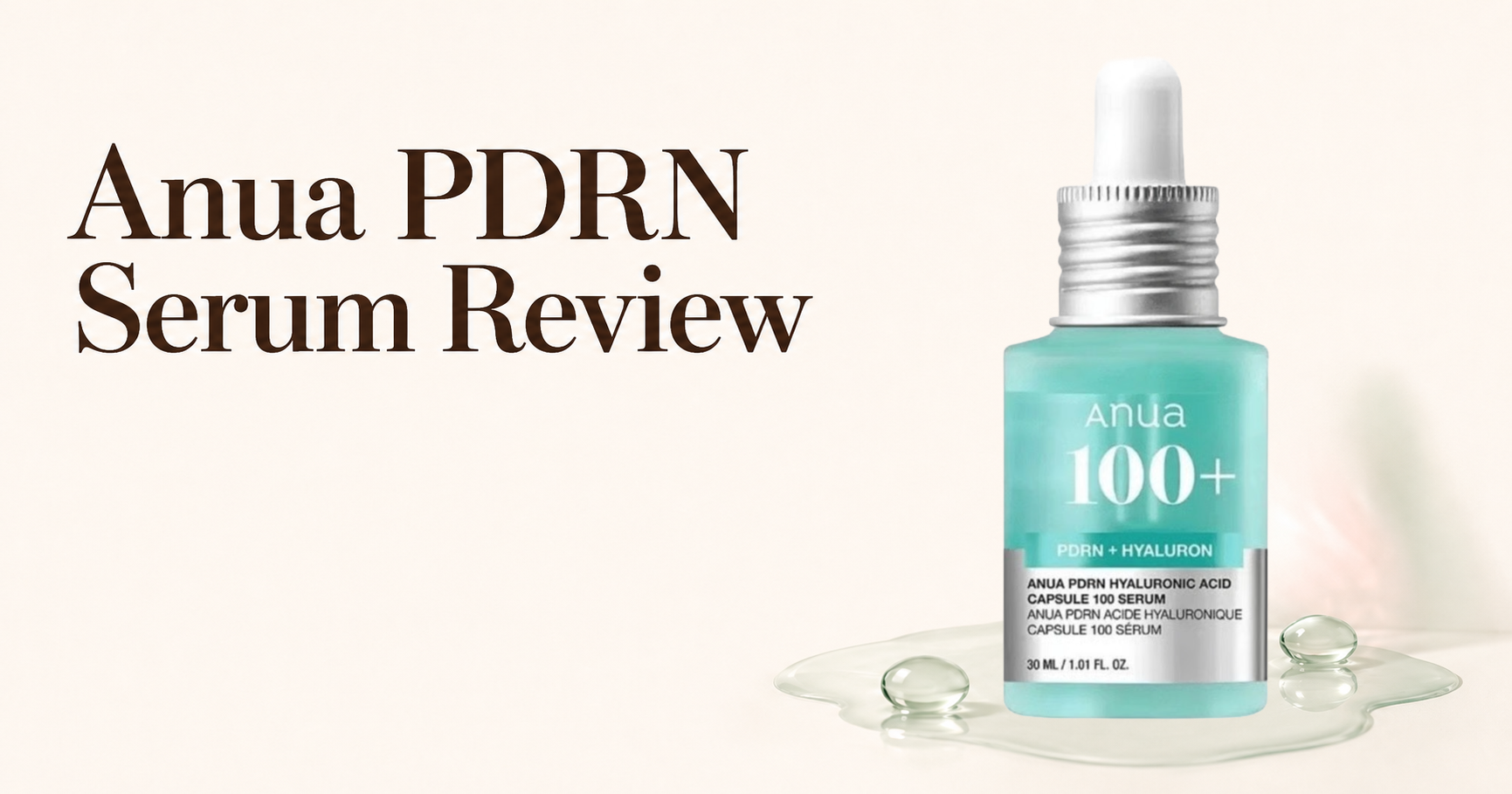
PDRN skincare has become highly visible online. Anua's serum combines salmon-DNA-derived Sodium DNA with several forms of hyaluronic acid, niacinamide, collagen, glutathione and a capsule-delivery system.
The formula is good, but the marketing can make it sound more proven than it is. This review separates what the serum is likely to do from what has not been shown.

Anua PDRN Hyaluronic Acid Capsule 100 Serum is mainly a hydrating serum. It should help dehydrated skin look smoother, plumper and more dewy. The evidence does not show that its topical PDRN rebuilds collagen or works like injected polynucleotides. Buy it for hydration, not regeneration.
Stylish & Healthy Rating
A strong hydrator with an overhyped hero ingredient. The formula is elegant, fragrance-free and easy to layer. It loses points because product-specific evidence for topical PDRN is limited, the capsule data do not prove biologically meaningful PDRN penetration, and several active concentrations are undisclosed.
Table of Contents
What does Anua claim?
Anua describes the serum as a mix of PDRN, hyaluronic acid and collagen for moisture, plumping and glow. The brand says the Sodium DNA is salmon-derived and markets the formula as containing 3% hyaluronic acid.[1][2]
Ulta also lists immediate test results after one use, including an 8.93% improvement in a plumping measurement and a 24.64% improvement in a hydration measurement. Those numbers support short-term cosmetic hydration. They do not prove new collagen, scar repair or deep skin regeneration.[2]
Skin can look smoother because it holds more water. That is useful, but it is not the same as rebuilding the dermis.
What is actually doing the work?
The first ingredients are water, butylene glycol, propanediol, glycerin and hydrolyzed hyaluronic acid. That makes this a humectant serum first. Humectants attract water and help the outer skin look softer and less creased.
| Ingredient group | What it probably does | What to know |
|---|---|---|
| Glycerin and glycols | Bind water and improve slip | These ingredients explain much of the immediate hydration.[12] |
| Eight forms of hyaluronic acid | Hydrate and form water-holding films | Different forms can behave differently, but eight names do not mean eight separate clinical benefits.[8][9] |
| Niacinamide | May support the barrier and even-looking tone | Anua does not disclose the percentage, so we cannot assume it is present at a studied 2% to 5% level.[3][10][11] |
| Collagen, glutathione and adenosine | Supporting conditioning or appearance roles | The concentrations are not disclosed, and Anua has not published long-term product-specific trials. |
| Sodium DNA, marketed as PDRN | The product's headline ingredient | Anua has reported 100 ppm, or 0.01%, through an official retailer Q&A.[2] |
Ulta markets 3% hyaluronic acid, but the public information does not explain exactly how that number was calculated. It cannot be used to work out the amount of pure dry HA polymer in the bottle.[2]
What does the PDRN evidence really say?
PDRN is made from DNA fragments. Medical research has explored pharmaceutical PDRN for wound healing and tissue repair. Much of that evidence involves injections, eye drops, wound dressings or damaged tissue, not a cosmetic serum placed on intact facial skin.[4][5]
That difference matters because a substance can behave very differently when injected than when placed on top of the skin. The outer barrier is designed to keep large molecules out. The well-known 500 Dalton rule is only a guideline, not a perfect law, but it explains why penetration claims need direct testing rather than assumptions.[6]
What about topical PDRN studies?
A small study published online in December 2025 tested a special low-molecular-weight PDRN cream made from peony. It used 1% PDRN in only ten people for four weeks. The treated area improved from its own starting point, but the study did not clearly prove a statistically significant elasticity advantage over the control area. All six authors worked for the company connected to the tested material.[7]
That study is interesting, but it is not evidence for Anua. It tested a different source, a specially engineered material and 1% PDRN, which is 100 times the 0.01% Anua has disclosed. However, no established minimum effective concentration exists for topical PDRN in this type of serum.
The biology is promising. The evidence for meaningful regeneration from this exact serum is not.
Does the capsule technology matter?
Ulta reports a separate capsule-versus-control comparison in which the capsule version produced modestly higher absorption measurements after 30 minutes. The retailer also states that the measured penetration remained limited to the stratum corneum, the outer skin layer.[2]
These capsule-versus-control results should be kept separate from the finished-product hydration and plumping measurements. The capsule comparison supports modest differences in measured outer-layer absorption. It does not establish that the capsule technology caused the separate hydration or plumping improvements.
Ulta states that the capsule system includes PDRN, hyaluronic acid and collagen. However, the public data do not provide PDRN-specific penetration measurements, capsule characterisation or evidence that intact PDRN reaches living epidermal or dermal cells in a clinically meaningful amount.
Who should use it?
Dehydrated skin: The formula should make tight or dull skin feel more comfortable.
Oily or combination skin: It adds water without feeling like a heavy cream.
Retinoid users: It can be a simple hydration layer around stronger products.
Acne-prone skin: It is fragrance-free and brand-tested as non-comedogenic, but no product guarantees zero breakouts.
Very reactive skin: Fragrance-free does not mean irritation-proof. Patch test if you have eczema, rosacea or frequent reactions.
Proven collagen remodeling: Sunscreen and retinoids have much stronger evidence.
What about fish allergy?
Anua says the Sodium DNA is salmon-derived but does not publish product-specific residual-protein or allergen testing. Recognised fish allergens are proteins, especially parvalbumins, rather than DNA. That does not prove the serum is unsafe, but it also means safety cannot be promised for someone with a severe fish allergy. Contact the manufacturer or an allergist before use.[14]
Other important cautions
The formula contains lauryl glucoside and myristyl glucoside. These can cause allergic contact dermatitis in some people, especially those with a known alkyl-glucoside allergy.[13] The serum is also not sold as a sterile microneedling product. Do not needle it into the skin or apply it to open wounds.
How to use it
- Apply a few drops after cleansing.
- Use it on slightly damp or dry skin.
- Follow with moisturizer if your skin is dry.
- Use sunscreen every morning.
- Start once daily if your skin is reactive.
Nothing in the published ingredient list creates an obvious standard incompatibility with retinoids, vitamin C, azelaic acid, exfoliating acids, peptides or benzoyl peroxide. Tolerability still depends on the full routine, so introduce one new active at a time.
Is it worth the money?
At the prices checked on July 4, 2026, the serum cost $30 on Anua and had a $28 Ulta list price. That is reasonable for a polished Korean serum, but expensive if you only need basic hydration. Simpler glycerin and hyaluronic acid serums can perform the same core job for less.[1][2]
Frequently asked questions
How much PDRN is in it?
Anua has reported 100 ppm through an official retailer Q&A. That equals 0.01%. This is a brand disclosure, not an independent laboratory result.
What does “Capsule 100” mean?
Anua does not clearly explain what the number 100 means. It does not mean 100% PDRN.
Does it contain salmon sperm?
Anua describes the ingredient as salmon-DNA-derived Sodium DNA. It does not publish enough sourcing detail to confirm the original tissue source. The finished serum does not contain raw reproductive material.
Can someone with a fish allergy use it?
Caution is reasonable. Recognised fish allergens are proteins, especially parvalbumins, rather than DNA. However, Anua does not publish product-specific residual-protein or allergen testing, so the serum cannot be promised safe for someone with a severe fish allergy. Contact the manufacturer or an allergist before use.[14]
Will it remove wrinkles?
It may temporarily soften dehydration lines by holding more water in the outer skin. There is no long-term product trial proving wrinkle remodeling.
Can I use it with retinol?
Yes. It works well as a hydrating layer. Reduce frequency if the total routine causes stinging or peeling.
Is it good for acne-prone skin?
It may be. The formula is lightweight and fragrance-free, but patch test and stop if breakouts clearly increase.
Is it better than a normal HA serum?
It is more complex, but no public head-to-head trial proves better long-term results. A simpler serum may be enough for basic hydration.
References
- Anua. (n.d.). PDRN Hyaluronic Acid Capsule 100 Serum. Retrieved July 7, 2026, from https://anua.com/products/pdrn-hyaluronic-acid-capsule-100-serum
- Ulta Beauty. (n.d.). Anua PDRN Hyaluronic Acid Capsule 100 Serum. Retrieved July 7, 2026, from https://www.ulta.com/p/pdrn-hyaluronic-acid-capsule-100-serum-pimprod2051435
- U.S. Food and Drug Administration. (2025, November 18). Summary of cosmetics labeling requirements. https://www.fda.gov/cosmetics/cosmetics-labeling-regulations/summary-cosmetics-labeling-requirements
- Squadrito, F., Bitto, A., Irrera, N., Pizzino, G., Pallio, G., Minutoli, L., & Altavilla, D. (2017). Pharmacological activity and clinical use of PDRN. Frontiers in Pharmacology, 8, Article 224. https://doi.org/10.3389/fphar.2017.00224
- Galeano, M., Pallio, G., Irrera, N., Mannino, F., Bitto, A., Altavilla, D., Vaccaro, M., Squadrito, G., Arcoraci, V., Colonna, M. R., Lauro, R., & Squadrito, F. (2021). Polydeoxyribonucleotide: A promising biological platform to accelerate impaired skin wound healing. Pharmaceuticals, 14(11), Article 1103. https://doi.org/10.3390/ph14111103
- Bos, J. D., & Meinardi, M. M. H. M. (2000). The 500 Dalton rule for the skin penetration of chemical compounds and drugs. Experimental Dermatology, 9(3), 165–169. https://doi.org/10.1034/j.1600-0625.2000.009003165.x
- Bak, S.-U., Jung, M. S., Kim, D. J., Jin, H. U., Lee, S. Y., & An, C. E. (2026). Anti-aging efficacy of low-molecular-weight polydeoxyribonucleotide derived from Paeonia lactiflora. International Journal of Molecular Sciences, 27(1), Article 220. https://doi.org/10.3390/ijms27010220
- Pavicic, T., Gauglitz, G. G., Lersch, P., Schwach-Abdellaoui, K., Malle, B., Korting, H. C., & Farwick, M. (2011). Efficacy of cream-based novel formulations of hyaluronic acid of different molecular weights in anti-wrinkle treatment. Journal of Drugs in Dermatology, 10(9), 990–1000. https://pubmed.ncbi.nlm.nih.gov/22052267/
- Essendoubi, M., Gobinet, C., Reynaud, R., Angiboust, J.-F., Manfait, M., & Piot, O. (2016). Human skin penetration of hyaluronic acid of different molecular weights as probed by Raman spectroscopy. Skin Research and Technology, 22(1), 55–62. https://doi.org/10.1111/srt.12228
- Tanno, O., Ota, Y., Kitamura, N., Katsube, T., & Inoue, S. (2000). Nicotinamide increases biosynthesis of ceramides as well as other stratum corneum lipids to improve the epidermal permeability barrier. British Journal of Dermatology, 143(3), 524–531. https://doi.org/10.1111/j.1365-2133.2000.03705.x
- Bissett, D. L., Oblong, J. E., & Berge, C. A. (2005). Niacinamide: A B vitamin that improves aging facial skin appearance. Dermatologic Surgery, 31(7, Part 2), 860–865. https://doi.org/10.1111/j.1524-4725.2005.31732
- Fluhr, J. W., Darlenski, R., & Surber, C. (2008). Glycerol and the skin: Holistic approach to its origin and functions. British Journal of Dermatology, 159(1), 23–34. https://doi.org/10.1111/j.1365-2133.2008.08643.x
- Fiume, M. M., Heldreth, B., Bergfeld, W. F., Belsito, D. V., Hill, R. A., Klaassen, C. D., Liebler, D., Marks, J. G., Jr., Shank, R. C., Slaga, T. J., Snyder, P. W., & Andersen, F. A. (2013). Safety assessment of decyl glucoside and other alkyl glucosides as used in cosmetics. International Journal of Toxicology, 32(5 Suppl.), 22S–48S. https://doi.org/10.1177/1091581813497764
- Ruethers, T., Taki, A. C., Johnston, E. B., Nugraha, R., Le, T. T. K., Kalic, T., McLean, T. R., Kamath, S. D., & Lopata, A. L. (2018). Seafood allergy: A comprehensive review of fish and shellfish allergens. Molecular Immunology, 100, 28–57. https://doi.org/10.1016/j.molimm.2018.04.008
Medical disclaimer: This article is for educational purposes and is not medical advice. Patch test new cosmetics if your skin is reactive. Seek medical assessment for persistent rash, facial swelling, severe allergy symptoms or a suspected skin condition.
Hot girls read the research.