
Yes, sunscreen can replace moisturizer for some people in the morning. If your sunscreen feels comfortable at the full amount, leaves no tightness or flaking, and works with your skin, a separate moisturizer is optional. Use both when your skin is dry, irritated, eczema-prone, sensitized by treatment, or uncomfortable before midday. The shortcut is only successful if you do not use less sunscreen to make it feel lighter.14
Moisturizer and Sunscreen Have Different Main Jobs
A moisturizer is designed to improve how the outer skin layer holds and handles water. Humectants attract water, emollients smooth gaps between surface cells, and occlusives slow water loss. Reviews of skin-barrier science find that moisturizers can improve hydration and transepidermal water loss, although results vary by formula and skin condition.13
A sunscreen is designed and labeled to protect against ultraviolet radiation. Its UV filters must be delivered in a sufficiently even film. The lotion, cream, gel or fluid around those filters may also be moisturizing, but that is a secondary formula property rather than the meaning of SPF.27
| Product | Main promise | Can moisturize? | How to use it |
|---|---|---|---|
| Dedicated sunscreen | UV protection | Often, depending on vehicle | Use the full labeled amount |
| Moisturizing sunscreen | UV protection plus cosmetic comfort | Often enough for oily or comfortable skin | Still treat it as sunscreen |
| Moisturizer with SPF | Moisturization plus labeled UV protection | Yes | Apply like sunscreen, not like a tiny dab of cream |
| Plain moisturizer | Hydration and barrier support | Yes | It does not replace sunscreen unless it carries a tested SPF claim |
What Has the Research Actually Tested?
There is no universal clinical trial that can sort everyone into “needs moisturizer” or “does not.” The useful evidence comes from separate questions about barrier care, layering, coverage and sunscreen amount.
Layering did not visibly reduce UV absorption
A UV-reflectance study tested six sunscreens with several moisturizing creams applied shortly before or after them. It found no significant reflectance difference from adding moisturizer. That is reassuring for layering, but UV photography is a surrogate and the study did not prove every product pairing preserves clinical SPF.5
People missed more face with SPF moisturizer
Participants left 16.6% of the face uncovered with SPF moisturizer versus 11.1% with sunscreen, mostly because of the eyelid area. This shows an application-behavior problem, not that SPF moisturizers are chemically weaker when used correctly.6
Using less sharply lowers protection
SPF is tested at 2 mg/cm². In one study, practical use averaged about 1 mg/cm², and measured protection fell as application thickness fell. The answer to a rich texture is a better formula, not half the dose.7
Who Can Try Sunscreen Alone?
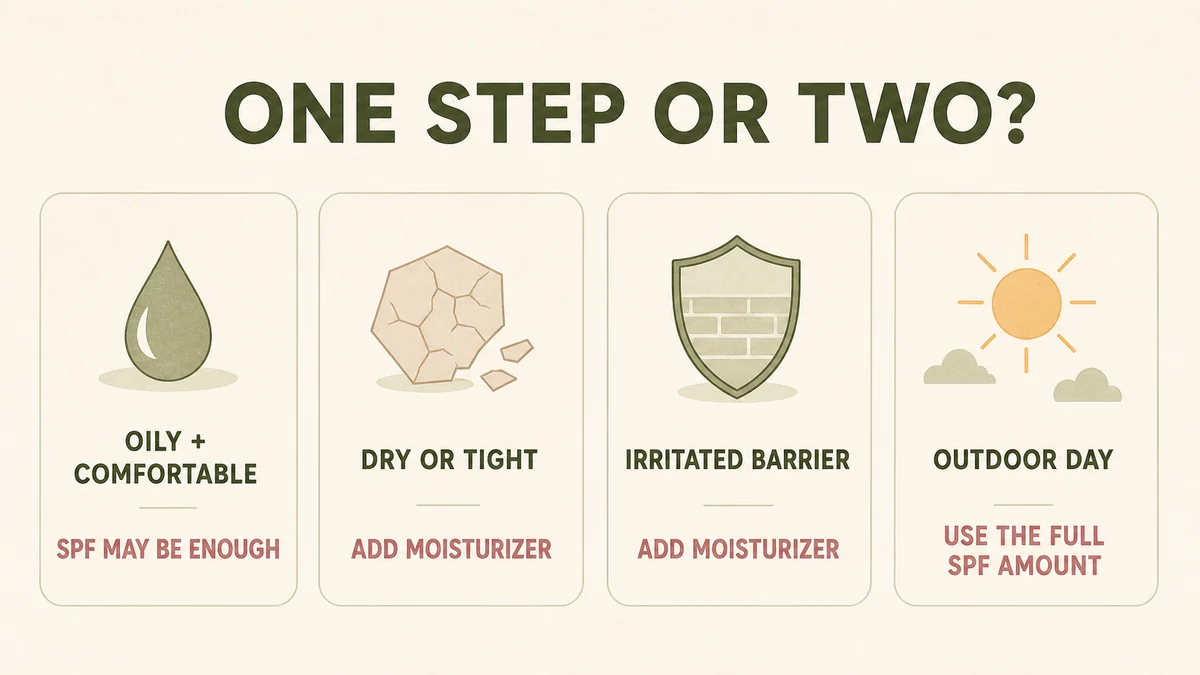
| Your situation | Best starting point | What to watch |
|---|---|---|
| Oily and comfortable | Try a moisturizing sunscreen alone | Tightness can hide underneath surface shine |
| Normal or combination | Either approach can work | Use moisturizer only where needed if that layers well |
| Dry, flaky or tight | Use moisturizer before sunscreen | Choose a cream or ointment appropriate for your skin |
| Irritated or over-exfoliated | Simplify and add gentle barrier support | Persistent burning or rash needs professional advice |
| Using a retinoid or drying acne treatment | Usually keep moisturizer | Your needs can change as treatment changes |
| Hot, humid weather | A lighter one-step routine may feel better | Sweat still triggers label-directed reapplication |
| Cold, windy or low-humidity weather | Two layers are often more comfortable | Reassess seasonally rather than forcing one rule year-round |
| Eczema or diagnosed barrier disorder | Follow your treatment plan | A cosmetically moisturizing SPF may not replace therapeutic emollient care |
Oiliness answers “how much sebum is on my skin?” It does not answer “is my barrier comfortable and hydrated?” If your face is shiny but also tight, flaky or stingy, read the oily-but-dehydrated skin guide before automatically removing moisturizer.
How to Tell Whether a Sunscreen Is Moisturizing Enough
The ingredient list can give clues, not a verdict. Humectants such as glycerin, propanediol, hyaluronic acid, urea or panthenol may support water retention. Emollients, fatty alcohols, silicones, oils and esters can improve softness and reduce rough feel. Ceramides and related lipids may be useful in some barrier-focused formulas.
But ingredient presence does not reveal concentration, film structure, finish or how the whole product behaves on your face. A long “hydrating ingredients” list can still feel tight. A simple sunscreen can feel beautifully emollient. Judge the completed formula at the amount you actually need.
The Five-Morning Test
- Start with calm skin. Do not run the test during a fresh rash, sunburn or major treatment reaction.
- Apply your usual treatment steps. Keep the rest of the routine stable so the comparison means something.
- Skip moisturizer and apply the full sunscreen amount. Spread it evenly across every exposed area instead of stopping when the texture begins to feel rich.
- Check after 15 minutes and again around midday. Note tightness, flaking, burning, excess grease, pilling and how makeup sits.
- Add moisturizer back if comfort worsens. If both layers pill, adjust the pairing or technique with our sunscreen-pilling guide.
If sunscreen alone feels equally comfortable for five ordinary mornings, the separate moisturizer probably is not essential for that routine. This is a comfort-and-barrier test, not a medical diagnostic test.
Correct Morning Order When You Use Both
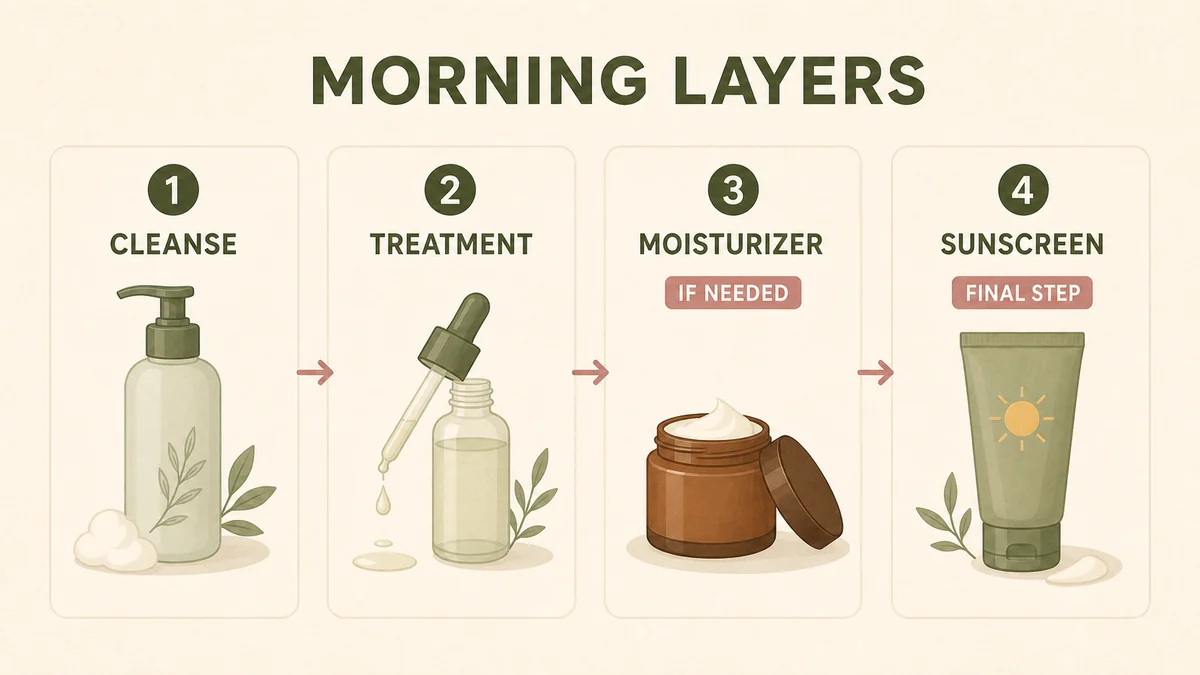
- Cleanse as needed. A gentle rinse may be enough for some skin in the morning.
- Apply treatment products. Follow prescription and product directions rather than inventing a universal wait time.
- Apply moisturizer if your skin needs it. Give the layer time to settle enough that the next product can spread evenly.
- Apply sunscreen last. FDA labeling directs generous, even application 15 minutes before sun exposure and reapplication at least every two hours, with extra directions after swimming, sweating or towel drying.2
A small human reflectance study suggests moisturizer used shortly before or after sunscreen did not meaningfully change UV absorption for the products tested.5 In practice, sunscreen last is still the simplest way to avoid disturbing its final film with another cream.
Five Mistakes That Can Turn a Smart Shortcut Into Underprotection
Using less because it feels heavy
This is the biggest problem. Find a sunscreen you can apply generously rather than shrinking the amount.7
Treating SPF moisturizer like a tiny dab
The protection only covers the skin you actually coat. Pay attention to hairline, ears, neck and the eye area that the product label allows.
Mixing products in your palm
The improvised mixture is not the finished sunscreen that was tested. Layering keeps the sunscreen amount easier to judge.
Ignoring changing skin
Weather, retinoids, acne treatments and illness can change comfort. A one-step summer routine may need two steps in winter.
Calling persistent burning “adjustment”
Wash off a product that causes marked burning, swelling or rash. Review likely causes in the moisturizer-burning guide and seek care for severe or persistent reactions.
Sunscreen can replace moisturizer when the full sunscreen amount leaves your skin comfortable. It is a practical routine choice, not a rule for every face. Keep a separate moisturizer when you are dry, tight, flaky, irritated or following a barrier-care plan. Whatever you choose, do not let simplification quietly become underapplication.
Frequently Asked Questions
Can sunscreen replace moisturizer?
Yes, for some people. If the full sunscreen amount leaves your skin comfortable without tightness, flaking or irritation, a separate morning moisturizer is optional. Dry, irritated or treatment-sensitized skin often benefits from both.
Can oily skin skip moisturizer and use sunscreen?
Often, yes. A moisturizing lotion or cream sunscreen may be enough. However, oily skin can still be dehydrated, so judge tightness and flaking as well as shine.
Should moisturizer go before or after sunscreen?
Apply moisturizer first and sunscreen as the final skincare step. Let the moisturizer settle enough for sunscreen to spread into an even film.
Is moisturizer with SPF the same as sunscreen?
For UV protection, treat a product carrying an SPF claim as sunscreen and follow its directions. The word “moisturizer” does not mean a small dab provides full labeled protection.
Can I mix moisturizer with sunscreen?
Layer them instead. The mixture in your palm has not been tested as the labeled sunscreen, and it makes the final sunscreen amount harder to judge.
How do I know sunscreen alone is not moisturizing enough?
Tightness, roughness, flaking, persistent stinging or makeup catching on dry patches are signs to add moisturizer or choose a more emollient sunscreen.
Do I need moisturizer under a moisturizing sunscreen in winter?
You may. Cold, wind and low humidity can increase dryness, so a routine that works in summer may need a separate moisturizer in winter.
Can a hydrating serum replace moisturizer under sunscreen?
Sometimes on comfortable oily skin, but a serum and moisturizer are not automatically equivalent. If the serum plus sunscreen leaves tightness or flaking, add a moisturizer that better reduces water loss.
References
Official guidanceHuman studyReview The direct yes-or-no question has limited research, so tested findings and practical inference are labeled separately.
- Rajkumar J, Chandan N, Lio P, Shi V. The skin barrier and moisturization: function, disruption, and mechanisms of repair. Skin Pharmacol Physiol. 2023;36(4):174-185. doi:10.1159/000534136. PubMed.
- U.S. Food and Drug Administration. Labeling and effectiveness testing: sunscreen drug products for over-the-counter human use. FDA.
- Rawlings AV, Canestrari DA, Dobkowski B. Moisturizer technology versus clinical performance. Dermatol Ther. 2004;17 Suppl 1:49-56. doi:10.1111/j.1396-0296.2004.04s1006.x. PubMed.
- American Academy of Dermatology. Sunscreen FAQs. AAD.
- Gálvez MVD, Aguilera J, Leal M, Sánchez-Roldán C, Herrera-Ceballos E. Sunscreens effectiveness are not altered by concomitant use of moisturizing creams: an ultraviolet reflectance photography study. Photodermatol Photoimmunol Photomed. 2022;38(3):250-258. doi:10.1111/phpp.12745. PubMed.
- Lourenco EAJ, Shaw L, Pratt H, et al. Application of SPF moisturisers is inferior to sunscreens in coverage of facial and eyelid regions. PLoS One. 2019;14(4):e0212548. doi:10.1371/journal.pone.0212548. PubMed.
- Teramura T, Mizuno M, Asano H, Naito N, Arakane K, Miyachi Y. Relationship between sun-protection factor and application thickness in high-performance sunscreen. Clin Exp Dermatol. 2012;37(8):904-908. doi:10.1111/j.1365-2230.2012.04388.x. PubMed.
- Hebert AA, Rippke F, Weber TM, Nicol NH. Efficacy of nonprescription moisturizers for atopic dermatitis: an updated review of clinical evidence. Am J Clin Dermatol. 2020;21(5):641-655. PubMed.
Medical note: This guide is general skincare education. Eczema, persistent burning, swelling, cracked skin or a worsening rash deserve individualized medical advice.
Keep the step you need. Keep the SPF amount. ♡