
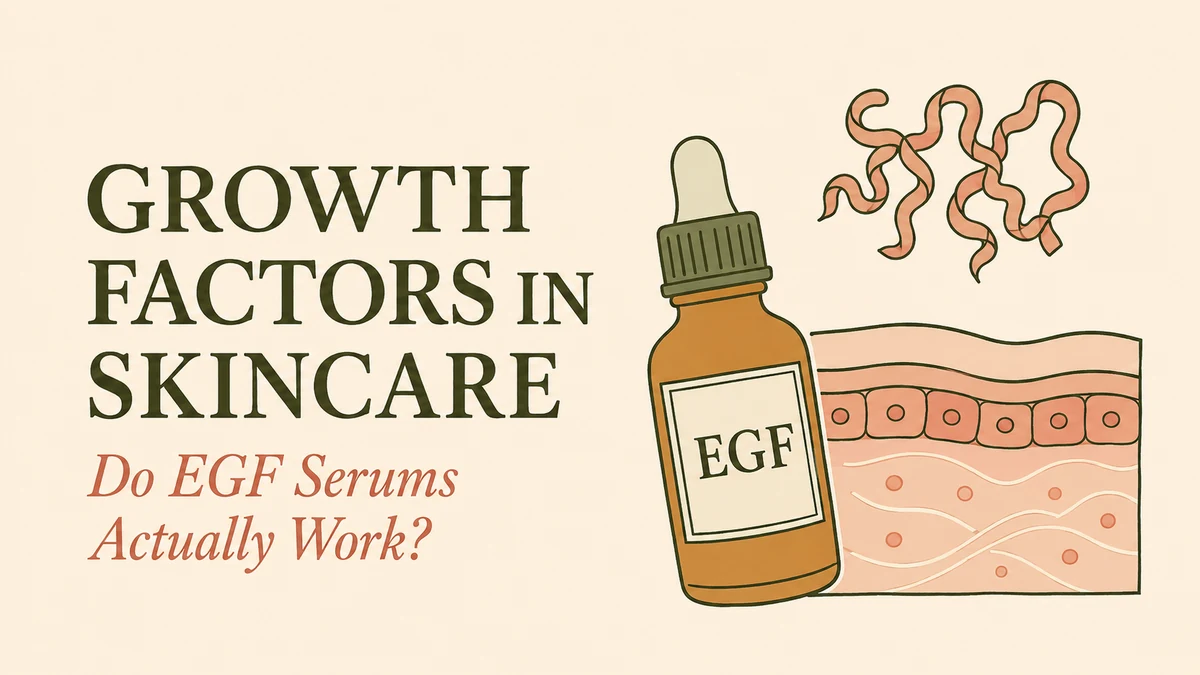
Growth factor serums may modestly improve the appearance of fine lines, texture, and overall photoaged skin after consistent use. The evidence is promising, not definitive. A 2023 systematic review found positive changes across many studies, but products, growth-factor sources, extra ingredients, controls, and outcome measures varied widely. The best question is not whether growth factors work as one category. It is whether a specific finished formula has credible human testing.
What are growth factors in skincare?
Growth factors are signaling proteins made by the body. They bind to specific receptors and help coordinate processes such as cell growth, migration, differentiation, wound repair, and production of extracellular-matrix components. That biology is established. The harder question is whether proteins placed on intact facial skin can remain active, reach useful targets, and create visible cosmetic improvement.
Epidermal growth factor, usually shortened to EGF, is the name most shoppers recognize. A product may also discuss fibroblast growth factor, transforming growth factor beta, platelet-derived growth factor, vascular endothelial growth factor, cytokines, or a conditioned-media blend. These are not interchangeable ingredients. They have different targets, sources, sizes, stability needs, and supporting evidence.
Is EGF the same as a peptide?
EGF is a protein made from a chain of amino acids, so it belongs to the broad peptide and protein family. In skincare shopping, however, "peptides" usually means much smaller cosmetic peptides. Smaller peptides can be easier to formulate and deliver than full growth-factor proteins. A peptide moisturizer and a growth-factor serum should not be treated as identical simply because both contain amino-acid chains.
| Label term | What it usually means | Main question to ask |
|---|---|---|
| EGF or rhEGF | Epidermal growth factor, sometimes produced through recombinant biotechnology | Was the finished formula tested on people? |
| Conditioned media | A complex mixture collected from cultured cells, which may include several proteins and cytokines | What is the source, purification process, and batch standard? |
| Growth-factor complex | A brand-specific blend that may contain several signaling materials | Which factors are present and at what active level? |
| Plant-derived growth factor | A loose marketing term that may describe a plant extract or a bioengineered human-identical protein | What is the exact INCI name and mechanism? |
Do growth factor serums actually work?
The most useful overview is a 2023 systematic review of topical growth-factor preparations for facial rejuvenation. It included 33 studies, 9 randomized controlled trials, 1,180 participants, and 23 different preparations. Products were usually applied twice daily for about three months.1
Investigators reported modest improvement from baseline. The median improvement was below 50% for texture, below 35% for fine lines and wrinkles, and below 20% for overall facial appearance. Participants often rated their results more generously than investigators did. Three comparative randomized trials found no statistically significant difference between the treatments being compared.1
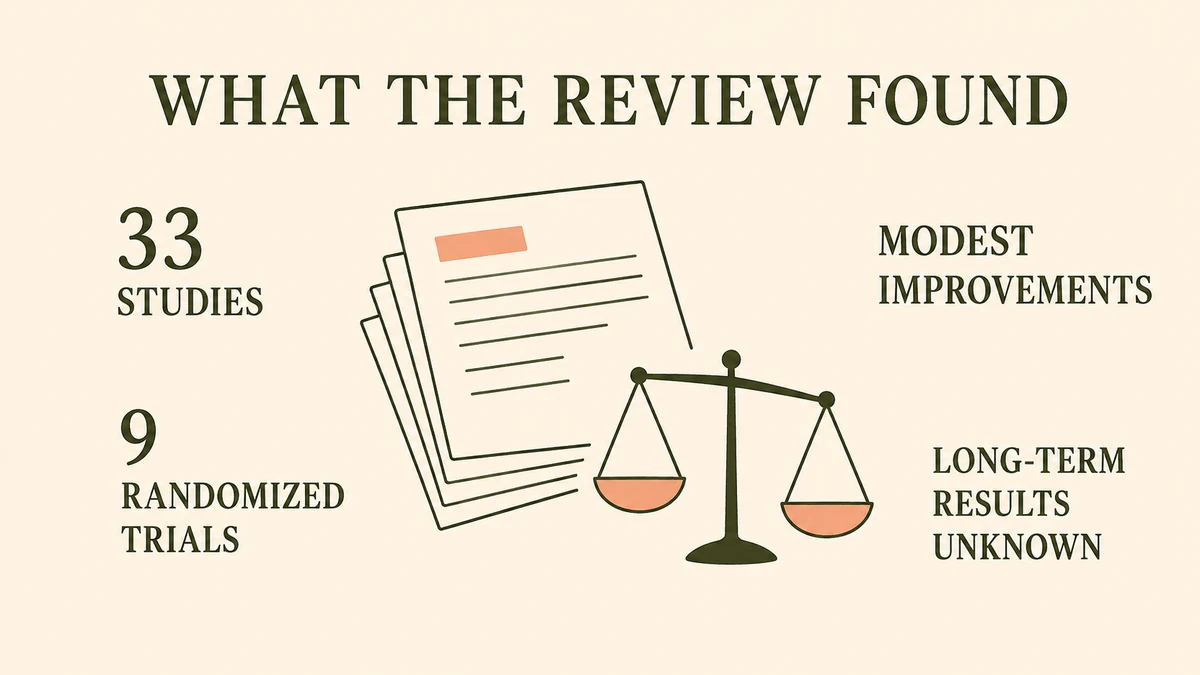
This is enough evidence to call topical growth factors plausible. It is not enough to promise dramatic lifting, deep wrinkle removal, or results equal to a prescription retinoid or procedure. Many studies were uncontrolled, small, short, or connected to a manufacturer. Because formulas included other ingredients, improvement cannot always be assigned to the growth factors alone.
What did controlled product studies find?
A small randomized, double-blind, split-face trial followed 20 people for three months and compared two human-derived growth-factor formulations. Both sides improved from baseline, but investigators and participants found no meaningful difference between the two formulas. The study was funded by a manufacturer, which does not invalidate the result but should be considered when judging certainty.2
A 2026 randomized pilot study compared recombinant EGF with a human-derived formulation in 20 women. Investigator ratings favored recombinant EGF for selected texture and firmness outcomes, while global wrinkle scores changed little. The authors described the perception findings as exploratory.3 Again, that tells us about two specific formulas in a small group, not every serum with EGF on the label.
The most defensible claim is that some well-formulated growth-factor products may produce gradual, modest improvements in texture, fine lines, and overall appearance over roughly three months. Claims about rebuilding the face, replacing retinoids, or creating procedure-level regeneration go beyond the evidence.
The delivery problem matters as much as the ingredient
Skin is designed to keep large materials out. A frequently used rule of thumb is that molecules above roughly 500 daltons have difficulty crossing an intact stratum corneum. Growth factors are much larger proteins. EGF is approximately 6,000 daltons, while some other growth factors are larger still.4
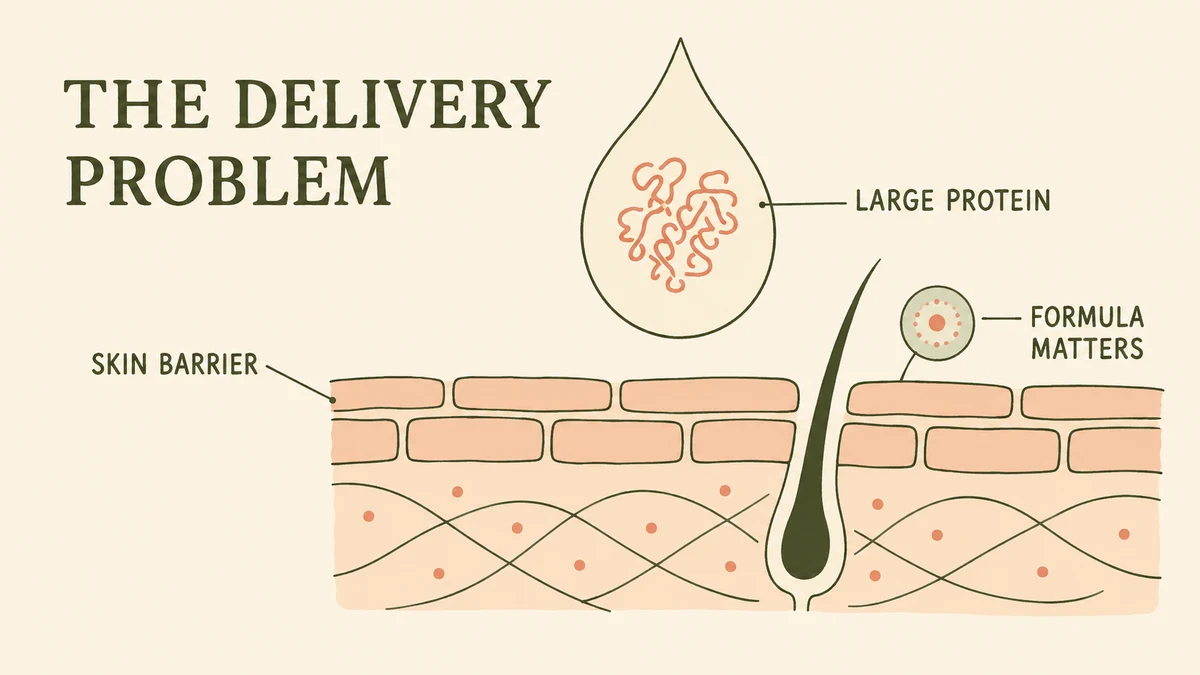
Researchers have proposed several possible routes, including hair follicles, sweat glands, specialized delivery vehicles, and signaling that begins closer to the surface. Reviews also discuss liposomes, hydrogels, nanoparticles, and other systems designed to protect EGF and improve delivery. Topical administration to uncompromised skin is still not fully understood.4
Growth factors are fragile
A growth-factor serum must survive manufacturing, heat, pH changes, contact with other ingredients, shipping, storage, and repeated opening. Proteins can unfold, aggregate, oxidize, or lose biological activity. That is why a percentage on the front label is not enough. Packaging, formula pH, vehicle, storage instructions, and testing at the end of shelf life all matter.
This also explains why an ordinary ingredient-list app cannot rank these products reliably. The list may reveal that a signaling protein is present, but it cannot show whether the protein remained active or reached a useful target in the study participants.
Are growth factor serums safe?
The 2023 systematic review found a low rate of reported adverse events across the included topical studies. However, the persistence of benefit beyond six months was unknown, and long-term safety evidence remains less developed than it is for established ingredients such as retinoids.1
That does not mean EGF serum has been shown to cause cancer. It means shoppers should not turn a theoretical discussion about growth signaling into either a safety guarantee or an internet panic. If you have an active cancer, a history of skin cancer, an unexplained changing lesion, or medical treatment that alters immune function, discuss biologically active skincare with your dermatologist before use.
The FDA does not approve cosmetic products or cosmetic ingredients before sale, apart from certain color additives. A cosmetic growth-factor serum should not be described as FDA-approved simply because one ingredient also has medical research or because the company follows manufacturing rules.5
Patch test a new serum. Stop if you develop persistent burning, swelling, hives, blistering, or a spreading rash. Do not apply a cosmetic serum to an open wound unless its labeling and your clinician specifically support that use.
Should you microneedle growth factor serum into the skin?
Not at home. Creating channels changes exposure, sterility needs, and risk. The FDA states that authorized microneedling devices have not been cleared for delivering cosmetics, topical medications, vitamin solutions, drugs, or blood products into the skin.6 If a licensed clinician recommends a post-procedure product, use the exact protocol they provide rather than adapting a retail serum yourself.
How to use a growth factor serum
- Follow the tested directions. If the brand has a credible finished-product study, copy its frequency and routine position.
- Apply after cleansing. A watery serum usually goes before moisturizer, but the formula instructions take priority.
- Keep the routine simple at first. Add one new product and give your skin time to show whether it tolerates it.
- Use moisturizer as needed. A growth-factor serum is not automatically a complete barrier cream.
- Wear sunscreen every morning. Preventing additional UV damage has stronger evidence than relying on a serum to reverse it.
Can you use growth factors with retinol?
There is no category-wide rule saying they cannot share a routine, but finished formulas differ. A simple approach is growth-factor serum in the morning and retinol at night. If you use both at night, introduce them separately, follow the serum instructions, and reduce frequency if irritation develops. Growth factors do not cancel the need for careful retinol use on sensitive skin.
How to choose a growth factor serum
- Look for finished-product testing. Ingredient theory is weaker than a controlled study on the exact bottle.
- Check the study design. Favor a comparator group, blinded assessment, objective measurements, diverse participants, and enough follow-up.
- Ask what is actually inside. EGF, conditioned media, and a vague growth-factor complex are not the same.
- Look for stability information. Packaging, shelf life, storage, and testing under real conditions matter for proteins.
- Keep expectations proportional. Modest texture or fine-line improvement is more realistic than "cellular regeneration" or a facelift in a bottle.
- Compare the price with proven basics. Daily sunscreen, a suitable retinoid, and consistent moisturizer usually deserve priority.
A growth-factor serum makes the most sense for someone who already uses sunscreen, has a stable routine, wants a gentle anti-aging add-on, understands that results are likely subtle, and can verify that the specific formula was tested. It makes less sense when the product is expensive, the label is vague, or basic skin care is still missing.
Growth factors vs peptides, exosomes, and PDRN
Peptides are usually smaller and easier to formulate, but the category is broad and every sequence has a different job. Exosomes are extracellular vesicles that may carry proteins, lipids, and nucleic acids. PDRN describes mixtures of DNA fragments. All three can be marketed with similar words such as repair, renewal, or regeneration, yet they are different materials with different evidence and quality-control problems.
If you are comparing expensive regenerative products, read our evidence guide to PDRN vs exosomes and our closer look at whether topical PDRN works like injections.
Our verdict
Growth-factor skincare is more than empty hype, but less than a breakthrough for most routines. Human studies support modest improvement from some formulas, while penetration, stability, study quality, product variation, and long-term evidence remain important limits. Buy the study and the formulation, not the phrase "growth factors."
Frequently asked questions
How long does a growth factor serum take to work?
Many studies assessed results after about three months of regular use. A promise of dramatic change in days is not consistent with the broader evidence.
Is EGF better than retinol?
No head-to-head evidence shows that EGF skincare is generally better than retinoids. Retinoids have a much larger evidence base for photoaging. EGF may appeal to people seeking a gentler add-on, but it is not a proven replacement.
Can growth factor serum help acne scars?
A retail serum should not be expected to remodel established atrophic acne scars. Procedures may be more appropriate, and post-procedure growth-factor research cannot be transferred automatically to daily use on intact skin.
Are human-derived growth factors better?
Current evidence does not establish a universal winner. Source, purification, consistency, delivery system, finished-formula testing, and safety controls matter more than a simple human-derived or synthetic label.
Can sensitive skin use EGF serum?
Possibly. Reported topical adverse events were generally uncommon, but the entire formula determines tolerance. Patch test and introduce it separately from other new products.
Continue reading
Sources
- Quinlan DJ, Ghanem AM, Hassan H. Topical growth factor preparations for facial skin rejuvenation: A systematic review. Journal of Cosmetic Dermatology. 2023;22(7):2023-2039. PubMed.
- Wu DC, Goldman MP. A Prospective, Randomized, Double-blind, Split-face Clinical Trial Comparing the Efficacy of Two Topical Human Growth Factors for the Rejuvenation of the Aging Face. Journal of Clinical and Aesthetic Dermatology. 2017;10(5):31-35. PubMed.
- A Randomized, Double-Blinded Pilot Study Comparing Synthetic Versus Human-Derived Topical Epidermal Growth Factor for Facial Rejuvenation and Psychosocial Perception. Journal of Cosmetic Dermatology. 2026. PubMed.
- Eskens O, Amin S. Challenges and effective routes for formulating and delivery of epidermal growth factors in skin care. International Journal of Cosmetic Science. 2021;43(2):123-130. Wiley Online Library.
- U.S. Food and Drug Administration. Does the FDA approve cosmetics before they go on the market? FDA.
- U.S. Food and Drug Administration. Microneedling Devices. Updated October 15, 2025. FDA.
- Mehta RC, Fitzpatrick RE. Endogenous growth factors as cosmeceuticals. Dermatologic Therapy. 2007;20(5):350-359. PubMed.
Medical note: This article is educational and does not diagnose or treat a skin condition. Ask a dermatologist about changing lesions, skin cancer concerns, persistent irritation, or products used around a procedure.
Hot girls read the research. ♡