
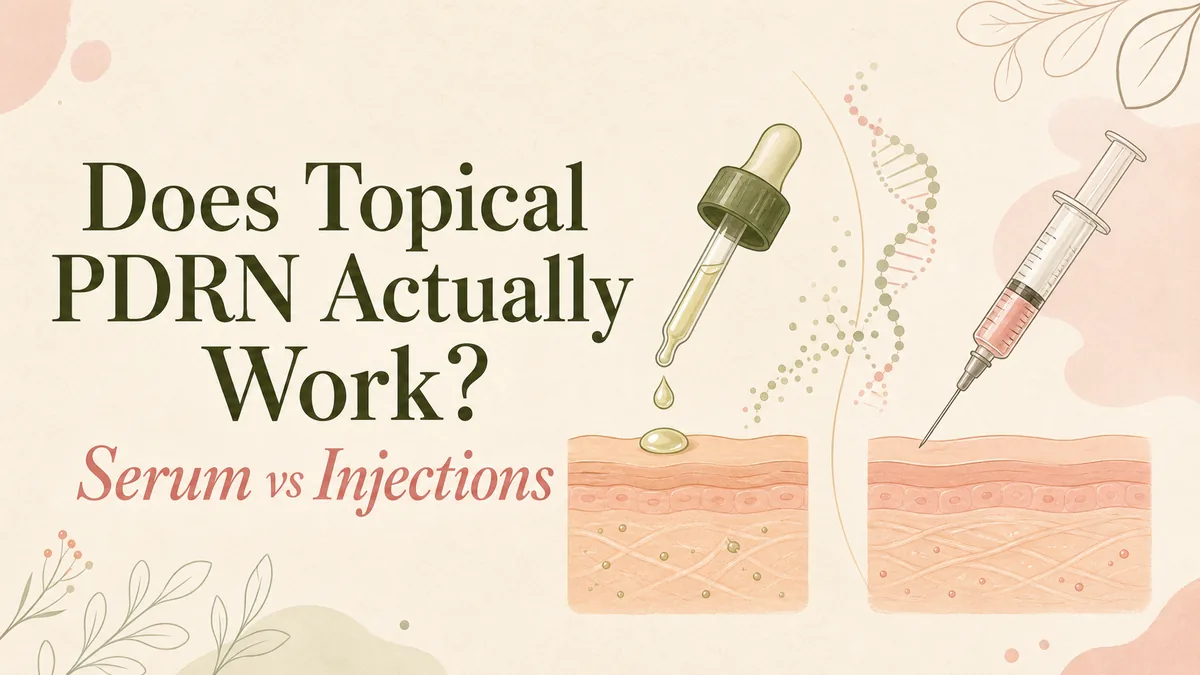
Topical PDRN may work in a well-designed formula, but it is not proven to work like PDRN or polynucleotide injections. A 2025 systematic review found promising results for injected PN, yet only nine low- or moderate-quality studies with 219 patients met its criteria.2 A 2026 study of one 0.1% PDRN-850K eye cream reported skin-delivery signals and short-term improvement, which is genuinely interesting, but it cannot validate every PDRN serum.5
Injected PN/PDRN: promising, still developing. The 2025 systematic review found nine eligible esthetic studies, 219 patients and substantial variation in injection area and technique. The authors rated the studies low or moderate quality and called for rigorous trials and clearer protocols.2 Topical PDRN: much earlier. A newer formulation-specific trial improves the picture, but broad serum claims still run ahead of the evidence.5
What Is PDRN?
Polydeoxyribonucleotide, shortened to PDRN, generally refers to purified mixtures of DNA fragments. Much of the older medical literature involves preparations derived from salmonid tissue and investigates wound healing, tissue repair and inflammation-related pathways.18 Cosmetic labels may instead use the ingredient name Sodium DNA; a cosmetic ingredient database lists animal, synthetic and plant origins, so that name alone does not establish source or equivalence to a studied PDRN preparation.13
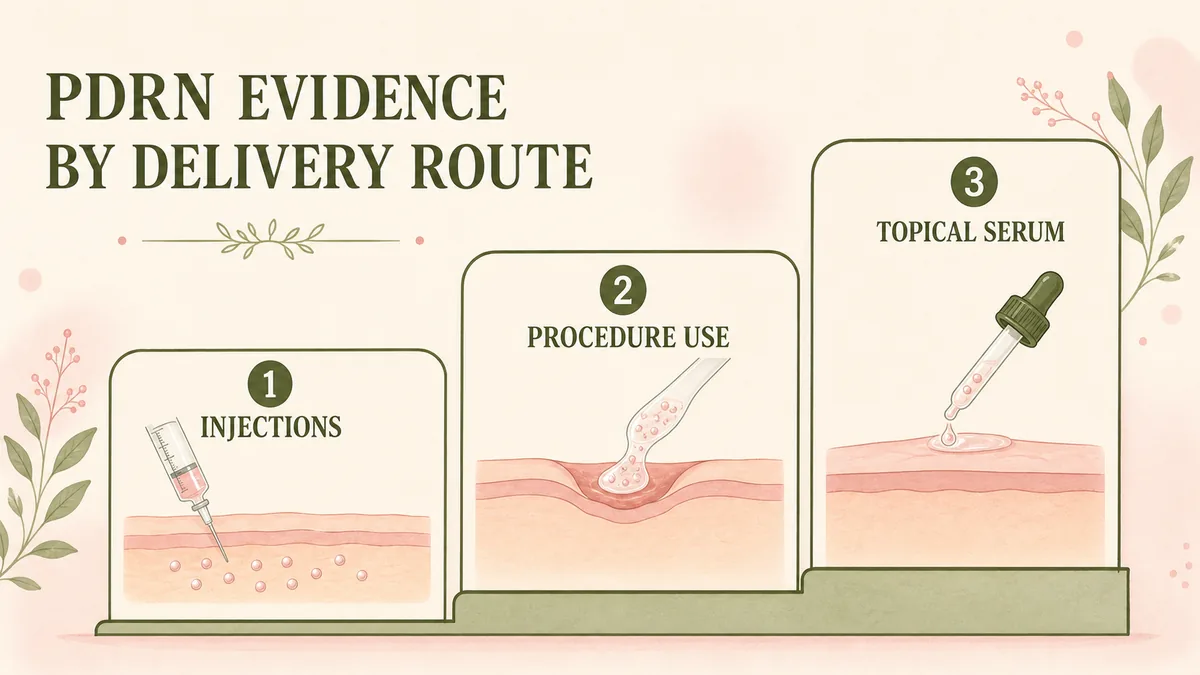
Mechanistic research often discusses adenosine A2A-receptor signaling and nucleotide salvage pathways.13 Those mechanisms can make a hypothesis biologically plausible; they do not tell us whether an unknown face serum penetrates intact skin or improves wrinkles in people. Cell experiments, wound studies, injections and leave-on cosmetics sit on different evidence rungs.
PDRN vs PN vs “Salmon DNA”
| Label | What it may mean | What it does not prove |
|---|---|---|
| PDRN | A heterogeneous mixture of DNA fragments, with size and processing varying by preparation. | That the material is standardized across brands or reaches the dermis from a serum. |
| PN / polynucleotide | Often longer-chain DNA biopolymers used in injectable gels or biorevitalization products. | That every PN and PDRN paper describes the same substance or dose. |
| Sodium DNA | A cosmetic ingredient name for a sodium salt of DNA; listed origins include animal, synthetic and plant.13 | Its source, fragment distribution, purity, concentration or clinical effect. |
| Salmon DNA | A consumer-facing source description, not a performance grade. | Sterility, injection suitability, penetration or anti-aging efficacy. |
| Plant PDRN | DNA-fragment material produced from a plant source or cell culture process. | Vegan certification or clinical equivalence to animal-derived products.7 |
A 2025 comparison review emphasized molecular and clinical differences between PN and PDRN.3 A 2026 plant-derived review went further: source, processing, structure and delivery platform should be evaluated together, and predominantly preclinical evidence should not be presented as clinical equivalence.7
What Does the Evidence Say About PDRN or PN Injections?
The best concise answer is promising but not settled. In the 2025 systematic review, several injection studies reported improvements in wrinkles, texture or elasticity, and adverse effects were generally mild and transient. But only 219 patients across nine low- or moderate-quality studies were included, procedures varied, and the authors found limited consensus about optimal use.2
Three of the four authors of that 2025 review disclosed ownership, training, advisory or key-opinion-leader relationships involving aesthetic practices or PDRN-related companies; the paper states the named companies did not fund or participate in the review.2 Disclosure does not make results false, but it increases the value of independent replication. A second systematic review appeared online in June 2026, although PubMed currently provides no abstract, so the quantitative summary above comes from the accessible 2025 review.4 A 2026 narrative review of post-procedure use also acknowledges small samples, variable formulations, limited human aesthetic RCTs and little long-term follow-up.9
Most important: injection evidence cannot be pasted onto a face serum. It supports the idea that certain nucleic-acid materials may have clinical effects when delivered into or through skin. It does not demonstrate that an ordinary cosmetic bottle achieves the same exposure.
Why Is Topical PDRN Harder to Prove?
The outer stratum corneum is an effective barrier. A classic review proposed that passive penetration through intact skin becomes unlikely for compounds above roughly 500 daltons, although real delivery depends on more than one cutoff.6 A pharmacology review describes one established PDRN preparation as a heterogeneous 50–1,500 kDa mixture, far above 500 Da.1 That does not make every topical delivery system impossible; it means penetration must be demonstrated for the specific material and formula.
Useful questions include: Is the material shorter or modified? Is it encapsulated? Was penetration measured in reconstructed, ex vivo or human skin? Was the exact finished formula tested? Did the study compare it with the same base formula without PDRN? A fluorescent signal in a model and a meaningful long-term clinical result are different endpoints.
A 2022 preclinical paper tested PDRN alone and a PDRN/vitamin C/niacinamide mixture in cell assays and UVB-exposed mice, using a microneedling therapy system for delivery; it was not a leave-on human serum trial.10 A 2025 company-affiliated plant-PDRN study included a two-week barrier-recovery experiment in ten people, but that small result cannot establish broad anti-aging equivalence across products.11
The 2026 Topical PDRN Study: What It Adds
A July 2026 study tested a defined medium-length preparation called PDRN-850K. Researchers used cell experiments, reconstructed epidermis, ex vivo skin and pilot human Raman measurements, then ran a randomized, double-blind, split-face clinical comparison. Thirty-one participants applied a 0.1% PDRN-850K eye cream on one side and 0.1% retinol on the other twice daily for 28 days.5
The paper reported time-dependent PDRN-associated signals in viable epidermal regions and improvements in periocular measurements, with the PDRN side outperforming the retinol comparator on several short-term outcomes.5 This is stronger evidence than a brand citing a fibroblast dish.
What it supports: at least one specifically characterized topical PDRN system produced measurable delivery signals and short-term human outcomes. What it does not support: every PDRN serum penetrates, PDRN has replaced retinoids, or 28-day eye-area changes establish durable whole-face anti-aging. The clinical arm compared PDRN with an active retinol comparator, not the same cream without PDRN. Three of five authors list company research affiliations, while the paper declares no conflicts of interest; independent, vehicle-controlled replication would make the result more persuasive.5 Retinoid evidence is much broader: a systematic review of topical tretinoin alone included seven randomized trials lasting three to 24 months.14
How to Evaluate a PDRN Serum Before Buying
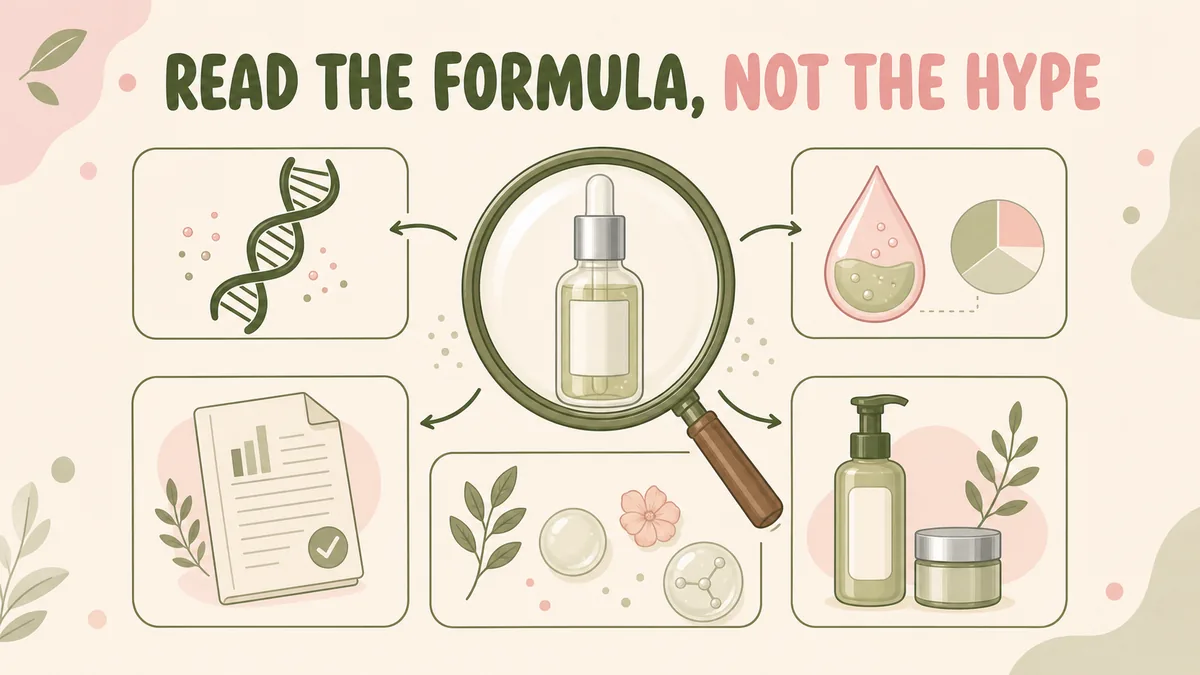
- Find the actual ingredient list. Look for Sodium DNA or another named DNA-derived material in the complete list. The name identifies a cosmetic ingredient, not its source, molecular distribution or equivalence to a clinical preparation.13
- Check the source claim. Salmon-derived, plant-derived and unspecified materials raise different allergy, ethics and verification questions. “Vegan PDRN” is not proof of clinical equivalence.7
- Ask whether size and delivery are described. A number without units, distribution or method is not very informative.
- Look for finished-product human data. Ingredient studies cannot isolate the effect of a multi-ingredient serum. A randomized vehicle-controlled trial is more useful than before-and-after photos.
- Read the supporting formula. Humectants and barrier-supporting ingredients may make a serum pleasant and effective for hydration even if its PDRN claim remains uncertain.
- Match the price to the evidence. Do not pay an injection-sized premium for a cosmetic claim supported only by injection papers.
For formula-level examples, read our Anua PDRN Hyaluronic Acid Capsule 100 Serum review and Medicube PDRN Pink Peptide Serum review. Both separate hydration-supporting ingredients from claims that the finished product has not directly proved.
Safety: Serum Use Is Not DIY Injection
A cosmetic serum is not a procedure product
Do not inject or microneedle an ordinary PDRN cosmetic into the skin. The FDA says authorized microneedling devices are not approved to deliver cosmetics or topical medications, and it has not reviewed the safety or effectiveness of combining the devices with those products.12
The whole formula matters
Fragrance, preservatives, plant extracts or other actives may irritate even if PDRN itself is tolerated.
Fish allergy and ethics
If a product is salmon-derived and you have a serious fish allergy, ask the brand for documentation and discuss use with a clinician rather than guessing.
Data may be absent
Check every active in the full formula and ask your prenatal clinician when safety data are limited.
Topical PDRN evidence now includes one formulation-specific, 28-day split-face study, but the evidence remains early. That is not a blank check for every serum. Injections have a larger, but still imperfect, clinical literature; topical results depend on material, delivery system and finished formula. Buy a serum for what its own evidence and complete ingredient list support, not for what an injection paper makes imaginable.
Frequently Asked Questions
Does topical PDRN actually work?
There is now early human evidence for at least one specifically engineered topical PDRN-850K eye cream, but that does not prove every PDRN serum works. Formula, molecular profile, delivery testing and finished-product data matter.
Is PDRN serum the same as PDRN injections?
No. A cosmetic serum stays on top of intact skin, whereas injections deliberately place a procedure product below the surface barrier. The products, exposure and risks differ, so injection evidence cannot be copied directly onto a topical bottle.
Is PDRN the same as polynucleotide or PN?
The terms overlap in marketing and some papers but are not always chemically or clinically interchangeable. PDRN commonly describes shorter DNA-fragment mixtures, while PN products may use longer chains or gels; exact definitions vary.
Can PDRN penetrate the skin?
A 2026 study detected signal from one medium-length PDRN system in viable epidermal regions using multiple models. That is product- and delivery-specific evidence, not proof that any generic sodium-DNA serum reaches the dermis.
Can topical PDRN replace retinol?
Not yet. One 28-day split-face study compared a specific 0.1% PDRN-850K eye cream with 0.1% retinol, while the retinoid class, especially tretinoin, has a broader human evidence base. Do not generalize that result to every PDRN serum or every retinoid.14
Is plant-derived PDRN vegan and equally effective?
Plant-derived DNA can avoid animal sourcing, but source claims need documentation. A 2026 review concluded that current evidence is predominantly preclinical and should not be treated as proof of clinical equivalence to animal-derived PDRN.
Can I microneedle a PDRN serum into my skin?
Do not microneedle an ordinary cosmetic serum into the skin. The FDA says authorized microneedling devices are not approved to deliver cosmetics or topical medications, and it has not reviewed the safety or effectiveness of combining the devices with those products.12
Is topical PDRN safe during pregnancy or with fish allergy?
Pregnancy-specific and allergy data for many cosmetic formulas are limited. Check the exact source and full ingredient list. If you are pregnant, breastfeeding or have a serious fish allergy, ask a qualified clinician rather than relying on the front label.
References
Systematic reviewHuman studyMechanistic evidence Evidence from injected products is not treated as direct proof for intact-skin cosmetics.
- Squadrito F, Bitto A, Irrera N, et al. Pharmacological activity and clinical use of PDRN. Front Pharmacol. 2017;8:224. doi:10.3389/fphar.2017.00224. PubMed.
- Lampridou S, Bassett S, Cavallini M, Christopoulos G. The effectiveness of polynucleotides in esthetic medicine: a systematic review. J Cosmet Dermatol. 2025;24(2):e16721. doi:10.1111/jocd.16721. PubMed.
- Kim ST. Comparison of polynucleotide and polydeoxyribonucleotide in dermatology: molecular mechanisms and clinical perspectives. Pharmaceutics. 2025;17(8):1024. doi:10.3390/pharmaceutics17081024. PubMed.
- Kream EJ, Anooshiravani N, Hosking AM, Boen M, Fabi SG. Global trends and evidence evaluation: a systematic review of polynucleotide and polydeoxyribonucleotide therapy in dermatology. Dermatol Surg. Published online June 15, 2026. doi:10.1097/DSS.0000000000005155. PubMed.
- Ye R, Wang Q, Du L, Li L, Hu F. Topical medium-length PDRN enhances dermal extracellular matrix repair in photodamaged skin via PI3K-Akt/TGF-β-regulated pathways. PLoS One. 2026;21(7):e0350905. doi:10.1371/journal.pone.0350905. PubMed.
- Bos JD, Meinardi MM. The 500 Dalton rule for the skin penetration of chemical compounds and drugs. Exp Dermatol. 2000;9(3):165–169. doi:10.1034/j.1600-0625.2000.009003165.x. PubMed.
- Kim HJ, Lee JW, Kim S, Son KH. Plant-derived polynucleotides/polydeoxyribonucleotides in skin biomaterials: delivery platforms and bioactivity attribution. J Funct Biomater. 2026;17(7):351. doi:10.3390/jfb17070351. PubMed.
- Colangelo MT, Galli C, Guizzardi S. The effects of polydeoxyribonucleotide on wound healing and tissue regeneration: a systematic review of the literature. Regen Med. 2020;15(4):1801–1821. doi:10.2217/rme-2019-0118. PubMed.
- Flores Rodríguez JC, Avelar LET, Yi K, et al. Polydeoxyribonucleotide (PDRN) in post-procedure recovery in aesthetic medicine: a narrative review. Cureus. 2026;18(5):e108886. doi:10.7759/cureus.108886. PubMed.
- Kim HM, Byun KA, Oh S, et al. A mixture of topical forms of polydeoxyribonucleotide, vitamin C, and niacinamide attenuated skin pigmentation and increased skin elasticity by modulating nuclear factor erythroid 2-like 2. Molecules. 2022;27(4):1276. doi:10.3390/molecules27041276. PubMed.
- Bak SU, Jung MS, Kim DJ, et al. Anti-aging efficacy of low-molecular-weight polydeoxyribonucleotide derived from Paeonia lactiflora. Int J Mol Sci. Published December 24, 2025;27(1):220. doi:10.3390/ijms27010220. PubMed.
- U.S. Food and Drug Administration. Microneedling devices. Updated October 15, 2025. FDA.
- COSMILE Europe. Sodium DNA: cosmetic ingredient database entry. COSMILE Europe.
- Sitohang IBS, Makes WIM, Sandora N, Suryanegara J. Topical tretinoin for treating photoaging: a systematic review of randomized controlled trials. Int J Womens Dermatol. 2022;8(1):e003. doi:10.1097/JW9.0000000000000003. PubMed.
Medical note: This article is educational and is not medical advice. Cosmetic PDRN serum is not a sterile injectable or procedure product. Seek qualified care for injections, microneedling, persistent irritation or treatment decisions during pregnancy or with serious allergy.
Research first. Panic never. ♡