
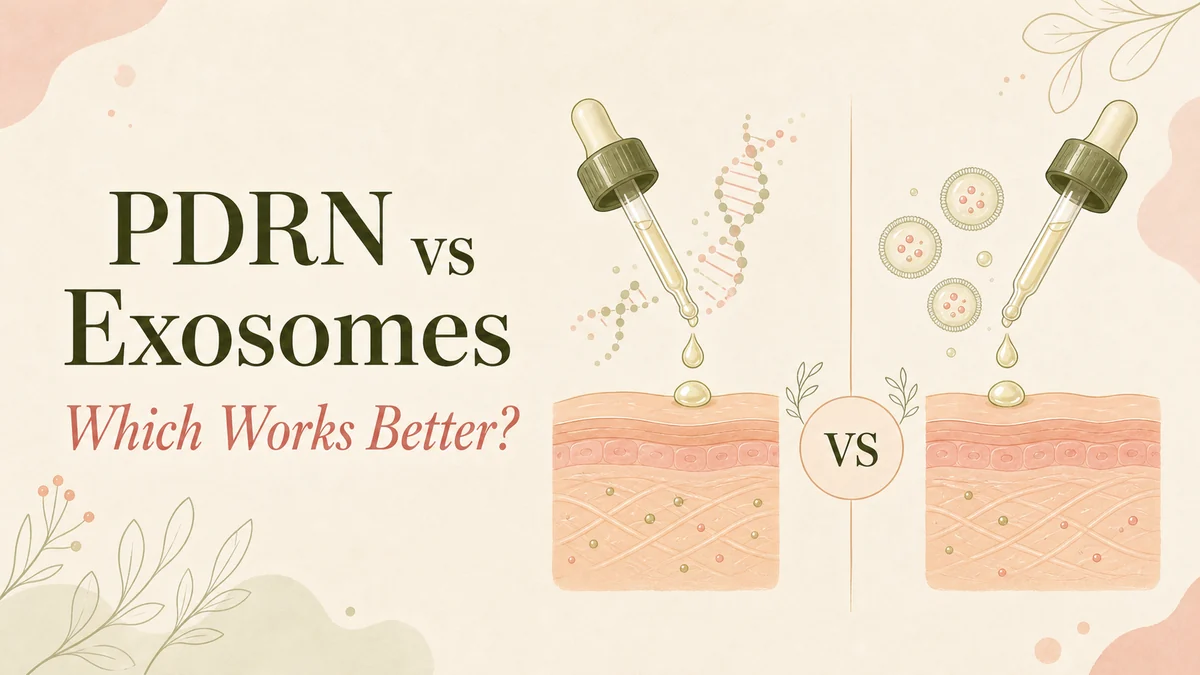
For an ordinary topical routine, PDRN currently has the clearer ingredient identity and a small amount of formulation-specific human evidence. Exosome skincare is more heterogeneous and harder to verify from a label. Neither category is proven to transform skin like an in-office procedure. Choose a finished formula with transparent sourcing, concentration, stability, and human testing, not the trendier front label.
PDRN and exosomes are not versions of the same thing
What is PDRN?
Polydeoxyribonucleotide, or PDRN, describes mixtures of DNA fragments. Medical and aesthetic literature often discusses materials derived from salmon or trout sperm cells, although plant-derived and engineered cosmetic materials are also appearing. Proposed actions include adenosine A2A receptor signaling and provision of nucleotides for salvage pathways. Product effects depend on fragment size, source, purity, dose, formulation, and delivery route.
What are exosomes?
Exosomes are a subset of extracellular vesicles released by cells. They can carry proteins, lipids, and nucleic acids involved in cell-to-cell communication. In aesthetic products, the word exosome may refer to very different sources, isolation methods, purities, and delivery systems. Some products use plant vesicles or exosome-like particles, which should not be assumed equivalent to human-cell-derived exosomes studied in clinical research.
| Question | PDRN | Exosomes |
|---|---|---|
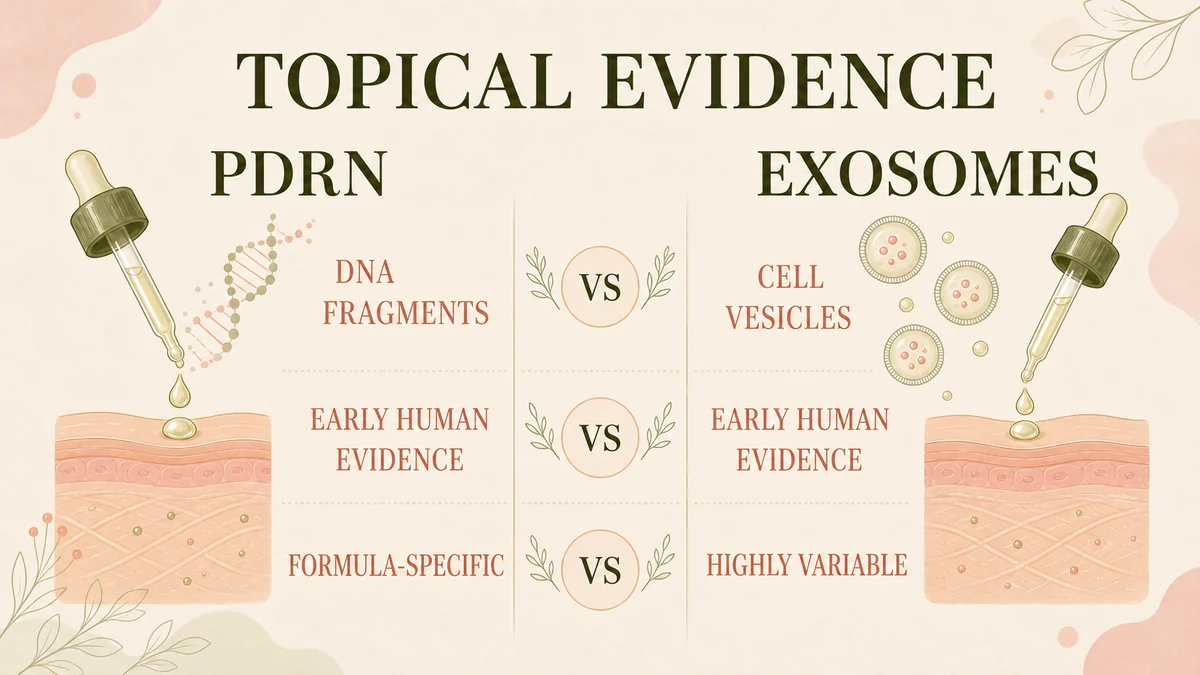
| Basic material | DNA fragments | Cell-derived extracellular vesicles |
| Label clarity | Often appears as sodium DNA or PDRN, but source and size may be missing | Source, vesicle characterization, count, and purity are often unclear |
| Human skin evidence | Promising for injected PN or PDRN; topical evidence is early | Early positive signals, but studies are heterogeneous and often procedure-assisted |
| Best-established route | Clinical literature is strongest for injections and wound-related applications | Many studies combine topical application with laser or microneedling |
| Biggest caution | Borrowing injection evidence for serums | Treating every exosome-labeled product as the studied biological material |
What does the PDRN evidence show?
A 2026 systematic review of randomized trials included seven studies and 183 participants across skin rejuvenation, scar prevention, and wound healing. Results were encouraging, especially for wound healing, but samples were small and protocols varied.1 This supports further research. It does not prove that every cosmetic PDRN serum works.
A newer randomized split-face study tested a specific 0.1% medium-length PDRN eye cream against 0.1% retinol over 28 days and reported skin-delivery signals plus short-term improvements.2 That study matters because it addresses topical delivery. It still validates one defined material and formula, not the whole market.
What does the exosome evidence show?
Recent systematic reviews report promising short-term improvements in hydration, elasticity, wrinkles, pigmentation, and texture. The consistent limitation is study heterogeneity. Sources differ, delivery methods differ, follow-up is short, and many studies are not randomized.3
A 2026 review of 16 studies and 503 participants judged the certainty of evidence low or very low for most outcomes because risk of bias ranged from moderate to critical.4 Positive signals are not the same as a standardized, predictable cosmetic ingredient class.
If an exosome product is applied after fractional laser or microneedling, the procedure changes the skin and can improve outcomes on its own. A study needs an appropriate procedure-only control to isolate the added effect of the product. Results from barrier-disrupted skin should not be transferred directly to daily use on intact skin.
Why topical claims are difficult
Healthy stratum corneum is designed to limit penetration. Large DNA fragments and extracellular vesicles face formulation and delivery challenges. A product also needs to remain stable during manufacturing, shipping, storage, and repeated opening.
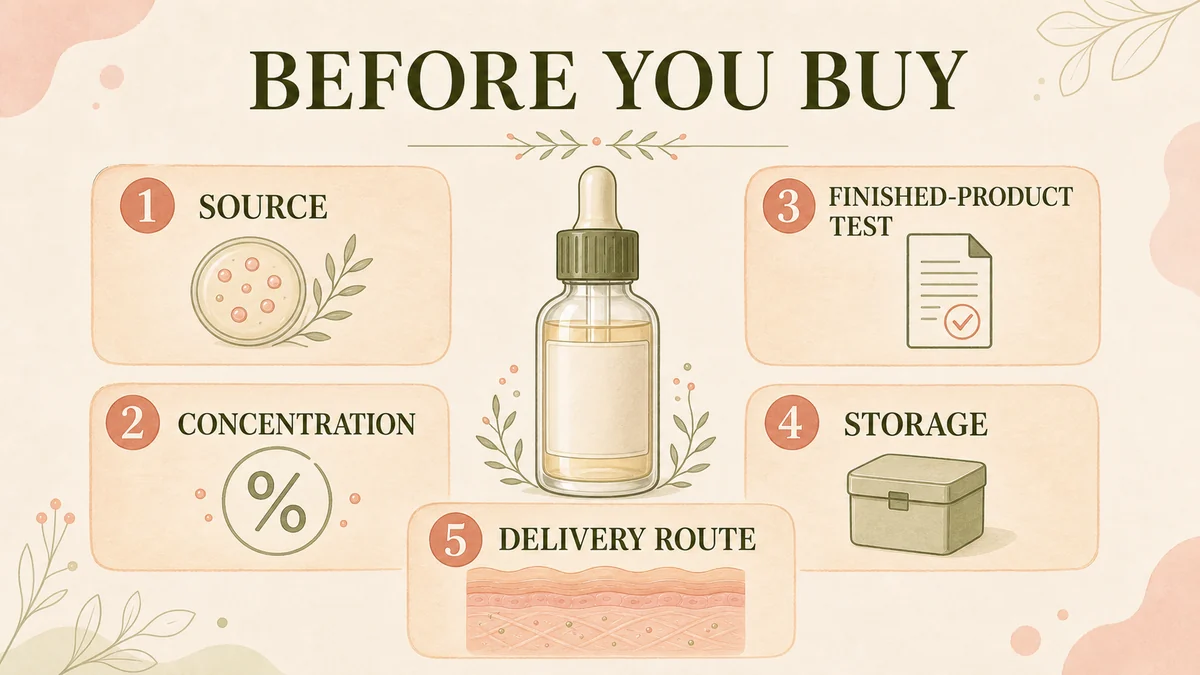
For PDRN, look for the INCI name, source, concentration, fragment or molecular-weight description, packaging, and a study on the finished formula. For exosome products, ask for the vesicle source, characterization method, particle count, purity markers, storage requirements, and human evidence on the exact product.
Words such as stem cell, regenerative, DNA repair, or exosome technology can describe marketing rather than a verified biological material. If a brand cannot explain what is inside the bottle and how it was tested, the claim is not ready for your wallet.
Which one should you choose?
Choose PDRN if:
- You want the more defined of the two topical categories.
- The brand discloses source, concentration, and formula-specific testing.
- Your main goal is hydration and a supportive routine, not procedure-level regeneration.
- You have checked the source if fish allergy, vegan preferences, or religious considerations matter to you.
Choose an exosome serum only if:
- The company identifies the vesicle source and characterization methods.
- Storage and stability instructions make sense.
- Evidence is tied to the finished product and the same delivery route you will use.
- You understand that a plant-vesicle cosmetic is not interchangeable with a human-cell-derived clinical product.
Choose neither if:
- Your routine lacks daily sunscreen, moisturizer, or a proven treatment for your actual concern.
- The product promises to replace dermatologic care.
- You are buying it only because injection results were pasted onto a serum page.
- The price is high but the specification is vague.
Safety and regulation matter
Cosmetic serums and injected biological products are not the same risk category. The FDA has stated that there are no FDA-approved exosome products and has warned about unapproved products marketed to treat diseases or conditions, including reports of serious adverse events with some uses.5 Do not inject a cosmetic serum or use it with an at-home device that creates channels unless qualified medical guidance specifically supports that product and method.
For ordinary topical use, patch test. Stop if you develop persistent burning, swelling, hives, blistering, or a spreading rash. People with fish allergy should not assume every PDRN product is safe or unsafe based only on the word salmon. Ask the manufacturer about purification and discuss serious allergy with a clinician.
Our verdict
PDRN wins for topical skincare by a small margin, mainly because it is easier to define and now has limited formula-specific topical evidence. Exosome skincare remains interesting but difficult to standardize and verify. For both, the finished formula matters more than the trend name, and proven basics still offer better certainty per euro spent.
Frequently asked questions
Are PDRN and salmon DNA the same?
Salmon DNA is a marketing phrase often used for fish-derived PDRN or sodium DNA. It does not reveal fragment size, purity, concentration, or performance.
Can I use PDRN and exosomes together?
There is no clear evidence that layering two cosmetic serums produces extra benefit. It adds cost and makes irritation harder to trace.
Are plant exosomes real exosomes?
Plants release extracellular vesicles, but product terminology varies. A plant-vesicle cosmetic should not borrow evidence from human-cell-derived exosome products.
Which is better after microneedling?
That is a procedure question, not a routine-skincare question. Use only products and aftercare recommended by the qualified clinician performing the procedure.
Build the cluster
Sources
- Alhussain AM, et al. Polynucleotides and Polydeoxyribonucleotides for Skin Rejuvenation, Scar Prevention, and Wound Healing: A Systematic Review of Randomized Clinical Trials. Cureus. 2026;18(7):e112403. PubMed.
- Topical medium-length PDRN enhances dermal extracellular matrix repair in photodamaged skin. 2026. PubMed.
- Flores Rodríguez JC, et al. Efficacy of Exosome-Based Therapies for Skin Rejuvenation: A Systematic Review of Human Studies. Cureus. 2026;18(2):e104182. PubMed.
- Gaebe K, et al. Effectiveness and Safety of Extracellular Vesicle-Based Therapies for Nonsurgical Facial Rejuvenation: A Systematic Review. 2026. PubMed.
- U.S. Food and Drug Administration. Public Safety Alert Due to Marketing of Unapproved Stem Cell and Exosome Products. FDA.
- Shin JW, et al. Comparison of Polynucleotide and Polydeoxyribonucleotide in Dermatology. Pharmaceutics. 2025;17(8):1024. PubMed.
Medical note: This article covers cosmetic skincare and published research. It does not recommend injectable exosomes, PDRN, or polynucleotides. Procedures require qualified medical care.
Research first. Panic never. ♡