
Most people do not need sunscreen for a short, ordinary trip outside when the UV Index is 0, 1 or 2. The World Health Organization places 0 to 2 in its lowest band and recommends routine sun-protection measures from UV 3 upward. But low does not mean zero exposure. Long time outdoors, bright snow, photosensitivity, prolonged direct sun through glass or strict pigmentation control can make protection sensible even on a low-UV day.125
The UV Index describes the strength of erythema-weighted solar ultraviolet radiation at a place and time. A higher value means an erythema-producing dose can accumulate faster. The number is not a timer, does not directly predict tanning speed and is not a complete measurement of every pigmentation-relevant wavelength.1711
What Does UV Index 0, 1 or 2 Mean?
WHO and Environment and Climate Change Canada group UV 0 to 2 in the low band. WHO's table says people can safely enjoy being outside at 0 to 2; its explanatory text says risk below UV 2 is limited and that protection is not normally needed. Canadian guidance adds a specific exception: use protective clothing and sunscreen during more than an hour outside on bright, snow-covered days.12
Those statements are not a guarantee that no UV reaches you. They are practical public-health guidance about typical risk. Your dose still changes with exposure time, cloud and ozone conditions, altitude, latitude, surface reflection and behavior.23
| UV level | Public category | Practical interpretation |
|---|---|---|
| 0 | Low | A short routine outing usually does not call for special sun protection. Consider your medical advice and setting. |
| 1 | Low | Ordinary brief exposure is low risk. Duration, reflection and sensitivity become relevant as time accumulates. |
| 2 | Low | Still low, but closest to the protection threshold. Several hours outside deserve more thought than a quick errand. |
| 3+ | Moderate or higher | WHO recommends protective measures; combine shade, clothing, hat, sunglasses and sunscreen as appropriate. |
Do You Need Sunscreen at Each Low UV Level?
UV Index 0: usually no for normal outdoor activity
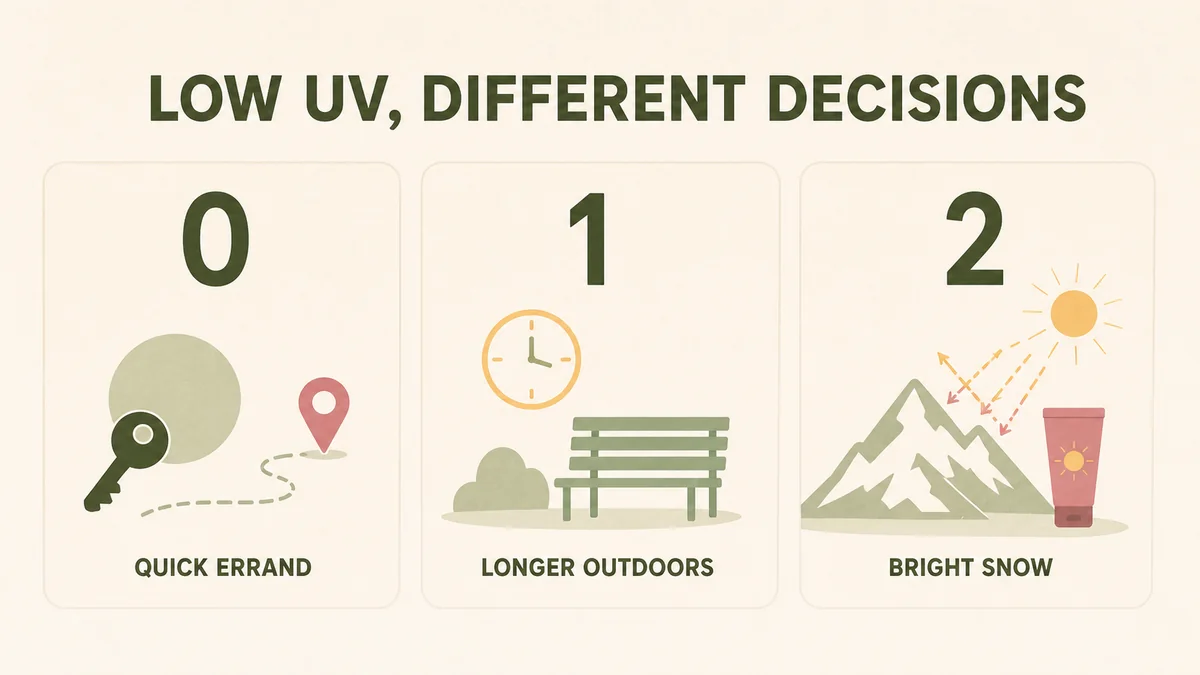
At UV 0, the potential for erythema-weighted harm is minimal. Most people do not need to apply sunscreen just to walk to a shop, commute briefly or spend a short period outside. Wearing sunscreen is still a valid personal habit, but the forecast alone does not make it urgent.
UV Index 1: usually no for a short outing
At UV 1, ordinary brief exposure remains low risk. Think about protection when “outside” means hours rather than minutes, especially in a reflective environment or if a clinician has told you to be stricter.
UV Index 2: low, but context matters more
UV 2 is the upper end of the low band. It is reasonable to skip sunscreen for a short routine trip if you have no special risk factors. It is also reasonable to use broad-spectrum sunscreen when you expect prolonged exposure or want consistent pigment control. These are not contradictory choices; they answer different goals.
Six Things That Change the Answer
Minutes versus hours
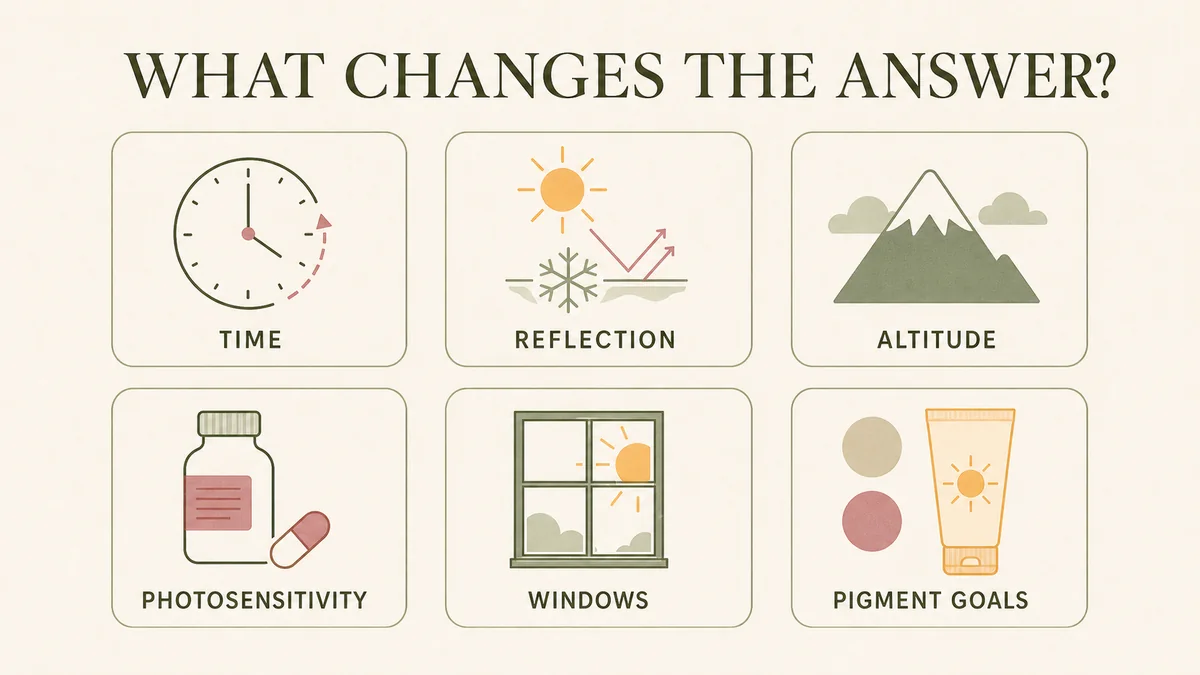
A low intensity experienced for a long time can produce more dose than the same intensity during a quick errand.
Snow and reflective surfaces
Fresh snow can reflect UV toward areas a brim may not fully shade. Official Canadian guidance singles out bright snow days.2
Use the forecast for your actual location
UV generally increases with elevation. A reliable local UV Index should already reflect that intensity, but a forecast for a lower nearby city may not represent a mountain location.23
Conditions and medicines
Photosensitive conditions and some medicines can require individualized protection. Follow your prescriber or dermatologist rather than a generic threshold.
Melasma and dark marks
A plan intended to limit pigment recurrence may be stricter than one intended only to prevent sunburn; visible light can also worsen some pigment disorders, which is why dermatologists may suggest tinted protection.59
Direct sun through glass
In one lamp-based experiment, all tested glass blocked UVB, while ordinary smooth glass transmitted substantially more UVA than laminated glass or glass with sun-control film.8
If the UV Index Is Low, Is UVA Also Zero?
No. The UV Index weights solar UV according to its erythema-producing effect; it is not a direct readout of UVA alone. UVA can contribute to pigmentation and photoaging, so a low UV Index does not prove that UVA is absent.5711 This does not mean everyone must fear a window at UV 1. It means the index should be used for the question it was designed to answer.
Glass complicates the indoor question. Experimental work found that laminated glass blocked UVA more effectively than some other automotive or building glass types.8 If you spend hours beside a bright window, drive for work or manage a photosensitive condition, ask whether clothing, distance from the window, window film or sunscreen is the most practical control.
Why Do Experts Give Different Daily Sunscreen Advice?
Because they answer different questions and sometimes tailor advice to population and skin type. WHO recommends protective measures at UV 3 and above.1 The British Association of Dermatologists' Patient Hub uses UV 3 for white skin and UV 11 for black and brown skin, and says year-round sunscreen is generally unnecessary in the UK except for certain medical conditions.6 The American Academy of Dermatology recommends broad-spectrum, water-resistant SPF 30 or higher on exposed skin whenever outdoors and promotes daily sun-protective habits.5
A person who prefers one automatic morning habit may choose daily sunscreen because it is easy and consistent. Someone in a low-UV winter climate may use the forecast and planned activity instead. Both approaches can be reasonable if application is adequate when protection is actually needed. Our evidence-based SPF guide explains amount, reapplication and label terms, while the UV Index 1–5 tanning guide explains why the number cannot predict a safe tanning time.
A Simple Decision Guide for UV 0 to 2
- Check the hourly UV forecast, not just the daily badge. The displayed daily value may be the peak near solar noon.1
- Estimate your exposure honestly. A quick walk, an hour by a window and an afternoon skiing are three different scenarios.
- Look for multipliers. Snow, altitude, photosensitizing treatment, strict pigment control and clinician advice can move you toward protection.
- Choose the easiest effective tool. A coat, brimmed hat, shade or sunglasses may do more than a rushed, under-applied layer.
- If you use sunscreen, apply enough. Real-world use is often below the amount used for SPF testing.10 If products roll up, use the sunscreen pilling guide; if your eyes sting, use the eye-sting troubleshooting guide.
At UV Index 0, 1 or 2, most people can handle short, ordinary outdoor activity without sunscreen. Add protection when duration, reflection, a non-local altitude forecast, photosensitivity, prolonged direct sun through glass or pigmentation goals make your situation less ordinary. Use the number as a decision tool, not a reason to panic and not a promise that every exposure is zero.
Frequently Asked Questions
Do I need sunscreen when the UV Index is 0?
For most people doing ordinary short outdoor activities, public-health guidance treats UV 0 as minimal risk and does not require special protection. Longer reflective exposure, a photosensitivity condition or individualized medical advice can change that decision.
Do I need sunscreen at UV Index 1?
Usually not for a short, routine trip outside. Consider protection if you will be outdoors for a long time, especially around snow or other reflective surfaces, or if your skin-care goal requires stricter pigmentation control.
Do I need sunscreen at UV Index 2?
UV 2 is still in the low category, but it is the top of that category. Duration and setting matter: a quick errand and several hours on bright snow are not equivalent exposures.
Can you still get sunburned below UV 3?
It is unlikely under ordinary low-UV conditions, but ARPANSA notes that sunburn is theoretically possible below UV 3 after sufficiently long exposure. Reflective snow, altitude, unusually sensitive skin or a changing UV level can make a low forecast less reassuring.4
Do I need sunscreen indoors at UV 0 to 2?
Not automatically. Window glass usually blocks much of UVB but can transmit some UVA. People sitting close to a bright window for long periods, driving extensively or managing a photosensitive condition may choose extra protection.
Does snow make a low UV Index dangerous?
Snow can reflect UV and increase exposure to the face and eyes. Canadian guidance specifically recommends sunscreen and protective clothing during more than an hour outside on bright, snow-covered days even in the low 0 to 2 range.
Does retinol mean I always need sunscreen at UV 0?
Retinol use does not change the weather app number. Follow the product label and your clinician's advice, especially if your skin is irritated or you use prescription retinoids; avoid using sunscreen as permission for intentional exposure.
Should people with melasma wear sunscreen at low UV?
Many people managing melasma or post-inflammatory pigmentation choose consistent broad-spectrum protection because their goal is stricter than avoiding sunburn alone. A dermatologist can tailor advice, including whether a tinted product is useful.
References
Official guidancePrimary studyReview Public-health thresholds describe population risk; individualized medical advice can be stricter.
- World Health Organization. Radiation: The ultraviolet (UV) index. Updated June 20, 2022. WHO.
- Environment and Climate Change Canada. Ultraviolet (UV) index and sun safety. Canada.ca.
- U.S. Environmental Protection Agency. UV Index Scale. EPA.
- Australian Radiation Protection and Nuclear Safety Agency. Study reports sunburn can still happen even if the UV Index is below 3. ARPANSA.
- American Academy of Dermatology. Sunscreen FAQs. Updated February 11, 2025. AAD.
- British Association of Dermatologists Patient Hub. Sun Protection Fact Sheet. Skin Health Info.
- Sklar LR, Almutawa F, Lim HW, Hamzavi I. Effects of ultraviolet radiation, visible light, and infrared radiation on erythema and pigmentation: a review. Photochem Photobiol Sci. 2013;12(1):54–64. doi:10.1039/C2PP25152C. PubMed.
- Duarte I, Rotter A, Malvestiti A, Silva M. The role of glass as a barrier against the transmission of ultraviolet radiation: an experimental study. Photodermatol Photoimmunol Photomed. 2009;25(4):181–184. doi:10.1111/j.1600-0781.2009.00434.x. PubMed.
- Agbai ON, Buster K, Sanchez M, et al. Skin cancer and photoprotection in people of color: a review and recommendations. J Am Acad Dermatol. 2014;70(4):748–762. doi:10.1016/j.jaad.2013.11.038. PubMed.
- Petersen B, Wulf HC. Application of sunscreen: theory and reality. Photodermatol Photoimmunol Photomed. 2014;30(2-3):96–101. doi:10.1111/phpp.12099. PubMed.
- World Health Organization, World Meteorological Organization, United Nations Environment Programme, International Commission on Non-Ionizing Radiation Protection. Global Solar UV Index: A Practical Guide. 2002. ISBN 92 4 159007 6. WHO guide (PDF).
Medical note: This article provides general sun-safety education. Follow individualized advice from your dermatologist or prescribing clinician for photosensitive conditions, medicines, previous skin cancer, melasma or other medical concerns.
Research first. Panic never. ♡