
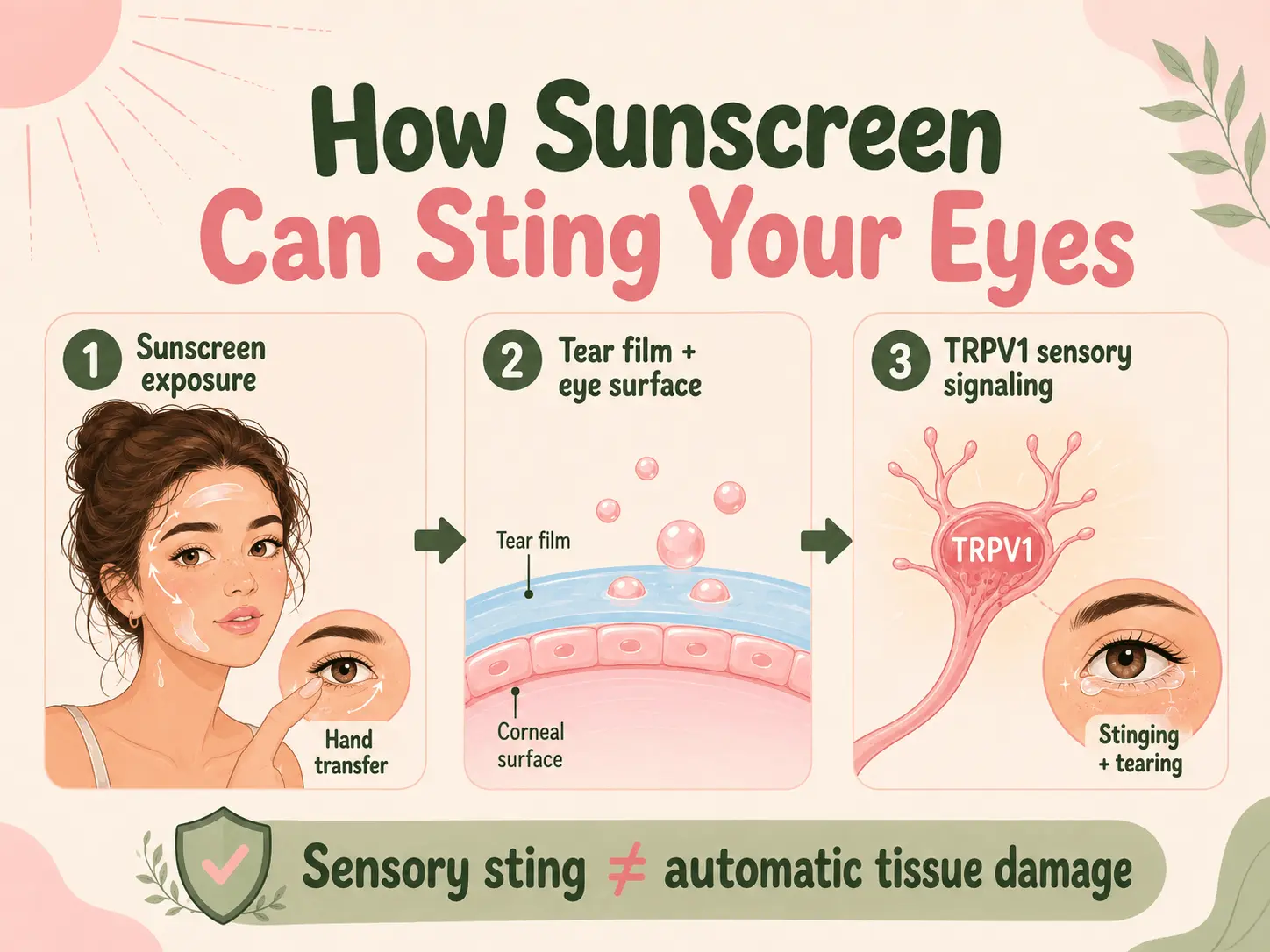
Sunscreen can burn or sting when the formula reaches the highly sensitive ocular surface. The cornea is densely innervated, and chemical stimulation can be perceived as stinging or burning.6 Newer sunscreen-specific research shows that at least one tested UV filter can activate TRPV1-linked sensory signaling even when conventional damage-oriented irritation assays classify it as non-irritating: in a 2026 laboratory study, octocrylene activated TRPV1-linked calcium signaling, while octinoxate did not in the same model.1 But the UV filter is not always the whole story. Some surfactants have direct ocular-irritation evidence, while other vehicle properties may also contribute but are less well studied specifically for sunscreen eye sting. A practical approach is to reduce eye exposure and switch to a finished formula you tolerate while maintaining sun protection.
Stinging is not identical to visible tissue damage. The 2026 UV-filter study found that both octocrylene and octinoxate were classified as non-irritating in BCOP and short-time exposure assays, yet octocrylene still activated TRPV1 signaling in a corneal-cell model.1 This shows that sensory-sting potential and damage-oriented irritation classification are not identical endpoints.
Start rinsing immediately. Poison Control recommends plenty of room-temperature running water for 15 to 20 minutes while blinking.7 Remove contact lenses if present. Do not rub the eye. Severe pain, persistent redness, swelling or any vision change after rinsing warrants urgent medical assessment.
In this guide
- Why sunscreen feels like it burns
- 7 evidence-informed causes
- Which UV filters are actually implicated?
- Is mineral sunscreen better for the eyes?
- Why sweat changes everything
- Why some eyes are more sensitive
- How to stop sunscreen stinging
- What to do if sunscreen gets in your eyes
- Common claims fact-checked
- Frequently asked questions
Why can sunscreen burn your eyes so badly?
Your ocular surface is built to detect danger quickly. Human experiments show that chemical stimulation of the cornea produces strong irritation, stinging and burning sensations, and the cornea is generally more sensitive than the conjunctiva.6 That sensitivity can trigger protective responses such as blinking and reflex tearing when an irritant reaches the ocular surface.
One important family of sensors is the transient receptor potential, or TRP, channels. TRP channels participate in sensory responses to chemical, thermal and osmotic stimuli. Sunscreen-specific research has focused on TRPV1, the capsaicin-sensitive ion channel that also participates in nociceptive signaling. A 2019 sunscreen-tolerance paper used a TRPV1-based NociOcular assay as one tier of its eye-sting testing program, and a 2026 study used TRPV1-overexpressing corneal epithelial cells to investigate individual UV filters.12
Sensory-sting potential and tissue-damage classification are not identical endpoints: in one 2026 in vitro study, octocrylene activated TRPV1-linked signaling despite non-irritant BCOP and STE results.
Why “sting” and “irritation” are not perfect synonymsThe tear film matters too. Hyperosmolar conditions can increase activity in corneal sensory nerve endings, supporting a plausible link between tear-film stress and altered ocular sensation.5 Surfactants are another plausible contributor: repeated low-dose ocular exposure to one surfactant damaged corneal epithelium in a mouse model, although that study was not about sunscreen specifically.4
Why does sunscreen burn my eyes? 7 evidence-informed causes
These are contributors, not seven universal causes that apply to every sunscreen. Direct sunscreen-specific evidence is strongest for some items and much weaker for others.
1. The sunscreen physically migrates into your tear film
Direct exposure logic · strongA product sitting on intact facial skin is very different from the same formula reaching the ocular surface. FDA guidance tells users to avoid the eyes when applying sunscreen, and spray sunscreen should not be sprayed directly onto the face.8 Poison Control likewise notes that creams, lotions and especially sprays can accidentally reach the eyes and cause irritation.7
Clue, not proof: if the sunscreen feels comfortable at first but starts burning after exercise, heat, rubbing, swimming or touching your eyes, product transfer or migration is a plausible explanation.
What helps: follow the product directions, avoid applying spray directly to the face, keep sunscreen-coated hands away from the eyes, and use a hat or sunglasses as additional protection. Trying a different finished formula or a precisely applied stick is reasonable, but neither strategy is proven universally superior for preventing eye sting.
2. A UV filter activates ocular sensory pathways
Direct filter evidence · emergingThe strongest recent evidence is unusually specific. Zhang and colleagues tested octocrylene and ethylhexyl methoxycinnamate, or octinoxate. Neither was classified as irritating by BCOP or short-time exposure testing, but octocrylene activated TRPV1-linked calcium influx while octinoxate did not.1 This shows that individual UV filters can behave differently and that conventional damage-oriented irritation assays may not capture TRPV1-mediated sensory-sting potential.
What it does not prove: that octocrylene always burns, that octinoxate never burns, or that every organic UV filter is worse than every mineral filter. Finished formulas contain combinations of filters and many inactive ingredients.
3. Some surfactants can disturb the ocular surface
Mechanistic evidence · not sunscreen-specificSunscreen is an emulsion, dispersion or solution, so inactive ingredients are essential to keep filters spreadable and stable. Some surfactants can be irritating to ocular tissues. In a 2021 mouse study, repeated exposure to low-dose disodium cocoamphodiacetate damaged corneal epithelium and increased markers of cell death.4 Other personal-care-product testing also shows that ocular irritation varies with formulation and surfactant system, although those data are not sunscreen-specific.11
The practical point is not to blacklist every surfactant or emulsifier. The finished formula matters, and an ingredient list alone cannot reliably predict eye sting. If two sunscreens use similar UV filters but only one stings, the vehicle may be part of the difference.
4. Tear-film conditions can influence ocular sensation
Ocular physiology · indirect sunscreen evidenceTear-film homeostasis affects ocular-surface sensation. Experimental work found that increasing tear-fluid osmolality increased firing of corneal cold thermoreceptor endings, with stronger effects as osmolality rose.5 This does not show that sunscreen itself raises tear osmolarity enough to cause eye sting; it only supports the broader point that osmotic stress can alter corneal sensory signaling.
Important limitation: dry, gritty or irritated eyes may coexist with an unstable ocular surface, but symptoms alone cannot prove that tear-film changes are the reason a particular sunscreen stings.
5. The entire finished formula has poor ocular tolerance for you
Product-level evidence · moderateOcular tolerance is a property of the whole sunscreen, not just its active filters. In 2026, researchers tested 41 moisturizers and sunscreens sold in Algeria using HET-CAM. Overall, 36.6% of the creams caused some irritation in that model, but the rate among sunscreens specifically was 25%.3 That study does not tell us which products will sting a particular person's eyes, but it demonstrates real product-to-product variability.
At the other end of the spectrum, a 2019 facial sunscreen performed well in EpiOcular testing, showed minimal TRPV1 activation, and was well tolerated in controlled human instillation testing.2 Good ocular tolerance is therefore achievable.
6. Spray droplets or hand transfer can deliver product directly to the eye
Exposure pathway · strongAccidental spray exposure can deposit sunscreen near or directly onto the ocular surface. FDA specifically says spray sunscreen should never be applied directly to the face.8 A safer technique is to spray into the hands first, then apply to facial skin while avoiding the eyes.
Hands are another route. Sunscreen on your fingers can be transferred straight into the eye when you rub, wipe sweat or adjust contact lenses.
7. Your eyes are already sensitized or the barrier is compromised
Plausible · indirect sunscreen evidenceDry-eye disease is associated with loss of tear-film homeostasis and can involve tear-film instability, hyperosmolarity and neurosensory abnormalities.10 Experimental work also shows that tear-fluid hyperosmolality can alter corneal nerve activity.5 These findings make it plausible that an already symptomatic ocular surface could respond differently to the same sunscreen exposure, but this has not been quantified in sunscreen-specific trials.
But this is an area where the research pack was more confident than the direct evidence allows. Direct controlled evidence quantifying sunscreen-eye-sting risk in people with dry eye, contact lenses or recent eye surgery is limited. If you have ongoing eye disease or have recently had eye surgery, product-specific advice from your eye-care professional is more appropriate than internet ingredient rules.
Which sunscreen ingredients are actually most likely to sting eyes?
There is no scientifically defensible master ranking of every UV filter from “worst” to “best” for the eyes. The available evidence is too sparse and too formulation-dependent. Online discussions often single out avobenzone, oxybenzone, homosalate and octocrylene, but direct controlled evidence for human eye sting is not equally strong across these filters.
| Ingredient / group | What the evidence supports | What not to conclude |
|---|---|---|
| Octocrylene | Activated TRPV1-linked calcium signaling in a 2026 corneal-cell model despite negative classic irritation assays.1 | Not proof that every octocrylene sunscreen will sting every person. |
| Octinoxate | Did not activate TRPV1 in the same 2026 model and was non-irritating in the other assays used.1 | Not proof of universal ocular tolerance across all concentrations or formulas. |
| Avobenzone / oxybenzone / homosalate | Direct controlled evidence linking these individual filters to human sunscreen eye sting is limited. | Do not rank them as universally “high irritation” without product-specific evidence. |
| Zinc oxide / titanium dioxide | Direct comparative human evidence proving that the mineral-sunscreen category causes less eye sting is limited. | Mineral sunscreen is not automatically tear-free because the finished vehicle and other ingredients still matter. |
| Some surfactants | Ocular irritation is chemistry- and concentration-dependent; repeated low-dose exposure to one surfactant damaged corneal epithelium in an animal model.4 | Do not generalize those findings to every surfactant or emulsifier. |
| Alcohol, fragrance, preservatives | These are plausible formulation-specific contributors, but direct sunscreen-specific ocular-sting evidence for these groups is limited. | An INCI list alone cannot predict eye sting reliably. |
If sunscreen A stings your eyes and sunscreen B does not, that real-world finished-formula difference is more informative than trying to identify one “bad” ingredient from the label. Keep a note of formulas that work and compare patterns over several products before blaming a single filter.
Is mineral sunscreen better if sunscreen burns your eyes?
It can be a very reasonable experiment, but it is not a guarantee. Mineral sunscreens use zinc oxide, titanium dioxide or both as UV filters. A stick can offer more precise placement than a fluid product, but direct comparative trials have not established that mineral sticks universally migrate less or prevent eye sting better than lotions.
The research does not justify saying mineral filters are universally non-irritating while organic filters are universally irritating. The 2019 ocular-tolerance study showed that one facial sunscreen could achieve very good eye tolerance in a tiered testing program; it did not establish a mineral-versus-organic class comparison.2 And the 2026 HET-CAM survey showed product-level variability rather than proving a simple mineral-versus-organic split.3
A stick around high-migration areas
Sticks give you precise placement. Whether that translates into less runoff or less eye sting than a lotion has not been established in direct comparative trials.
An ocular-tolerance-tested facial SPF
Product-level ocular-tolerance testing is more directly relevant than inferring tolerance from a “mineral” label alone.
Why does sunscreen burn my eyes only when I sweat?
This pattern is consistent with increased product movement during sweating, but it does not prove the mechanism. Sunscreen films can be affected by sweating, which is why water resistance and reapplication during sweating are addressed in sunscreen labeling and FDA guidance.8 If product reaches the eyelid margin or tear film, the ocular surface is exposed directly.
This can explain why a product feels comfortable indoors yet stings during exercise. Practical options include following the product directions, using a water-resistant sunscreen when sweating, minimizing rubbing around the eyes, and trying a more precisely applied formula if needed.
- Apply sunscreen according to the product directions before sun exposure.
- Use a water-resistant sunscreen when sweating and follow its reapplication directions.8
- Try a stick on the forehead or temples if precise placement helps you avoid accidental eye exposure; this is a practical trial, not a proven universal fix.
- Blot sweat instead of rubbing sunscreen toward the eyes.
- Wear sunglasses, a cap or visor for extra UV protection.
Why do some people tolerate the same sunscreen and others cannot?
Eye sting is not a simple yes/no property of a molecule. Exposure dose, tear-film condition, ocular sensitivity, formula concentration, application pattern and individual sensory thresholds all matter. Human corneal testing shows substantial sensitivity to chemical stimuli, and experimental tear-film research shows sensory firing changes with osmotic conditions.56
Individual sensory thresholds and ocular-surface conditions can differ, so subjective responses to the same product can vary. The available evidence does not allow a precise prediction of who will sting from a particular sunscreen.
How to stop sunscreen from burning your eyes
Reduce migration and change the formula, not the protection goal.
FDA recommends broad-spectrum sunscreen as part of a larger sun-protection strategy and tells users to avoid the eyes during application.8 A hat and sunglasses can reduce UV exposure around the eyes while you troubleshoot a sunscreen you can actually tolerate.
- Stop spraying sunscreen directly onto your face. FDA specifically advises against direct facial spray application.8 Spray into your hands first, then apply carefully.
- Test the sunscreen on a normal, non-sweaty day. If it only stings during exercise, migration is a plausible contributor, but the pattern does not prove it.
- Try a different finished formula. Do not assume switching one isolated ingredient will solve it. Ocular tolerance varies at the product level.23
- Consider a stick around the forehead and high-migration areas. A stick provides precise placement, which may help you avoid accidental eye exposure; direct evidence that it reduces runoff or eye sting compared with lotions is limited.
- Follow the sunscreen label before activity. FDA general directions advise applying sunscreen 15 minutes before sun exposure for photoprotection, but that timing has not been proven as a specific eye-sting prevention rule.8
- Keep sunscreen-coated hands away from the eyes. Wash or wipe fingers before adjusting lenses or rubbing your eyelids.
- Use physical protection too. Sunglasses and a brimmed hat reduce UV exposure without adding more product near the eye.
- If your eyes are chronically dry or inflamed, deal with that separately. Recurrent burning from many unrelated products is a reason to discuss ocular-surface health with an optometrist or ophthalmologist.
What should I do if sunscreen gets in my eyes?
Poison Control's advice for sunscreen or similar products in the eyes is straightforward: rinse immediately with plenty of running water for 15 to 20 minutes and blink while rinsing.7 Do not wait for the burning to “wear off” before you start flushing.
- Begin rinsing now. Use room-temperature running water.
- Keep blinking while the water runs across the eye. This helps wash material out of the tear film and under the lids.
- Remove contact lenses. Poison Control advises removing them while irrigating the eye; do not delay immediate rinsing.9
- Do not rub the eye. Friction can worsen surface irritation.
- Get urgent medical help for severe or persistent symptoms. Vision changes, significant swelling, severe pain or continuing redness after thorough irrigation need assessment.
Poison Control describes sunscreen eye exposure as generally low in toxicity, but persistent or severe symptoms after proper irrigation still require medical assessment.7
Sunscreen eye-burning myths: fact-checked
Direct research shows individual organic filters can behave differently, and at least one finished facial sunscreen has shown good ocular tolerance in controlled testing.12
The complete formula still reaches the eye if it migrates. Filter class is only one variable.
TRPV1-linked sensory signaling can be detected even when conventional damage-oriented irritation assays classify a tested material as non-irritating.1
Your response to the finished product and any product-level ocular-tolerance data are more informative than a one-ingredient blacklist.
Related: If your sunscreen is not stinging but instead rolls into little flakes or “eraser crumbs,” read Why Does My Sunscreen Pill? 8 Reasons + How to Stop It.
The bottom line
Sunscreen eye sting is real, but the science does not support reducing the issue to “chemical filters are irritating and mineral filters are safe.” The most direct new evidence shows that at least one common filter, octocrylene, can activate a TRPV1-linked sensory pathway in vitro while another, octinoxate, did not in the same assay.1 Product-level studies show variability: some sunscreen products were irritating in an ocular model, while one tested facial sunscreen showed good tolerance across cell-based, TRPV1 and controlled human testing.23
A practical strategy is to minimize accidental eye exposure, switch finished formulas when one repeatedly stings, consider a stick if precise placement is useful, and use sunglasses or a hat as additional UV protection. If sunscreen actually gets in the eye, rinse immediately and thoroughly.7
Frequently asked questions
Why does sunscreen burn my eyes?
Because the finished formula has reached the ocular surface and can stimulate sensitive corneal or conjunctival pathways. Direct sunscreen-specific evidence includes TRPV1-linked signaling from octocrylene in an in vitro model; other formulation factors may contribute, but their sunscreen-specific evidence is less direct.16
Can octocrylene contribute to eye sting?
It may. A 2026 in vitro study found TRPV1-linked activation from octocrylene, but it did not prove that every octocrylene sunscreen causes clinical eye sting.1
Is mineral sunscreen better for sensitive eyes?
It is reasonable to test one, but direct comparative human evidence that mineral sunscreens sting less is limited. The finished formula still matters, and a stick is mainly a precise-placement option rather than a proven universal fix.
Why does sunscreen sting only when I sweat?
Sweating can affect sunscreen films. If a sunscreen is comfortable until exercise or heat, migration toward the eye is a plausible contributor, but that pattern does not prove the cause.
Can sunscreen damage the eye?
Accidental sunscreen eye exposure is generally expected to cause irritation rather than severe toxicity, but persistent pain, marked redness or vision changes after thorough rinsing need urgent assessment.
How long should I rinse sunscreen out of my eyes?
Poison Control recommends immediate irrigation with plenty of running water for 15 to 20 minutes while blinking.7
Should I stop wearing sunscreen around my eyes?
No. Avoid getting sunscreen in the eyes themselves, but protect surrounding skin with a well-tolerated formula and use sunglasses or a hat for additional UV protection. FDA specifically says to avoid the eyes when applying sunscreen.8
Are “non-sting” sunscreens actually tested?
Some are. A published 2019 sunscreen study combined a tissue irritation assay, a TRPV1-based sting assay and controlled human testing, showing that product-level ocular tolerance can be evaluated scientifically.2
References
- Zhang T, Sun F, Liu Y, et al. Leveraging a TRPV1-overexpressing cell model: an integrated testing strategy for UV filter-induced ocular irritation. Cutaneous and Ocular Toxicology. 2026;45(2):243-250. doi:10.1080/15569527.2026.2649261.
- Narda M, Ramos-Lopez D, Mun G, Valderas-Martinez P, Granger C. Three-tier testing approach for optimal ocular tolerance sunscreen. Cutaneous and Ocular Toxicology. 2019;38(3):212-220. doi:10.1080/15569527.2019.1601106.
- Mecheri I, Djafer R, Belmahi MH. Assessment of ocular irritation potential of moisturizing and sunscreen cosmetic creams marketed in Algeria using the HET-CAM test. Toxicology in Vitro. 2026;111:106168. doi:10.1016/j.tiv.2025.106168.
- Wu J, Wu T, Zheng S, Huang Y, Wang L. Low-dose repeated exposure to chemical surfactant impairs corneal epithelium: When personal cleaning products entering the eye. Experimental Eye Research. 2021;210:108696. doi:10.1016/j.exer.2021.108696.
- Parra A, Gonzalez-Gonzalez O, Gallar J, Belmonte C. Tear fluid hyperosmolality increases nerve impulse activity of cold thermoreceptor endings of the cornea. Pain. 2014;155(8):1481-1491. doi:10.1016/j.pain.2014.04.025.
- Acosta MC, Tan ME, Belmonte C, Gallar J. Sensations evoked by selective mechanical, chemical, and thermal stimulation of the conjunctiva and cornea. Investigative Ophthalmology & Visual Science. 2001;42(9):2063-2067.
- National Capital Poison Center. Suntan lotion and insect repellent in the eyes. Poison Control. Accessed August 12, 2026.
- U.S. Food and Drug Administration. Sunscreen: How to Help Protect Your Skin from the Sun. Accessed August 12, 2026.
- National Capital Poison Center. Splashed a poison in your eye? Poison Control. Accessed August 12, 2026.
- Craig JP, Nichols KK, Akpek EK, et al. TFOS DEWS II Definition and Classification Report. Ocular Surface. 2017;15(3):276-283. doi:10.1016/j.jtos.2017.05.008.
- Donahue DA, Kaufman LE, Avalos J, Simion FA, Cerven DR. Survey of ocular irritation predictive capacity using Chorioallantoic Membrane Vascular Assay (CAMVA) and Bovine Corneal Opacity and Permeability (BCOP) test historical data for 319 personal care products over fourteen years. Toxicology in Vitro. 2011;25(2):563-572. doi:10.1016/j.tiv.2010.12.003.
Medical note: This article is educational and does not diagnose or treat eye disease. Seek urgent medical care for significant eye pain, vision changes, marked swelling, a suspected corneal injury or symptoms that persist after thorough irrigation.
Research first. Panic never. ♡