
Medicube Rosemary PDRN Scalp Serum is best considered a cosmetic scalp-care purchase, not a proven replacement for hair-loss treatment. The brand reports improvements in hair thickness and flakiness, but those outcomes are different from demonstrating new hair growth. Consider it for its leave-in format and scalp-care role; do not buy it expecting the evidence behind minoxidil.
“Rosemary,” “PDRN” and “fuller-looking hair” put three attractive ideas into one pink tube. Before buying, separate your goal: a more comfortable scalp, less visible flaking, better-looking roots or treatment for progressive thinning.
This review looks at the 20 mL Rosemary PDRN Scalp Serum, also sold with Refresh & Nourish wording. It uses official product information, the published retailer ingredient list and hair-loss guidance. We have not personally tested its cooling sensation, residue, applicator or long-term results.
Medicube Rosemary PDRN Scalp Serum
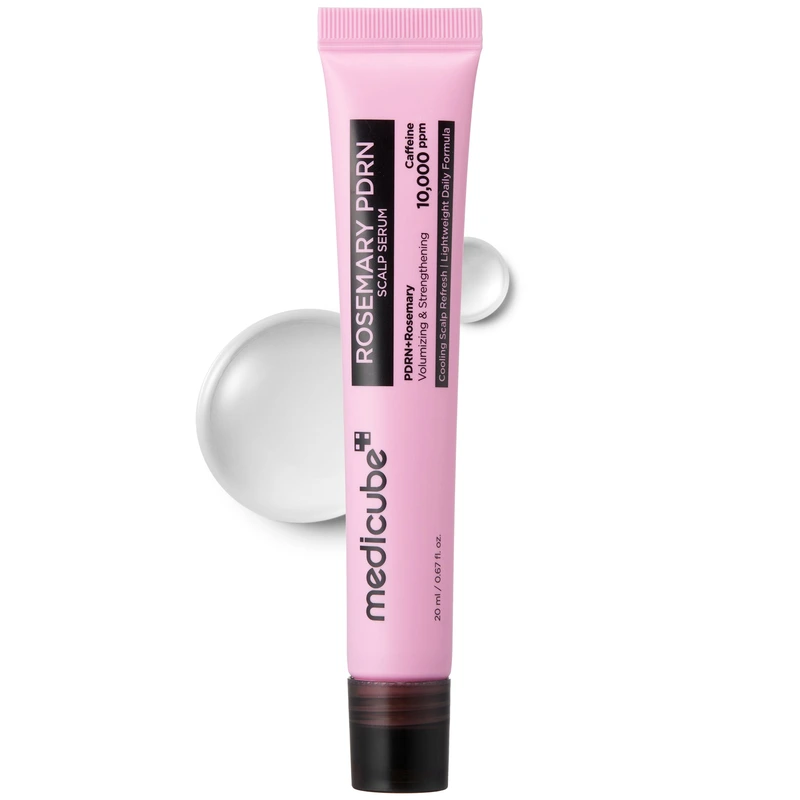
Pack pictured: 20 mL / 0.67 fl oz
Brand positioning: Lightweight care for thicker, fuller-looking hair
Buying distinction: Cosmetic appearance versus demonstrated regrowth
This is the scalp product, not Medicube's facial PDRN serum. Choose by the full product name and pack size rather than the brand's pink packaging alone.
Does Medicube Scalp Serum actually grow hair?
The public claims reviewed do not establish that it regrows hair or treats pattern hair loss. Medicube reports scalp and hair measurements, including a four-week thickness result. A change in strand thickness is not the same measurement as an increase in hair count.
| Published result | Why it is relevant | What it does not establish |
|---|---|---|
| 23.2% improvement in root hair thickness after four weeks | A thickness-related cosmetic outcome | New follicles, more hairs or reversal of pattern hair loss |
| 53.2% reduction in scalp flakiness after four weeks | A scalp appearance outcome | A diagnosis-specific dandruff treatment result |
| 14.17% increase in scalp cooling sensation after one use | An immediate sensory measurement | Better follicle activity or a prediction of regrowth |
These figures appear on Medicube's listing, which names the testing institute.1 The public summary does not supply enough protocol detail to confidently assess the control, participant selection, measurement technique or how results vary between users. It also leaves questions about whether every listed outcome belongs to the serum alone or a broader routine.
The fair conclusion is neither “the tests mean nothing” nor “the serum grows hair.” They give specific claims to investigate, while leaving important gaps. For a regrowth claim, we would want a controlled trial of this exact finished product with relevant hair-count outcomes and sufficient follow-up.
What is in Medicube Rosemary PDRN Scalp Serum?
Ulta's published list starts with water and Alcohol Denat., then includes caffeine, hydrolyzed sponge, menthol and fragrance. It also discloses Sodium DNA at 100 ppb and rosemary leaf extract at 0.2 ppb.2 These are retailer-published label values, not our laboratory measurements.
How much PDRN and rosemary is that?
Taking the displayed units literally, 100 ppb equals 0.00001%, while 0.2 ppb equals 0.00000002%. Those conversions are arithmetic, not evidence about what dose works. “ppb” means parts per billion; it is not interchangeable with “ppm,” which means parts per million.
The photographed official tube separately says caffeine 10,000 ppm. That equals 1%, but it is a different ingredient and disclosure. A conspicuous number beside one active cannot be reassigned to PDRN because the product's name emphasizes PDRN.
These tiny listed values make it especially important to request finished-product evidence rather than borrow results from a different rosemary preparation or PDRN treatment. They do not prove that the whole serum is ineffective. They also do not identify an established minimum effective dose or tell us what contribution each ingredient makes.
The online list could be revised, and formulas can differ by market. If your box shows different units or concentrations, do not combine those numbers with this version's review. Ask Medicube to clarify any discrepancy.
Cooling is a feeling, not a regrowth test
A tingling or fresh sensation can make a product seem active. It is not a reliable way to measure hair growth. Decide whether the application is comfortable rather than treating stronger tingling as a better result.
We would be cautious about choosing this as a first experiment for a scalp that is already sore or reactive. The disclosed fragrance, menthol and alcohol are relevant to that decision, but the ingredient list alone cannot predict whether you personally will react. Repeated irritation is a reason to stop, not a sign that the serum is working harder.
Does the rosemary-versus-minoxidil study apply?
A frequently cited 2015 trial compared a rosemary-oil preparation with 2% minoxidil in 100 people over six months. Its abstract reported increased hair counts in both groups at six months and no significant difference between groups.3
That is not a trial of Medicube. Rosemary oil and a finished cosmetic containing rosemary leaf extract are not automatically interchangeable. Neither the preparation nor its dose can be assumed to match this tube.
Also, a study that does not detect a difference does not automatically prove that two treatments are equivalent. “Rosemary is as good as minoxidil” is a broader claim than that result can confidently support.
If your goal is treating ongoing thinning, start with the cause. The AAD explains that hair-loss treatment depends on diagnosis and includes options such as minoxidil for appropriate patients.5 A cosmetic serum may be something you enjoy using, but it should not delay assessment of a widening part, patchy loss or persistent shedding.
What about PDRN, EGF and the spicules?
Medicube highlights PDRN, EGF, caffeine and an ultra-fine spicule application concept.1 That tells you what the brand emphasizes. It does not identify which component caused a finished-product result.
Medical PDRN research concerns particular materials, doses and delivery routes. The published pharmacology review covers uses including tissue repair; it is not clinical validation of this leave-in cosmetic.4 A scalp-serum claim needs evidence about the scalp serum.
Spicules also do not make the product equivalent to a professionally delivered treatment. We would want direct measurements before claiming that they deliver a meaningful PDRN dose to the relevant tissue. Do not add home microneedling to try to make the serum “work better.”
Our topical PDRN versus injections guide explains that evidence gap in more detail. It is the same question we ask of facial products: was this result demonstrated for the exact cosmetic, or borrowed from another setting?
How do you use the Medicube scalp serum?
Ulta's directions say to lightly towel-dry after shampooing, part the hair, apply to the scalp and massage gently. Its precautions advise stopping if irritation occurs.2 Follow your package for the current directions and amount. This is a leave-in product, not a substitute for washing.
Keep your shampoo and styling routine stable while trying it. Track the outcome you bought it for: comfort, visible flakes, residue or how roots look. Use consistent lighting and the same hair part for photographs; a new hairstyle is not a useful before-and-after comparison.
If flakes are the main issue, investigate that problem rather than assuming every scalp serum is a dandruff treatment. The AAD recommends choosing an appropriate dandruff shampoo and following its directions, with professional advice when symptoms persist.6
Who should buy it, and who should skip it?
Consider it if: you want an optional leave-in scalp-care step, are interested in the applicator and can judge it by cosmetic comfort and appearance. Buy one product to assess, rather than the whole matching range by default.
Skip or reassess if: you need established treatment for progressive hair loss, have an irritated scalp, or expect the rosemary name to reproduce the result of a different clinical preparation. Buying a longer ingredient list does not resolve uncertainty about the cause of thinning.
Compare delivered price and pack size before ordering. Twenty milliliters is a small tube; its value depends partly on how much scalp you intend to cover. We have not measured how many applications one tube provides, so we would not invent a monthly cost.
Our verdict: an interesting cosmetic format with specific but incompletely documented public claims. The better reason to buy is a scalp-care experience you want to try. The evidence reviewed does not justify selling it as a dependable regrowth treatment.
Quick questions
Do I need the matching shampoo and conditioner?
No. A matching range is not proof that all three products are necessary. Start with the product that addresses the role missing from your routine, and keep other changes limited so you can judge it.
Can I apply it over minoxidil?
We did not find a controlled compatibility study of that exact combination. Follow the medication's directions and ask a pharmacist or dermatologist about adding another leave-in scalp product, especially if your scalp is irritated.
Will four weeks be enough to judge hair regrowth?
Do not treat the brand's four-week thickness claim as a universal regrowth timeline. Cosmetic appearance and hair-count outcomes are different. Progressive loss needs an appropriate assessment and treatment plan.
Is it the same as Medicube Pink Peptide Serum?
No. The facial serum has a different formula and use. Our Medicube facial PDRN review evaluates that product separately.
Related reading
Sources and review method
Product information checked September 27, 2026. Manufacturer findings, retailer label disclosures and editorial interpretation are identified separately. Product photography belongs to the respective brand; the banner is an AI-generated editorial illustration, not a photograph or proof of results.
- Medicube — Rosemary PDRN Scalp Serum, claims, directions and official product image.
- Ulta Beauty — ingredient list, disclosed ppb values and application directions.
- Panahi et al. (2015) — rosemary oil versus 2% minoxidil, randomized comparative trial.
- Squadrito et al. (2017) — Pharmacological Activity and Clinical Use of PDRN.
- American Academy of Dermatology — hair loss diagnosis and treatment.
- American Academy of Dermatology — how to treat dandruff.
This article is educational buying guidance, not a diagnosis or treatment plan. Persistent skin or scalp symptoms and ongoing hair loss deserve professional assessment.
Hot girls read the research. ♡