
Shower filters are often sold like skincare products. They are promoted for clearer skin, calmer eczema, softer hair and less shedding. The reality is more limited.
Water chemistry can affect how skin and hair feel. Hard water can increase the deposition of certain surfactants on skin, and minerals or metals can collect on hair fibres. But that does not mean every shower filter treats acne, eczema or hair loss. [8][16][17]
This article is not sponsored. Stylish & Healthy did not receive or personally test either product. The review is based on public documentation. The Qure shopping link is an Amazon affiliate link. As an Amazon Associate, Stylish & Healthy may earn from qualifying purchases at no extra cost to you.
This is a research-based evidence and marketing-claim review. Stylish & Healthy did not independently laboratory-test the Qure cartridge. The product appears straightforward to install based on its published design and instructions, but this review did not independently assess installation or long-term use.
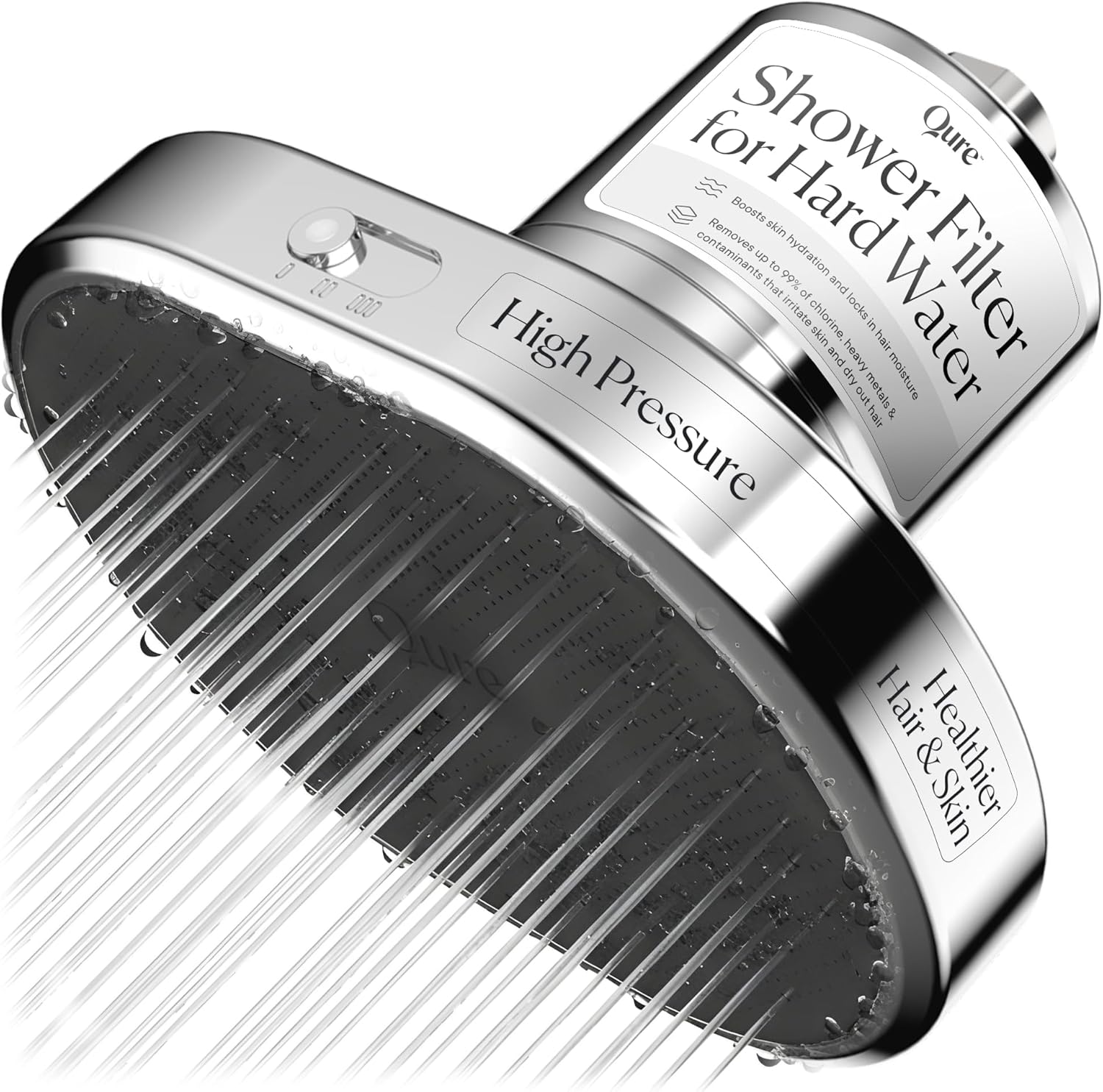
Product image via Amazon.
Qure Shower Filter
Qure is designed and manufacturer-reported to reduce free chlorine. Its filtration media are technically plausible, but the publicly available test documentation is incomplete.
The 5.8/10 rating is an editorial evidence-and-transparency score, not a clinical effectiveness score.
View the Qure Shower FilterAmazon affiliate link: Stylish & Healthy may earn from qualifying purchases at no extra cost to you.
Qure is designed and manufacturer-reported to reduce free chlorine. Its filtration media are technically plausible, but the public test documentation is incomplete. It is not proven to treat acne, eczema or hair loss, and its limescale claim does not prove that it softens hard water. Stylish & Healthy rating: 5.8/10.
Table of Contents
What is the Qure Shower Filter designed to do?
Qure uses three filtration layers:
- Carbon fibre for free-chlorine reduction.
- KDF-55, a copper-zinc medium that is technically capable of reacting with chlorine and some soluble metals.[21]
- FOF media, which Qure says helps limit scale buildup.
Qure reports up to 99% chlorine reduction when the cartridge is new, 95% after 4,000 litres and 90% after 6,000 litres. It recommends replacement at around 5,000 litres or three months. These are manufacturer-reported figures.[1] [2]
The missing detail matters. The public materials reviewed did not include the complete laboratory report, incoming contaminant levels, water temperature, flow rate, variation between units or equivalent capacity data for the other contaminants named in marketing.
Free-chlorine reduction is the strongest part of Qure's case. Claims about broad metal removal, microplastics, microorganisms, chloramine, water softening and clinical skin benefits are less well documented publicly.
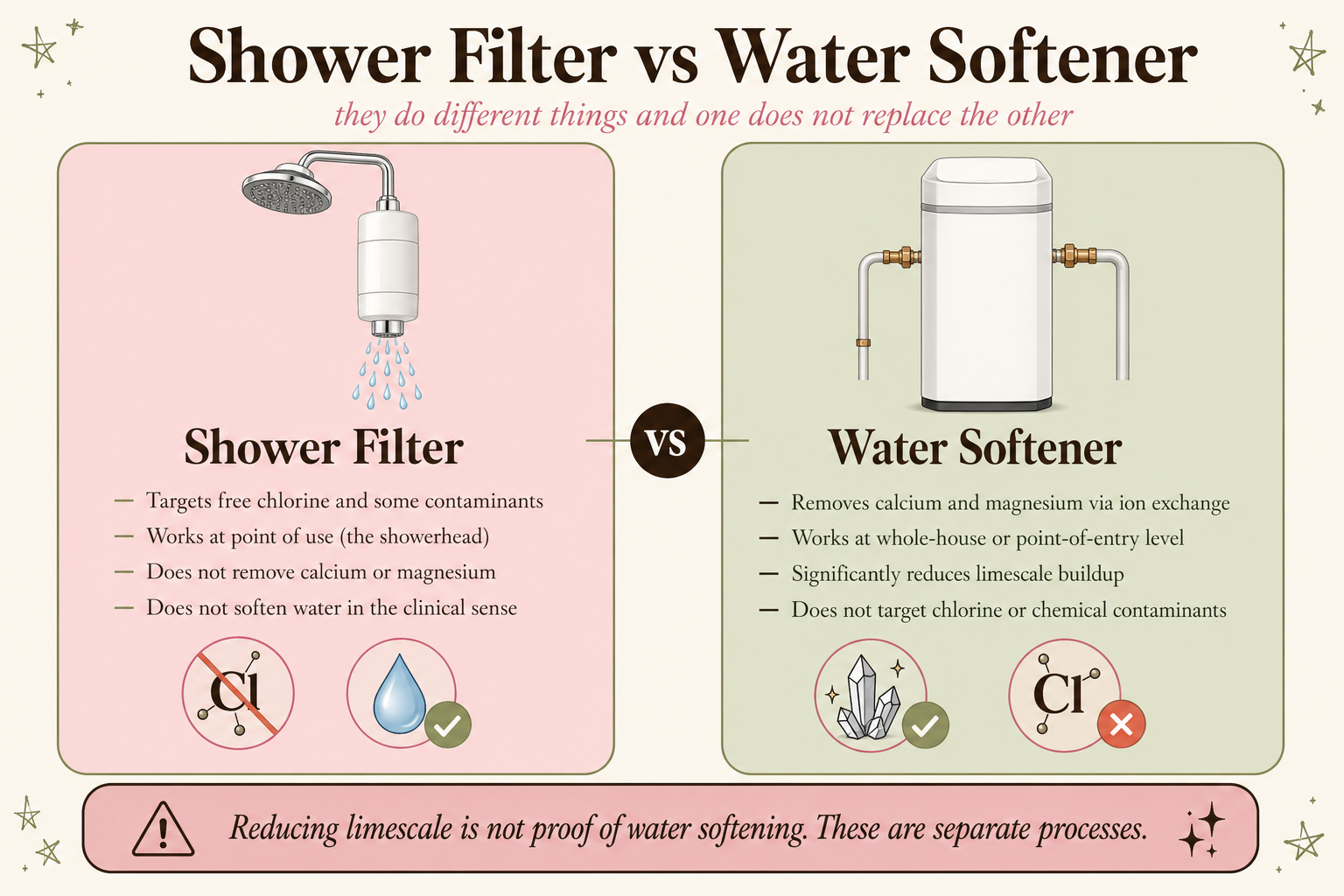
A shower filter is not the same as a water softener
Hard water contains dissolved calcium and magnesium. The US Geological Survey classifies 121 to 180 mg/L as CaCO3 as hard and anything above 180 mg/L as very hard. Hard water can leave scale and make soap harder to rinse.[5]
A true ion-exchange water softener removes calcium and magnesium by exchanging them for sodium or potassium. That technology is covered by NSF/ANSI 44. A shower cartridge that reduces chlorine or limits visible scale has not necessarily lowered measured hardness.[3]
Less visible limescale does not automatically mean softer water. Qure claims that its FOF layer helps limit scale accumulation, but no public before-and-after calcium, magnesium or total-hardness results were identified.
Free chlorine is not chloramine
Some water systems disinfect with free chlorine. Others use chloramine, which combines chlorine with ammonia and stays active for longer in water pipes.[6]
Testing for free-chlorine reduction should not be treated as proof of chloramine reduction. Public product information reviewed for this article did not verify that Qure reduces chloramine.
Can shower filters help acne or eczema?
Acne
No robust peer-reviewed human trial was identified showing that a shower filter reduces acne lesion counts or validated acne-severity scores.
Acne develops inside the hair follicle and involves oil production, blocked pores, inflammation and microbial factors. Evidence-based treatments include retinoids, benzoyl peroxide, salicylic acid, antibiotics and hormonal treatments when appropriate.[12] [13]
A filter could still make cleansing feel more comfortable for some people, especially when acne treatments already cause dryness or burning. That is a comfort benefit, not proof that the filter treats acne.
Eczema
The eczema evidence is more complicated. Studies have found an association between hard water and childhood eczema, but the overall certainty is low because much of the evidence is observational. [7]
One controlled human study found that hard water increased sodium lauryl sulfate deposition on skin and was linked with greater water loss and irritation. The effect was stronger in people with atopic dermatitis or skin-barrier vulnerability.[8]
However, the largest treatment trial was negative. The SWET trial included 336 children with moderate-to-severe eczema in hard-water areas. Adding a whole-home ion-exchange softener to usual eczema care did not produce a meaningful improvement.[9]
A smaller prevention pilot in high-risk babies was interesting but inconclusive, and a 12-person vitamin C showerhead study did not show a significant benefit. Neither study tested Qure. [10][11]
A shower filter may improve comfort for some people with dry or sensitive skin, but it should not replace moisturiser, prescribed eczema treatment or proven acne care. Shorter lukewarm showers have a clearer practical rationale because hotter and prolonged water exposure can increase skin-barrier disruption.[14]
Can Qure improve hair or scalp health?
Hair claims often mix up three different outcomes:
- How soft, smooth or shiny the hair feels.
- How much the hair shaft breaks.
- Whether the follicle grows new hair.
Hard-water studies are small and inconsistent. Some found more mineral deposition or changes in hair measurements after hard-water exposure. Others found no meaningful difference in strength, elasticity or surface damage.[15] [16][17]
Copper in hair fibres can increase oxidative damage, especially after UV exposure or chemical processing. That makes metal reduction a plausible cosmetic target. It does not prove that Qure removes enough copper under real shower conditions to change hair outcomes.[18] [19]
No credible evidence shows that shower filters regrow hair or treat androgenetic alopecia, alopecia areata or chronic shedding. Systemic toxic-metal exposure can cause hair loss, but that is not the same as ordinary household shower-water exposure.[20]
A filter may improve softness, residue or manageability for some users whose water contains relevant minerals or metals. It should not be marketed as a hair-growth treatment.
What do the testing and NSF claims actually mean?
Qure says the filter is third-party tested to meet NSF water-filtration standards. Its refill page also uses the phrase “Exceeds NSF-177 certifications.”[2]
As of July 9, 2026, Qure was not listed by brand in NSF's public NSF/ANSI 177 shower-filter directory. A certification could theoretically appear under a legal manufacturer or OEM, but Qure's public materials did not provide a verifiable listing number.[4]
NSF/ANSI 177 verifies shower-filter requirements including free available chlorine reduction. It does not automatically verify chloramine, hardness, metal, microorganism, microplastic or clinical skin claims. [3]
Qure also reports a 15% increase in skin moisture and a 22% increase in scalp moisture after eight weeks. The public page does not provide enough study detail to judge the sample, controls, statistics or clinical importance. These should be described as manufacturer findings, not established treatment results.
The statement that tap water contains “over 320 chemicals” is also not useful on its own. Detecting a substance does not prove a harmful dose, meaningful skin absorption or relevance to acne, eczema or hair.
Weddell Duo Shower Filter
Weddell publishes clearer public filtration documentation, including a stated NSF/ANSI 177 certification, rated capacity, flow rate and linked third-party reports.[22]
This does not prove that Weddell treats acne, eczema or hair loss. It simply makes it easier to verify the free-chlorine claim.
Is the Qure Shower Filter worth buying?
You know your water uses free chlorine, dislike the chlorine smell or post-shower tightness, and want a polished point-of-use filter. You understand that results may be cosmetic or comfort-based.
Your main problem is very hard water, chloramine, acne, eczema flares, hair loss or a medical scalp condition. Those goals need water testing, a true softener or evidence-based treatment.
Before buying, check your local water report. Find out whether the disinfectant is free chlorine or chloramine and note the hardness level. A filter is only useful when its verified target matches the water problem you actually have.
When testing any filter, change one thing at a time. Take photos in the same lighting and track one outcome, such as post-shower tightness or hair manageability, for several weeks. Do not change skincare, shampoo and shower habits at the same time.
5.8/10. Qure is a plausible chlorine-focused comfort product with attractive design and limited public capacity data. Its marketing reaches beyond the evidence. Buy it for a realistic free-chlorine goal, not as an acne, eczema, hard-water or hair-loss treatment.
Frequently asked questions
Does Qure help acne?
No good human trial shows that shower filters reduce acne lesions. Some users may notice less dryness or tightness, but that is different from treating acne.
Can Qure cure eczema?
No. Water changes may affect comfort, but the largest trial of whole-home softening found no meaningful additional benefit in children with moderate-to-severe established eczema.
Does Qure soften hard water?
Not proven. Qure says its FOF layer limits scale, but no public calcium, magnesium or total-hardness results were identified.
Is Qure NSF certified?
As of July 9, 2026, Qure was not listed by brand in NSF's public NSF/ANSI 177 directory. A listing could theoretically exist under an OEM or legal manufacturer, but Qure did not provide a verifiable listing number in the public materials reviewed.
Does Qure remove chloramine?
Public product information did not verify chloramine reduction. Free-chlorine results should not be assumed to apply to chloramine.
Can a shower filter stop hair loss?
No credible evidence shows that shower filters regrow hair or treat common hair-loss disorders. They may change how hair feels when local water contains relevant minerals or metals.
References
- Qure Skincare. Shower Filter. Accessed July 9, 2026. Qure Skincare.
- Qure Skincare. Shower Filter Refill. Accessed July 9, 2026. Qure Skincare.
- NSF. NSF Standards for Water Treatment Systems. Accessed July 9, 2026. NSF. NSF/ANSI 177 – Shower Filter Certification. Accessed July 9, 2026. NSF standards overview; NSF/ANSI 177 certification.
- NSF. Search for NSF Certified Drinking Water Treatment Units, Water Filters. Accessed July 9, 2026. NSF certified-product directory.
- U.S. Geological Survey. Hardness of Water. U.S. Geological Survey.
- U.S. Environmental Protection Agency. Chloramines in Drinking Water. Updated March 12, 2026. Accessed July 9, 2026. U.S. EPA.
- Jabbar-Lopez ZK, Ung CY, Alexander H, et al. The effect of water hardness on atopic eczema, skin barrier function: A systematic review, meta-analysis. Clinical & Experimental Allergy. 2021;51(3):430–451. doi:10.1111/cea.13797. PMID: 33259122. PubMed.
- Danby SG, Brown K, Wigley AM, Chittock J, Pyae PK, Flohr C, Cork MJ. The effect of water hardness on surfactant deposition following washing and subsequent skin irritation in atopic dermatitis patients and healthy controls. Journal of Investigative Dermatology. 2018;138(1):68–77. doi:10.1016/j.jid.2017.08.037. PMID: 28927888. PubMed.
- Thomas KS, Dean T, O’Leary C, Sach TH, Koller K, Frost A, Williams HC, the SWET Trial Team. A randomised controlled trial of ion-exchange water softeners for the treatment of eczema in children. PLOS Medicine. 2011;8(2):e1000395. doi:10.1371/journal.pmed.1000395. PLOS Medicine.
- Jabbar-Lopez ZK, Ezzamouri B, Briley A, et al. Randomized controlled pilot trial with ion-exchange water softeners to prevent eczema (SOFTER trial). Clinical & Experimental Allergy. 2022;52(3):405–415. doi:10.1111/cea.14071. PMID: 34854157. PubMed.
- Holt S, Helm C, Corin A, Tofield C, Williams M, Weatherall M. A pilot study of the efficacy of a vitamin C-containing showerhead on symptoms of eczema. New Zealand Medical Journal. 2009;122(1300):91–92. PMID: 19701267. Full report available. PubMed; New Zealand Medical Journal PDF.
- Reynolds RV, Yeung H, Cheng CE, et al. Guidelines of care for the management of acne vulgaris. Journal of the American Academy of Dermatology. 2024;90(5):1006.e1–1006.e30. doi:10.1016/j.jaad.2023.12.017. PMID: 38300170; PMCID: PMC11537166. PubMed Central.
- American Academy of Dermatology Association. Acne: Who Gets and Causes. Accessed July 9, 2026. American Academy of Dermatology Association.
- Herrero-Fernandez M, Montero-Vilchez T, Diaz-Calvillo P, Romera-Vilchez M, Buendia-Eisman A, Arias-Santiago S. Impact of water exposure and temperature changes on skin barrier function. Journal of Clinical Medicine. 2022;11(2):298. doi:10.3390/jcm11020298. PMID: 35053992; PMCID: PMC8778033. PubMed Central.
- Srinivasan G, Srinivas CR, Mathew AC, Duraiswami D. Effects of hard water on hair. International Journal of Trichology. 2013;5(3):137–139. doi:10.4103/0974-7753.125609. PMID: 24574692; PMCID: PMC3927171. PubMed Central.
- Srinivasan G, Chakravarthy Rangachari S. Scanning electron microscopy of hair treated in hard water. International Journal of Dermatology. 2016;55(6):e344–e346. doi:10.1111/ijd.13141. PMID: 26711619. PubMed.
- Alahmmed LM, Alibrahim EA, Alkhars AF, Almulhim MN, Ali SI, Kaliyadan F. Scanning electron microscopy study of hair shaft changes related to hardness of water. Indian Journal of Dermatology, Venereology and Leprology. 2017;83(6):740. doi:10.4103/ijdvl.IJDVL_1119_16. PMID: 28799530. PubMed.
- Grosvenor AJ, Marsh J, Thomas A, Vernon JA, Harland DP, Clerens S, Dyer JM. Oxidative modification in human hair: The effect of the levels of Cu(II) ions, UV exposure and hair pigmentation. Photochemistry and Photobiology. 2016;92(1):144–149. doi:10.1111/php.12537. PMID: 26451514. PubMed.
- Marsh JM, Iveson R, Flagler MJ, Davis MG, Newland AB, Greis KD, Sun Y, Chaudhary T, Aistrup ER. Role of copper in photochemical damage to hair. International Journal of Cosmetic Science. 2014;36(1):32–38. doi:10.1111/ics.12088. PMID: 23962007. PubMed.
- Yu V, Juhász M, Chiang A, Atanaskova Mesinkovska N. Alopecia and associated toxic agents: A systematic review. Skin Appendage Disorders. 2018;4(4):245–260. doi:10.1159/000485749. PMCID: PMC6219226. PubMed Central.
- Kymera International. KDF® 55 and 85 Process Media in Point-of-Entry Water Treatment Systems: Chlorine, Iron and Hydrogen Sulfide Reduction. Technical Bulletin. Accessed July 9, 2026. Kymera International PDF.
- Weddell Water. Weddell Duo Shower Filter. Accessed July 9, 2026. Weddell Water.
Source wording was kept conservative where full test reports or complete methods were not public. Product-page statements are identified as manufacturer claims, not clinical proof.
Medical disclaimer: This article is for education only. Acne, eczema, scalp disease and hair loss can require diagnosis and treatment. Seek professional care for severe inflammation, infection, rapidly worsening symptoms, bald patches, scarring, persistent shedding or symptoms that do not improve with basic care.
Hot girls read the research.
Love, Stylishandhealthy ♡