
Hair growth oils are sold as if every bottle solves the same problem. Rosemary oil is called a natural minoxidil. Castor oil is said to make hair dramatically thicker. Peppermint oil supposedly “wakes up” follicles. Coconut oil is promoted as both a repair treatment and a regrowth treatment.
The evidence is much less dramatic—and much more useful. Some oils can protect the hair shaft or improve the feel of a dry scalp. One popular oil has a limited human evidence signal for hair density. Several others are supported mainly by laboratory research, animal studies, or cosmetic conditioning effects.
Rosemary oil has the strongest human evidence among common cosmetic oils, but the evidence is still limited. Coconut oil is better supported for reducing protein loss and breakage. Castor, argan, and jojoba oils mainly condition hair rather than regrow it. Peppermint evidence is mostly from mice, and onion evidence comes from a small study of onion juice in patchy alopecia areata—not generic “slow growth.”
Table of Contents
Why hair can seem to grow slowly
The scalp follicle moves through a cycle: anagen, the active growth phase; catagen, a short transition phase; and telogen, a resting phase followed by shedding. On the scalp, anagen can last for years. Hair length therefore depends not only on the speed of growth, but also on how long follicles stay in anagen and how much of the produced hair survives without breaking.[1]
That distinction changes the entire conversation. Hair can look “stuck” even when follicles are still producing fibre normally.
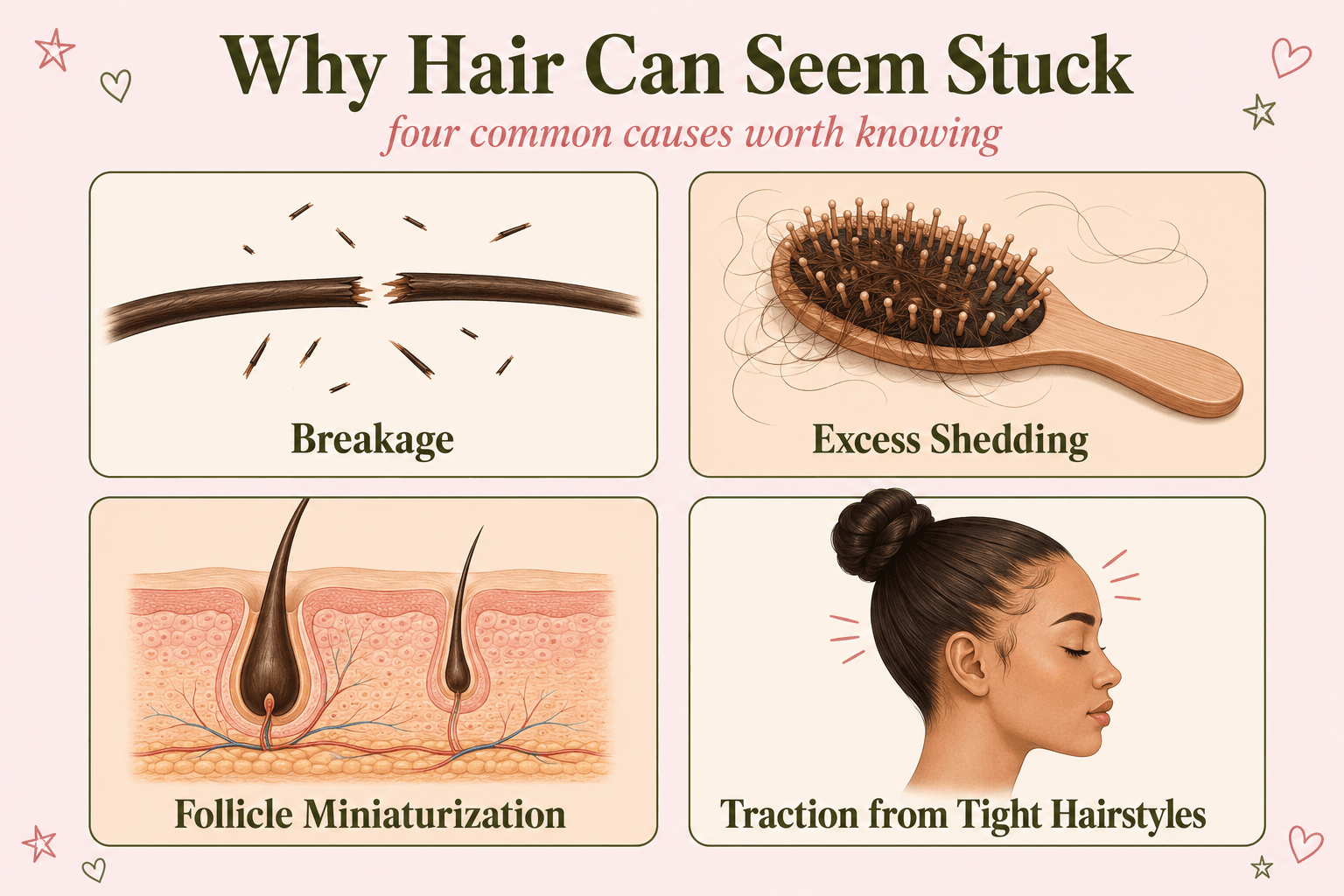
1. Your hair is growing, but the ends keep breaking
If you can see new growth near the roots while your overall length barely changes, the problem may be length retention. Bleaching, repeated heat, aggressive detangling, tight styles, weathering, and friction can weaken the shaft. The ends then split or snap at roughly the same rate that new hair emerges.
In this case, a protective pre-wash oil may be useful even if it does nothing to the follicle. Reducing breakage can make hair become visibly longer over time.
2. You are shedding more than usual
Telogen effluvium occurs when more follicles than usual shift into the resting and shedding phase. Common triggers include childbirth, illness, surgery, major stress, rapid weight loss, and some medications. The American Academy of Dermatology distinguishes excessive shedding from progressive hair loss because the causes and treatment priorities differ.[2]
Oil cannot remove the trigger or instantly reset the hair cycle. Postpartum shedding, for example, is usually temporary and is linked to hormonal changes after pregnancy—not a scalp that suddenly needs more oil.[3]
3. Your follicles are producing finer, shorter hairs
A widening part, receding hairline, or gradually thinner ponytail can point to androgenetic alopecia. In pattern hair loss, susceptible follicles progressively miniaturize and spend less time in anagen. Cosmetic oils may be supportive, but they should not delay diagnosis or evidence-based treatment.
4. Tight styles are injuring the hairline
Braids, ponytails, buns, locs, extensions, and weaves can create traction alopecia when they repeatedly pull on the same follicles. Early damage may improve when tension stops; long-term traction can become permanent. Pain, bumps, or a headache during styling are not signs that a style is “secure”—they are warning signs.[4]
Hair that “will not grow” is often hair that cannot retain what it grows.
Growth and retention are not the same outcome.Do hair growth oils actually work?
It depends on the claim. A well-formulated oil can plausibly reduce friction, soften brittle strands, help protect hair during washing, or improve the appearance of dryness. Those are real cosmetic benefits.
What oils may do
Reduce friction, improve shine, protect damaged lengths, support scalp comfort, and help retain length by reducing breakage.
What oils usually cannot do alone
Reverse scarring alopecia, fix nutritional deficiency, stop telogen effluvium immediately, or reliably restore advanced pattern hair loss.
The marketing term hair growth oil often mixes four different outcomes: faster follicle growth, less shedding, greater density, and less breakage. A product can improve one without affecting the others.
The best hair oils for slow growth, ranked by evidence
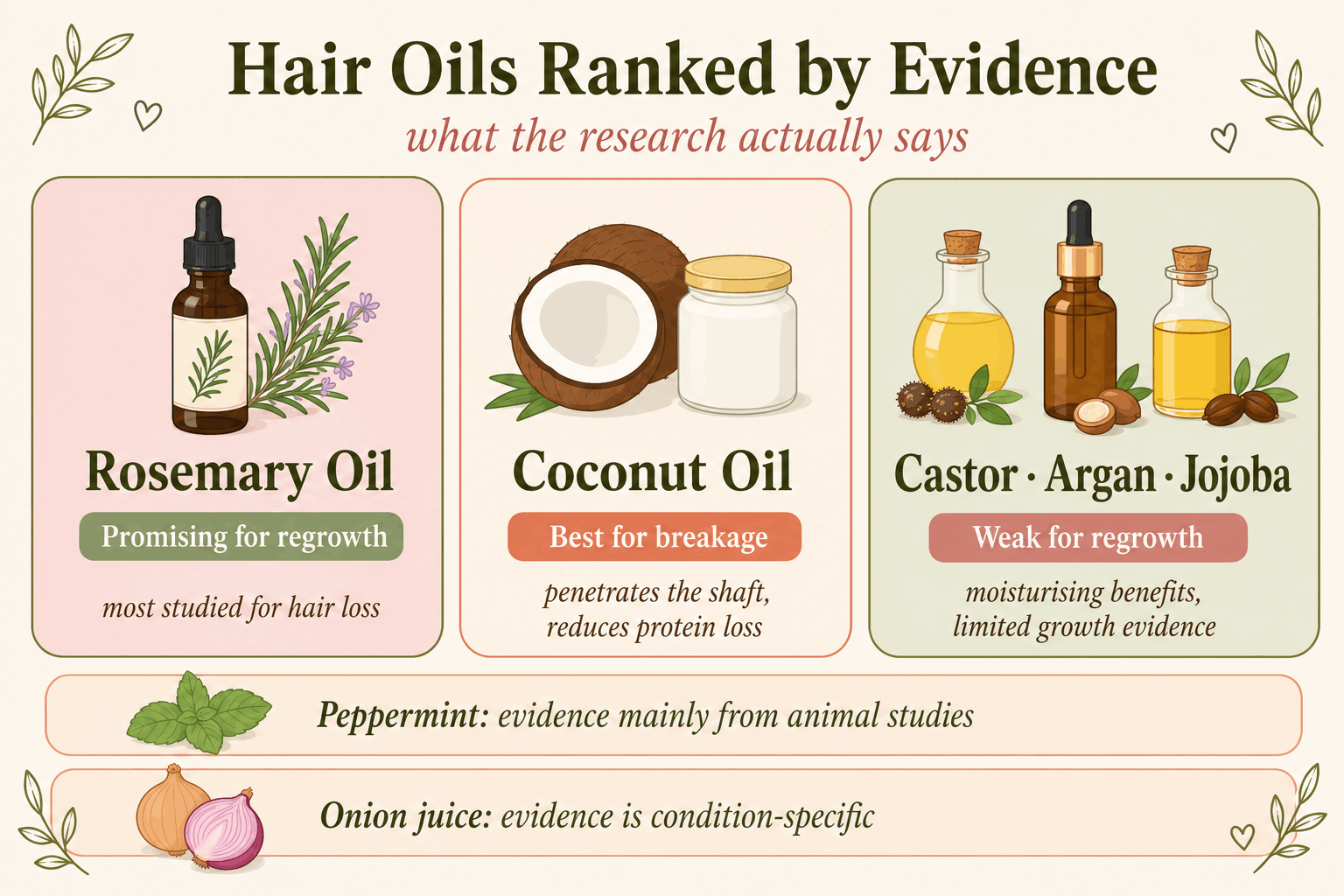
1. Rosemary oil: the strongest signal, not definitive proof
Rosemary oil has the best-known direct human study among common plant oils. In a 2015 randomized comparative trial, 100 men with androgenetic alopecia used either rosemary oil or 2% minoxidil for six months. Neither group showed a significant hair-count increase at three months. At six months, mean hair count increased within both groups, with no statistically significant difference between them.[5]
This is regularly reduced online to “rosemary oil works as well as minoxidil.” That is too confident. The study had no placebo group, used only 2% minoxidil, had a modest sample, and did not establish formal equivalence. A non-significant difference does not prove two treatments are equally effective.
Promising Rosemary oil may support hair density in some people with androgenetic alopecia over several months. It is not proven to accelerate healthy hair growth, treat every type of loss, or replace established therapy.
Essential oils can irritate skin. Use a properly formulated scalp product or a conservative dilution, patch test first, and stop if burning, rash, or persistent itching develops.
2. Coconut oil: best supported for breakage and length retention
Coconut oil’s strongest evidence is not regrowth—it is hair-shaft protection. A comparative cosmetic-science study found that coconut oil reduced protein loss in damaged and undamaged hair when used before or after washing. Its structure allows it to penetrate the shaft more effectively than mineral or sunflower oil in that study.[6]
A systematic review of coconut, castor, and argan oils found more support for coconut oil in brittle-hair care than for increasing follicular growth.[7]
Best for breakage Coconut oil can help damaged hair retain protein and survive washing and manipulation. That can improve visible length over time without making follicles grow faster.
3. Castor oil: useful conditioner, weak regrowth evidence
Castor oil is thick, highly occlusive, and popular in edge and scalp products. It can improve shine, reduce friction, and seal moisture into coarse or dry strands. However, the systematic review found no strong human evidence that castor oil stimulates hair growth.[7]
Its texture can also create problems when overused: sticky residue, matting, difficult cleansing, and buildup on scalps that are already oily or flaky.
Overhyped for growth Castor oil is best positioned as a conditioning and moisture-sealing oil—not a clinically validated regrowth agent.
4. Peppermint oil: impressive mouse data, missing human proof
The widely shared peppermint study compared 3% peppermint oil, 3% minoxidil, jojoba oil, and saline in mice for four weeks. Peppermint oil increased follicle depth, dermal thickness, and follicle number in that animal model.[8]
That makes peppermint oil interesting, but it does not prove it regrows human scalp hair or outperforms minoxidil in people. A cooling or tingling sensation is also not evidence that follicles are being activated.
5. Onion juice: a narrow result that marketing stretches too far
A small 2002 trial tested crude onion juice in people with patchy alopecia areata. Regrowth was reported more often in the onion-juice group than in the tap-water control group.[9]
The study involved a specific autoimmune condition and a raw juice preparation. It does not validate onion oil, onion shampoo, or broad claims about ordinary slow growth, postpartum shedding, or pattern hair loss.
6. Argan and jojoba oils: good supporting ingredients
Argan oil can smooth rough hair and improve cosmetic feel. Jojoba is a lightweight liquid wax that works well as a carrier and lubricant. Neither has reliable human evidence for reversing pattern baldness or directly stimulating scalp-hair growth.[7]
| Oil | Best-supported role | Regrowth evidence | Best fit |
|---|---|---|---|
| Rosemary | Possible density support | Limited human trial | Gradual pattern thinning, as an adjunct |
| Coconut | Protein-loss and breakage protection | Weak for follicle growth | Damaged, brittle, textured, or processed hair |
| Castor | Heavy conditioning and shine | No strong human evidence | Coarse, dry lengths used sparingly |
| Peppermint | Cooling sensation; preclinical interest | Mainly animal data | Only in safely formulated products |
| Onion juice | Small alopecia-areata study | Condition-specific | Not a default DIY treatment |
| Argan / jojoba | Lightweight conditioning | No established growth effect | Fine hair or lighter finishing formulas |
Which oil fits your actual problem?
Gradual thinning or a widening part
Rosemary has the strongest evidence among cosmetic oils, but persistent or progressive thinning deserves diagnosis. Pattern loss, telogen effluvium, thyroid disease, iron deficiency, medication effects, and inflammatory scalp conditions can overlap visually. The AAD emphasizes that effective treatment starts with identifying the cause.[10]
Breakage and poor length retention
A coconut-rich pre-wash treatment is the most evidence-aligned oil strategy. Apply a modest amount to the mid-lengths and ends before washing, while also reducing overlapping bleach, excessive heat, rough detangling, and repeated friction.
Fine or oily hair
Heavy daily scalp oiling is usually unnecessary. Use a small amount of a lighter jojoba- or argan-based product on the lengths, and cleanse often enough to prevent residue. More product does not produce faster growth.
Curly, coily, or highly textured hair
Length retention may matter more than increasing biological growth speed. Oils can reduce friction during detangling and protect vulnerable ends. Coconut has the clearest shaft-protection evidence; castor and argan mainly offer conditioning.
Thinning edges or protective styles
Remove the source of tension first. Oil can soften the hairline, but it cannot protect follicles from continuous pulling. Smooth, shiny areas, persistent tenderness, or loss that continues after changing the style warrant professional assessment.
Postpartum shedding
Postpartum telogen effluvium is commonly temporary. Oil may improve the feel of the remaining hair, but it is unlikely to change the hormonal cycle driving shedding. Seek medical advice when loss is severe, prolonged, or accompanied by other symptoms.
Dandruff, flakes, or an itchy scalp
Do not automatically add more oil. Seborrheic dermatitis is not simply “dry scalp,” and dermatology treatment usually centres on medicated shampoos and inflammation control.[11] Oil may be used separately on dry lengths while the scalp condition is managed.
How to use hair oil safely and effectively
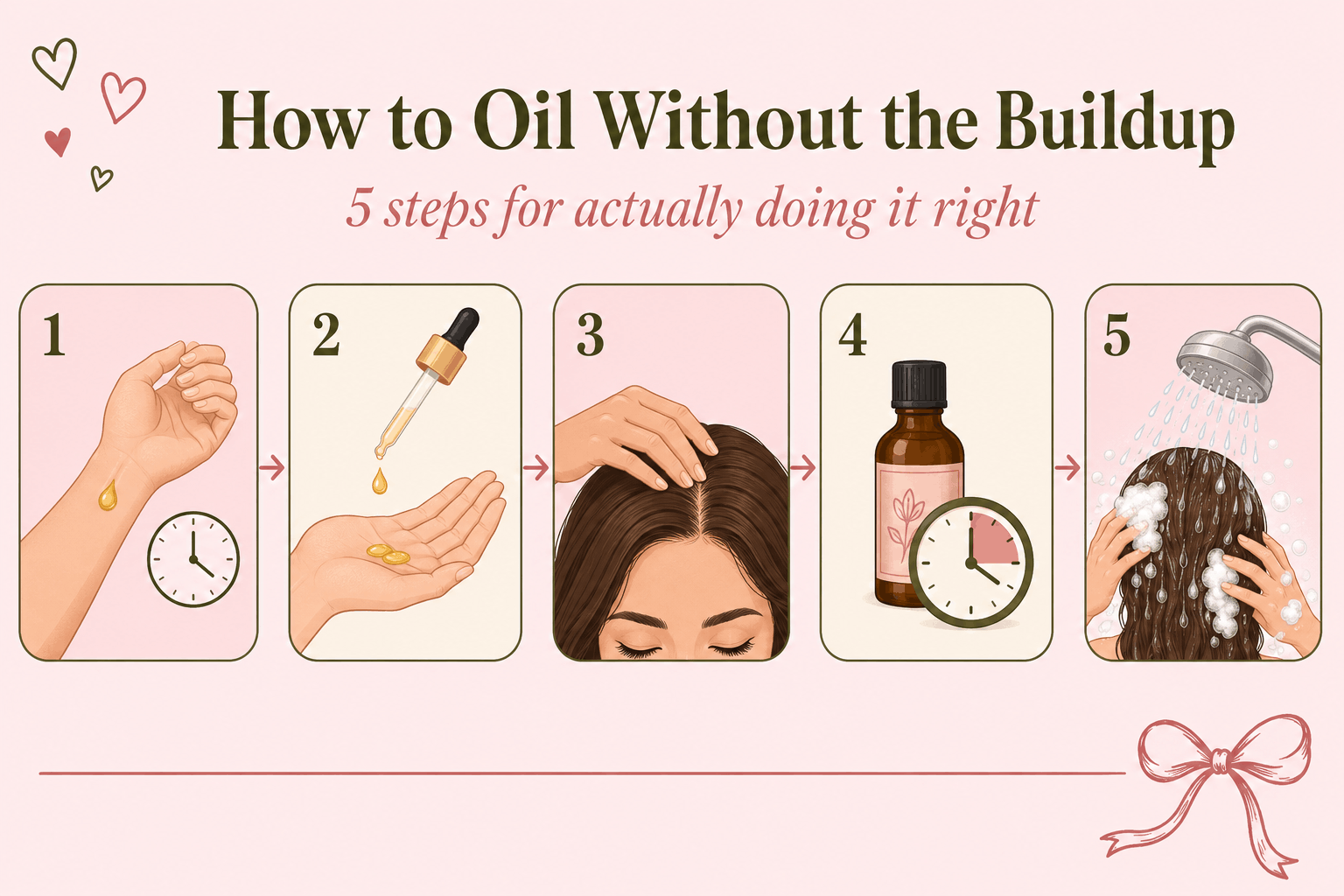
- Check where the product belongs. A scalp serum, pre-wash oil, and finishing oil are not interchangeable.
- Patch test first. This matters most with rosemary, peppermint, fragrance, and multi-essential-oil blends.
- Start once weekly. Observe how your scalp and hair respond before increasing frequency.
- Use a small amount. A few drops distributed in sections are more rational than saturating the scalp.
- Target the actual issue. Apply to the lengths for breakage; use a scalp formula on the scalp only when the formula is designed for it.
- Wash residue out thoroughly. Persistent buildup can worsen itching, flakes, and limpness.
- Track results consistently. Use the same lighting, parting, hairstyle, and camera angle. Assess density over months, not days.
You develop persistent burning, redness, swelling, rash, pustules, worsening flakes, or a clear increase in scalp discomfort. “Tingling” is not a requirement for efficacy.
When hair oil is not enough
Book an appointment with a dermatologist or qualified healthcare professional when you notice sudden bald patches, rapid widening of the part, smooth or shiny hairless areas, scalp pain or pustules, heavy shedding that does not improve, or hair loss accompanied by fatigue, weight changes, or menstrual changes.
A small study of standardized scalp massage found increased hair thickness after 24 weeks, but not faster growth, and the sample was very small.[12] Massage can be a gentle routine addition; it is not a substitute for diagnosis or treatment.
Hair oil is most useful when expectations match the evidence. Rosemary may modestly support density. Coconut can protect damaged strands and improve length retention. Most other oils are conditioners with stronger marketing than regrowth data.
Frequently asked questions
Does hair growth oil really make hair grow faster?
Most oils have not been shown to increase the normal speed of follicle growth. Some can reduce breakage or support density, which may make hair look fuller or become longer over time.
What is the best oil for slow hair growth?
Rosemary has the strongest human evidence for possible density support. Coconut is the better choice when damaged ends keep breaking and preventing length retention.
Is rosemary oil better than castor oil?
For regrowth evidence, yes. Rosemary has a human comparative trial; castor oil does not. Castor is better treated as a heavy conditioning oil.
Can coconut oil regrow hair?
It is not proven to stimulate new follicles. Its strongest evidence is for reducing protein loss and protecting the hair shaft.
How long does rosemary oil take to work?
In the main trial, a significant increase in mean hair count appeared at six months, not three. That does not guarantee the same result from every formula.
How often should I oil my scalp?
There is no universal schedule. Start conservatively, follow the product instructions, and reduce or stop if you develop buildup, irritation, or worsening dandruff.
References
- Hoover E, Alhajj M, Flores JL. Physiology, Hair. [Updated 2023 Jul 30]. In: StatPearls [Internet]. Treasure Island (FL): StatPearls Publishing; 2026 Jan–. Available from: NCBI Bookshelf.
- American Academy of Dermatology Association. Do you have hair loss or hair shedding? [Internet]. Rosemont (IL): American Academy of Dermatology Association; [cited 2026 Jul 4]. Available from: American Academy of Dermatology Association.
- Bullock L. Hair loss in new moms: Dermatologist tips. [Updated 2025 Oct 2]. American Academy of Dermatology Association [Internet]. Rosemont (IL): American Academy of Dermatology Association; 2025. Available from: American Academy of Dermatology Association.
- Ludmann P, Schleehauf B. Hairstyles that pull can lead to hair loss. [Updated 2024 Nov 6]. American Academy of Dermatology Association [Internet]. Rosemont (IL): American Academy of Dermatology Association; 2024. Available from: American Academy of Dermatology Association.
- Panahi Y, Taghizadeh M, Marzony ET, Sahebkar A. Rosemary oil vs minoxidil 2% for the treatment of androgenetic alopecia: a randomized comparative trial. Skinmed. 2015 Jan–Feb;13(1):15–21. PMID: 25842469. Available from: PubMed.
- Rele AS, Mohile RB. Effect of mineral oil, sunflower oil, and coconut oil on prevention of hair damage. J Cosmet Sci. 2003 Mar–Apr;54(2):175–192. PMID: 12715094. Available from: PubMed.
- Phong C, Lee V, Yale K, Sung C, Mesinkovska N. Coconut, Castor, and Argan Oil for Hair in Skin of Color Patients: A Systematic Review. J Drugs Dermatol. 2022 Jul 1;21(7):751–757. doi: 10.36849/JDD.6972. PMID: 35816075. Available from: PubMed.
- Oh JY, Park MA, Kim YC. Peppermint Oil Promotes Hair Growth without Toxic Signs. Toxicol Res. 2014 Dec;30(4):297–304. doi: 10.5487/TR.2014.30.4.297. PMID: 25584150; PMCID: PMC4289931. Available from: PubMed Central.
- Sharquie KE, Al-Obaidi HK. Onion juice (Allium cepa L.), a new topical treatment for alopecia areata. J Dermatol. 2002 Jun;29(6):343–346. doi: 10.1111/j.1346-8138.2002.tb00277.x. PMID: 12126069. Available from: PubMed.
- American Academy of Dermatology Association. Hair loss: Diagnosis and treatment. [Updated 2022 Dec 13]. American Academy of Dermatology Association [Internet]. Rosemont (IL): American Academy of Dermatology Association; 2022. Available from: American Academy of Dermatology Association.
- Ludmann P. Seborrheic dermatitis: Diagnosis and treatment. [Updated 2024 May 14]. American Academy of Dermatology Association [Internet]. Rosemont (IL): American Academy of Dermatology Association; 2024. Available from: American Academy of Dermatology Association.
- Koyama T, Kobayashi K, Hama T, Murakami K, Ogawa R. Standardized Scalp Massage Results in Increased Hair Thickness by Inducing Stretching Forces to Dermal Papilla Cells in the Subcutaneous Tissue. Eplasty. 2016 Jan 25;16:e8. PMID: 26904154; PMCID: PMC4740347. Available from: PubMed Central.
Medical disclaimer: This article is for educational purposes and is not medical advice. Sudden, painful, patchy, scarring, or persistent hair loss should be assessed by a qualified healthcare professional.
Hot girls read the research.