
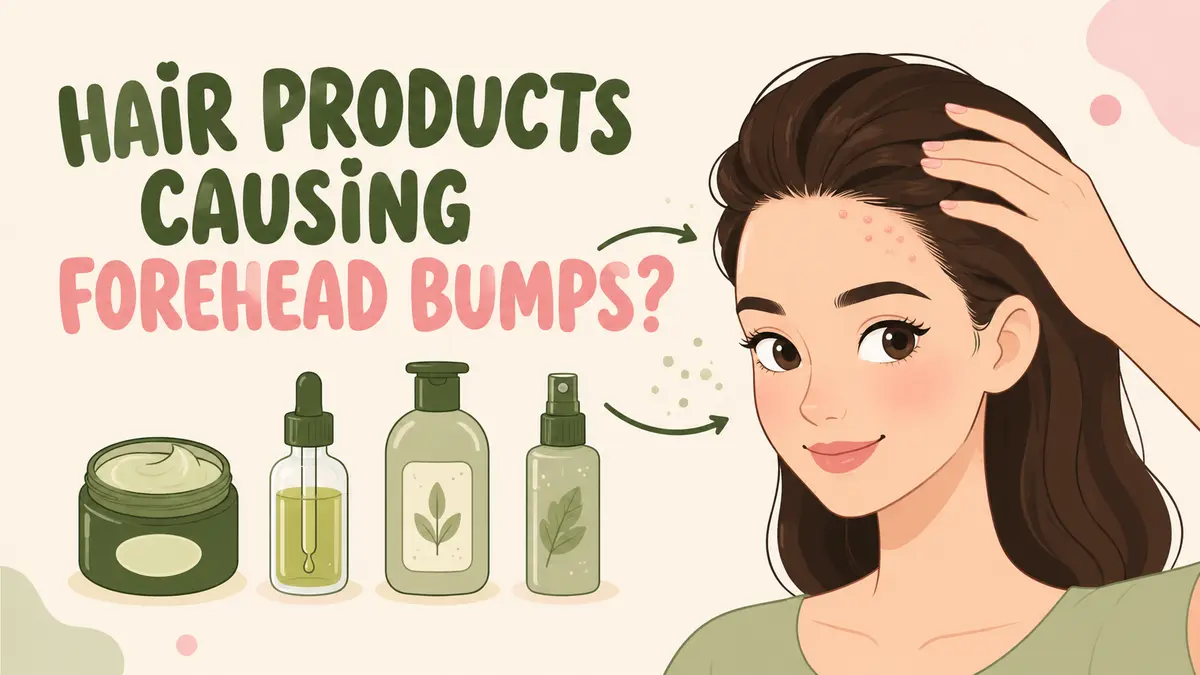
Yes, hair products can cause or worsen forehead acne. Oil-rich pomades, hair oils, waxes, leave-in conditioners and styling residue can repeatedly contact the skin and contribute to clogged follicles. The classic pattern is a cluster of small whiteheads or skin-colored bumps along the hairline, temples or back of the neck, sometimes with a few inflamed pimples. Dermatologists call this acne cosmetica, and the hair-product pattern is often called pomade acne.123
Classic human studies describe pomade acne and acne cosmetica.23 A 2020 proof-of-concept experiment in one woman found that residue from one shampoo-and-conditioner regimen remained detectable for up to two hours and residue from one leave-in styling product for up to four hours. It measured deposition, not acne.4 A separate single-arm, eight-week study followed 27 people using a non-comedogenic hair-care regimen. Dermatologist grading improved in 52% of participants with facial acne and 70% with truncal acne, but there was no control group, no reported blinded comparison and no comparison with continued usual hair care.5 Iris Rubin, the author of both studies, is the founder and chief medical officer of SEEN Hair Care. The 2021 study evaluated SEEN Shampoo and Conditioner.12 Treat these commercially connected findings as limited support, not proof that residue always causes acne.
In this guide
What does hair product acne look like?
Hair product acne usually looks more subtle than a dramatic cystic breakout. The most typical lesions are closed comedones, also called whiteheads, and tiny flesh-colored papules. You may feel the texture before you can clearly see it. A few red pimples or pustules can appear too.13
The distribution matters. Look at the places where product-coated hair, runoff or residue repeatedly touches your skin:
- The upper forehead and hairline
- The temples and sideburn area
- The upper cheeks where hair rests
- Behind the ears and along the neck
- The upper back or chest after rinsing conditioner
- Under headbands, caps, bonnets or helmets that hold residue against skin
| Pattern | Typical clues | What it may suggest |
|---|---|---|
| PatternSmall whiteheads and skin-colored bumps | Typical cluesConcentrated where hair or product touches; often not very itchy | What it may suggestAcne cosmetica or pomade acne13 |
| PatternMixed blackheads, whiteheads and inflamed pimples | Typical cluesAlso appears away from the hairline | What it may suggestOrdinary acne, possibly worsened by hair products |
| PatternRed, scaly, burning or very itchy rash | Typical cluesMay involve the ears, eyelids, neck or scalp | What it may suggestIrritant or allergic contact dermatitis8 |
| PatternMonomorphic itchy follicular papules or pustules | Typical cluesTrue comedones are absent from these lesions; heat, sweating or occlusion may raise suspicion | What it may suggestMalassezia folliculitis is one possibility10 |
Do not diagnose the cause from location alone. Forehead acne can also be influenced by hormones, genetics, medications, skincare, makeup, and sweat combined with friction or occlusion. A useful at-home clue is improvement after you remove one suspected exposure while keeping the rest of your routine stable, but that pattern is not diagnostic.
How can hair products cause forehead acne?
1. Product residue reaches facial skin
Hair products do not stay neatly on the hair. They may move onto the forehead during application, run down the face in the shower, transfer from hair while you sleep, or build up on pillowcases and headwear. In a 2020 experiment in one woman, researchers used D-Squame tape sampling and ATR-FTIR imaging to detect residue from one shampoo-and-conditioner regimen on the scalp, forehead, cheek and upper back for up to two hours, and residue from one leave-in styling product for up to four hours.4
That experiment showed exposure, not acne causation, and it cannot establish how every formula behaves. Study author Iris Rubin is the founder and chief medical officer of SEEN Hair Care.12 The result is best understood as proof of concept for skin contact, not proof that detected residue will cause a breakout.
2. Repeated exposure can support comedone formation
A comedone begins when keratin and sebum accumulate inside a follicle.13 One proposed explanation is that some oily or persistent products add to the occlusive burden at the follicular opening when exposure repeats. Classic reports described comedone formation after pomade or cosmetic exposure, but those older designs included animal tests and heavily occluded human-back tests that do not directly predict every modern finished formula.236
3. Friction and heat can keep residue against the skin
Bangs, tight headwear, headbands and helmets can press product-coated hair against the forehead. Heat and sweat may spread residue or prolong contact. This is plausible exposure logic rather than direct proof from the cited studies. Sweat itself is not dirty or inherently acne-causing; the practical concern is the combination of contact, friction, occlusion and individual susceptibility.
The useful question is not “Is this ingredient bad?” It is “Does this finished product keep contacting my acne-prone skin?”
A better way to investigate hairline breakoutsWhich hair products are most likely to cause forehead acne?
No study cited here directly ranks every hair-product category by acne risk. As a practical starting point, prioritize formulas with the most contact: products that are heavy, oil-rich, sticky, waxy, frequently applied or left close to the hairline. That makes these the first products worth investigating:
Pomades and hair grease
These are the classic pomade-acne suspects because they are deliberately rich and long-lasting near the scalp and hairline.2
Edge control and waxes
They are applied exactly where forehead bumps tend to cluster and can remain in place all day.
Hair oils and oil-based serums
Pure oils or rich blends may transfer from hair to skin, including overnight.
Leave-in conditioner and curl creams
These stay on the hair and may repeatedly touch the temples, cheeks, neck or back.
Rinse-out conditioner and masks
Runoff may reach the face, chest and back. Residue can remain even after rinsing, although residue does not automatically mean acne.4
Sprays, dry shampoo and heat protectants
Mist may settle on the forehead, while powders and film-formers may mix with other residue.
Shampoo can be worth considering, but a quickly rinsed product is a less obvious first suspect than a greasy leave-on formula that sits against your skin for hours. This is an exposure-based inference, not a proven risk ranking. Start with the contact pattern that makes the most sense.
Which hair product ingredients should you avoid for forehead acne?
There is no scientifically reliable blacklist that predicts every breakout from an ingredient list. Much of the old comedogenicity lore came from testing concentrated raw materials in rabbit ears or under heavy occlusion. A human study of finished cosmetics later showed that products containing ingredients considered comedogenic were not necessarily comedogenic as complete formulas.6 That reassessment enrolled only six people and tested a finite set of products, so it supports “not necessarily” rather than proving that every finished formula is non-comedogenic.
A rating attached to coconut oil, isopropyl myristate, lanolin, petrolatum, a wax or a fatty alcohol does not tell you how much is in the formula, how the ingredients interact, how much reaches your face or whether your skin will react. Use the ingredient list to generate a hypothesis, not a verdict.
| Ingredient or group | What is reasonable to say | What is too certain |
|---|---|---|
| IngredientCoconut and other plant oils | ReasonableA heavy oil may be worth testing when it repeatedly reaches acne-prone facial skin. | Too certainEvery product containing that oil will clog every person's pores. |
| IngredientPetrolatum and mineral oil | ReasonableAn oily pomade may cause problems because of the whole formula and repeated exposure.2 | Too certainPetrolatum or mineral oil alone automatically causes acne in all formulas. |
| IngredientWaxes, esters and rich emollients | ReasonableThey may contribute to product texture or persistence, so a heavy leave-on formula can be worth testing. This is formulation logic, not a class-wide acne finding. | Too certainA high rating from a raw-material test predicts real-world acne perfectly. |
| IngredientSilicones such as dimethicone | ReasonableA silicone name alone does not predict how the whole formula will behave; no silicone-specific acne study is cited here. | Too certainEvery ingredient ending in “cone” suffocates skin or clogs pores. |
| IngredientFragrance, preservatives and hair-dye chemicals | ReasonableThese are more relevant to irritation or allergy when the skin is itchy, burning, red or scaly.8 | Too certainEvery itchy hairline rash is acne. |
What should you shop for? “Oil-free,” “non-comedogenic,” “non-acnegenic” and “won't clog pores” are useful screening labels, and the American Academy of Dermatology recommends looking for them when hair products seem to be causing breakouts.1 These labels are reasonable screening clues, but testing methods and definitions are not sufficiently standardized to guarantee that a product will suit your skin.13
How to check whether hair products are contributing: a 4 to 6 week product trial
This is not a validated diagnostic test. It is a practical single-variable trial: remove one plausible exposure, keep the rest of the routine stable and observe whether the pattern changes.
- Photograph the area in the same lighting. Take a clear front and side photo before you change anything.
- List every product that touches your hair. Include shampoo, conditioner, masks, oils, serums, curl creams, edge control, sprays, dry shampoo and heat protectant.
- Remove the most likely leave-on triggers. Start with greasy products used near the hairline. If several are plausible and your hair can tolerate it, simplify to a small non-comedogenic routine.
- Keep products away from facial skin. Apply oils and masks from mid-lengths to ends when possible. Wash your hands after styling and gently cleanse visible residue from the hairline.
- Change the things that hold residue. Wash pillowcases, sheets, bonnets, scarves, hats, caps, headbands and helmet liners. The AAD specifically advises cleaning items that touch the head.1
- Keep the rest of your skincare steady. If you introduce three acne treatments at the same time, you will not know whether removing the hair product helped.
- Judge the trend after 4 to 6 weeks. The AAD says this type of acne can take about 4 to 6 weeks to clear after the acne-causing product stops contacting the skin; this does not promise complete clearing for everyone by week six.1
Do not expect every existing bump to disappear in three days. A useful early sign is fewer new bumps in the contact zone. Compare weekly photos, not your skin every hour.
How do you get rid of forehead acne from hair products?
Removing the trigger comes first. Treating the bumps while the same residue keeps reaching your skin is a frustrating loop. Once exposure is controlled, mild acne may gradually settle on its own.1
Use a gentle, consistent face routine
- Cleanse gently, especially after styling or heavy sweating.14
- Do not scrub the hairline with harsh shampoo, brushes or grainy exfoliants.14
- Use a moisturizer and sunscreen labeled non-comedogenic if your skin needs them.
- Keep oily hair products off the forehead after cleansing.
If cleansing or treatment starts to sting, burn or peel, compare the pattern with our guide to skin-barrier damage versus acne before adding more actives.
Standard acne treatments can help persistent comedones
The 2024 American Academy of Dermatology guideline strongly recommends topical retinoids and benzoyl peroxide among standard acne treatments.7 Adapalene can help closed comedones; whether it is available without a prescription depends on the country. Benzoyl peroxide is commonly used when inflammatory pimples are present. Both can irritate skin, so follow the product directions and introduce treatment carefully. If you are pregnant or trying to become pregnant, do not start or continue a topical retinoid without guidance; the AAD says most experts recommend stopping adapalene during pregnancy.11
For a broader treatment plan, see the evidence-based acne treatment guide and the comparison of salicylic acid versus benzoyl peroxide. If your acne is painful, scarring, widespread, persistent after the product trial or difficult to diagnose, see a dermatologist rather than continuing to swap products.
When hairline bumps may not be acne
Contact dermatitis
Hair products can cause irritant or allergic contact dermatitis. A 2022 systematic review found that hair dyes, shampoos and conditioners were common scalp-product categories reported in allergic contact dermatitis studies. Common features included eczema-like lesions, itching and burning.8 Fragrance, hair-dye chemicals, cocamidopropyl betaine-related allergens and isothiazolinone preservatives were among the reported allergens.
A red, scaly, burning or intensely itchy hairline rash is not a good fit for simple closed-comedone acne. A dermatologist may recommend patch testing if allergy is suspected.8
Folliculitis
Folliculitis can resemble acne because both affect hair follicles.9 Some forms cause itchy papules or pustules. Malassezia folliculitis in particular is often monomorphic, meaning the bumps look similar to one another, and true comedones are absent from the Malassezia folliculitis lesions.10 These clues raise suspicion but cannot confirm the diagnosis from appearance alone.
Ordinary acne with several triggers
Your hair routine can worsen acne without being the only cause. Hormones, genetics, medications, skincare, makeup, friction and occlusion may overlap. Improvement after a product switch does not mean every future breakout has the same trigger.
Related reading: Compare Malassezia folliculitis and closed comedones, build a plan with the acne treatment guide, compare salicylic acid and benzoyl peroxide, or check whether irritation fits skin-barrier damage rather than acne.
The bottom line
Hair products can cause or worsen forehead acne, especially when oily or persistent residue repeatedly contacts the hairline. The evidence includes classic clinical descriptions, a one-person deposition experiment and a 27-person uncontrolled intervention. The two newer studies are limited and commercially connected, so they do not prove that residue always causes acne.245
The most useful response is not to panic over one ingredient. Look at the finished product, where it touches your skin, how often you use it and whether the pattern improves during a single-variable 4 to 6 week product trial.
Frequently asked questions
Can hair products cause forehead acne?
Yes. Oily or residue-forming hair products can contribute to acne when they repeatedly contact the forehead, temples, neck or back. The usual pattern is small whiteheads and skin-colored bumps near the hairline.1
How do I know if my hair products are causing acne?
Look for bumps concentrated where hair or product touches the skin, a flare after starting a new product, and improvement during a 4 to 6 week single-variable product trial. This is a useful clue, not a validated diagnosis.
How long does hair product acne take to clear?
The American Academy of Dermatology says clearing can take about 4 to 6 weeks after the acne-causing product stops contacting the skin.1
Does coconut oil cause forehead acne?
A heavy coconut-oil product may be worth testing if it repeatedly reaches acne-prone facial skin. Coconut oil does not guarantee a breakout in every person or every finished formula, and no coconut-oil-specific forehead-acne study is cited here.
Do silicones in hair products clog pores?
An ingredient ending in “cone” is not enough to predict acne. Finished-product behavior, concentration, exposure and individual susceptibility matter more than a one-ingredient blacklist.6
Can shampoo and conditioner cause forehead acne?
They may be worth considering if runoff or residue repeatedly reaches the skin. A one-person experiment found residue from one shampoo-and-conditioner regimen on the forehead, cheek and upper back after rinsing, but it measured deposition rather than acne.4
Is itchy hairline acne really acne?
Not always. Strong itching, burning, redness or scaling can suggest contact dermatitis. Monomorphic itchy papules or pustules without true comedones can raise suspicion for Malassezia folliculitis, but appearance alone cannot diagnose it.810
What should I do first if hair products seem to be causing acne?
Stop the most plausible leave-on exposure, keep hair products off facial skin, wash residue from pillowcases and headwear, and keep the rest of your routine stable for 4 to 6 weeks. Persistent acne may need standard treatment.
References
- American Academy of Dermatology Association. Are your hair care products causing breakouts? Accessed August 16, 2026.
- Plewig G, Fulton JE, Kligman AM. Pomade acne. Arch Dermatol. 1970;101(5):580-584. doi:10.1001/archderm.1970.04000050084011. PMID: 4245751.
- Kligman AM, Mills OH Jr. “Acne cosmetica.” Arch Dermatol. 1972;106(6):843-850. doi:10.1001/archderm.1972.01620150029011. PMID: 4264346.
- Rubin IK, Gourion-Arsiquaud S. Deposition and retention of hair care product residue over time on specific skin areas. J Drugs Dermatol. 2020;19(4):419-423. doi:10.36849/JDD.2020.4809. PMID: 32272520.
- Rubin IK. Efficacy of a non-comedogenic hair care regimen for the reduction of mild-to-moderate truncal and facial acne: a single-arm 8-week study. J Drugs Dermatol. 2021;20(6):690-693. doi:10.36849/JDD.2021.5772. PMID: 34076395.
- Draelos ZD, DiNardo JC. A re-evaluation of the comedogenicity concept. J Am Acad Dermatol. 2006;54(3):507-512. doi:10.1016/j.jaad.2005.11.1058. PMID: 16488305.
- Reynolds RV, Yeung H, Cheng CE, et al. Guidelines of care for the management of acne vulgaris. J Am Acad Dermatol. 2024;90(5):1006.e1-1006.e30. doi:10.1016/j.jaad.2023.12.017. PMID: 38300170.
- Pham CT, Juhasz M, Lin J, Atanaskova Mesinkovska N. Allergic contact dermatitis of the scalp associated with scalp-applied products: a systematic review of topical allergens. Dermatitis. 2022;33(4):235-248. doi:10.1097/DER.0000000000000844. PMID: 35318978.
- American Academy of Dermatology Association. Acne-like breakouts could be folliculitis. Accessed August 16, 2026.
- Henning MAS, Hay R, Rodriguez-Cerdeira C, et al. Position statement: recommendations on the diagnosis and treatment of Malassezia folliculitis. J Eur Acad Dermatol Venereol. 2023;37(7):1268-1275. doi:10.1111/jdv.18982. PMID: 36912427.
- American Academy of Dermatology Association. Is any acne treatment safe to use during pregnancy? Accessed August 16, 2026.
- Rubin IK. Bridging the gap between hair care and skincare. Practical Dermatology. October 2022. Accessed August 16, 2026.
- Maarouf M, Saberian C, Shi VY. Myths, truths, and clinical relevance of comedogenicity product labeling. JAMA Dermatol. 2018;154(10):1131-1132. doi:10.1001/jamadermatol.2018.1741.
- American Academy of Dermatology Association. 10 skin care habits that can worsen acne. Accessed August 16, 2026.
Medical note: This article is educational and does not diagnose or treat a skin condition. See a dermatologist for painful, scarring, rapidly worsening or persistent breakouts, or for a rash with marked itching, burning, swelling or scaling.
Research first. Panic never. ♡