
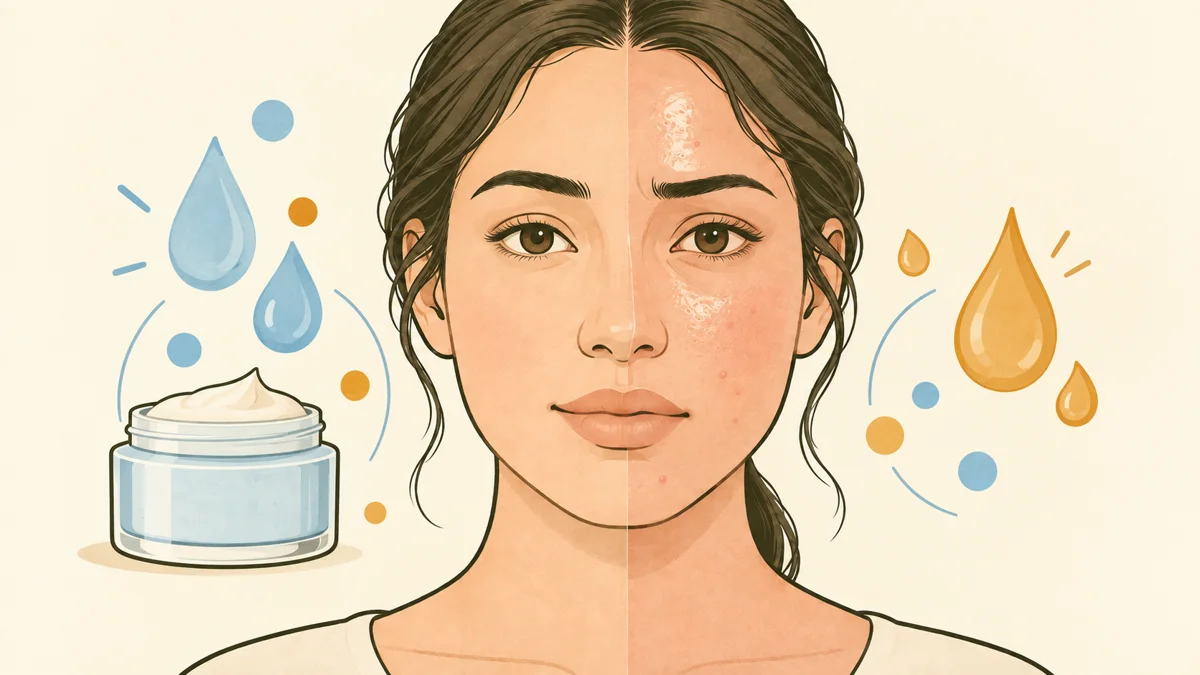
If your face looks shiny right after moisturizer, you may be seeing the product sitting on your skin rather than a sudden rise in sebum. If shine develops hours later, your natural oil production, other layers, and the weather may play a part. Try a smaller amount or a light gel or lotion, while keeping moisturizer where your skin needs it.
Is it oil or just a shiny finish?
Moisturizers contain ingredients that leave a film to slow water loss and soften skin. That film can reflect light, especially when you apply a rich cream or layer it over a serum and sunscreen. Shine that appears within minutes is more likely to be the finish of those products than new sebum produced in that short time. That is a practical clue, not a laboratory diagnosis.
Oil that appears later in the day may be your usual sebum. Skin can also feel tight while looking shiny because oil and water in the outer skin layer are different things. Our oily but dehydrated skin guide explains that distinction.
Why can a moisturizer feel too greasy?
The texture may be richer than your skin needs, you may be using more than needed, or several products may be leaving overlapping films. The American Academy of Dermatology says gels are generally lighter than creams and suggests considering a gel for oily skin.1
A shiny finish does not prove that a moisturizer is clogging pores. Conversely, if one product repeatedly leads to new bumps, it may simply be a poor fit. Look for an oil-free or noncomedogenic formula if you are acne-prone, while remembering that labels cannot guarantee how your individual skin will respond.2
Harsh cleansing can irritate skin, and the AAD recommends gentle cleansing and moisturizing even for oily skin.2 The popular idea that any moisturizer makes oil glands overcompensate is too simple. One small cosmetic study measured lower sebum readings after product use, but it tested specific formulas and does not prove that all moisturizers reduce oil production.3
What should you change first?
- Use a small amount on clean skin and see how it feels after a few minutes.
- Try a light gel or lotion if a cream leaves you greasy.
- Apply more to dry cheeks and less to a naturally oily T-zone.
- Check the finished morning routine. Sunscreen may be adding most of the shine.
- Give one change several days before changing another product.
If your skin is comfortable without a separate morning moisturizer, your sunscreen may provide enough moisture. Keep using adequate sunscreen rather than thinning it to control shine. If a product burns or a rash develops, stop it and seek advice if the reaction persists.
Quick questions
Should oily skin skip moisturizer?
Not automatically. Oily skin can still feel dry or irritated, especially with acne treatments. Choose a texture that feels comfortable and use it where needed.
Will a gel moisturizer stop sebum production?
No moisturizer can promise that. A gel can feel lighter and look less shiny, which may be the change you actually want.
Continue reading
Sources
- American Academy of Dermatology. How to pick the right moisturizer for your skin. AAD.
- American Academy of Dermatology. How to control oily skin. AAD.
- Cheng Y et al. Moisturizing and anti-sebum secretion effects of cosmetic application on human facial skin. International Journal of Cosmetic Science. 2009. PubMed.
Medical note: This article is educational. Seek professional care for persistent, painful, or worsening skin symptoms.
Hot girls read the research. ♡