
There is no clinically validated universal list of fungal acne-safe sunscreen ingredients. Malassezia yeasts depend on external lipids, but laboratory lipid metabolism does not prove that one ester in a finished sunscreen will trigger Malassezia folliculitis on your face. Start with broad-spectrum SPF 30 or higher, favor a lightweight non-comedogenic formula, patch test, and treat a persistent itchy follicular eruption with a clinician rather than endless product swapping.
First, fungal acne is not acne
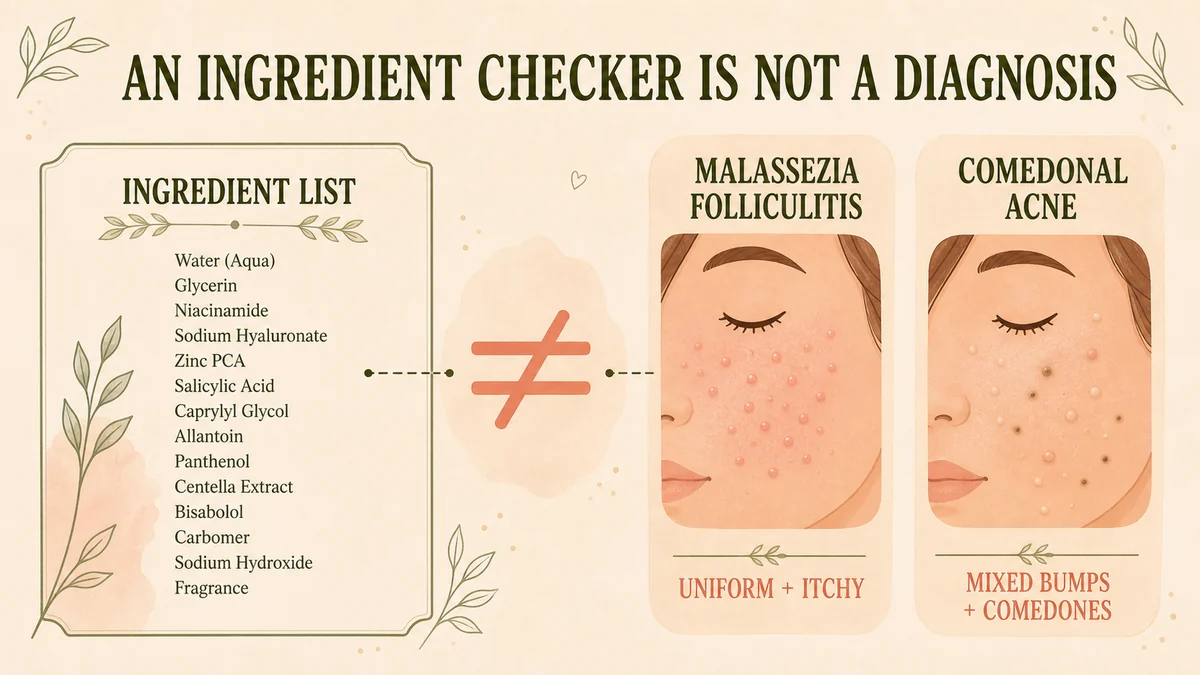
The popular phrase fungal acne usually refers to Malassezia folliculitis. It is a follicular eruption linked to yeast overgrowth, not acne vulgaris. Typical clues include small, similar-looking papules or pustules, itch, and involvement of the forehead, hairline, chest, shoulders, or back. True comedones point more toward acne, although both conditions can occur together.1
This distinction matters because a sunscreen cannot fix a misdiagnosis. If bumps persist despite a simple routine, professional diagnosis is more useful than repeatedly checking ingredient lists.
Malassezia species lack complete fatty-acid synthesis and use lipases to obtain fatty acids from external sources, including human sebum. Reviews also emphasize that interactions with topically applied lipids are poorly studied and can be growth-promoting, neutral, or even inhibitory depending on the compound and context.23 That is not enough to validate a simple online yes-or-no checker for finished sunscreens.
How to choose a sunscreen that has a better chance of working
1. Protect against UVA and UVB
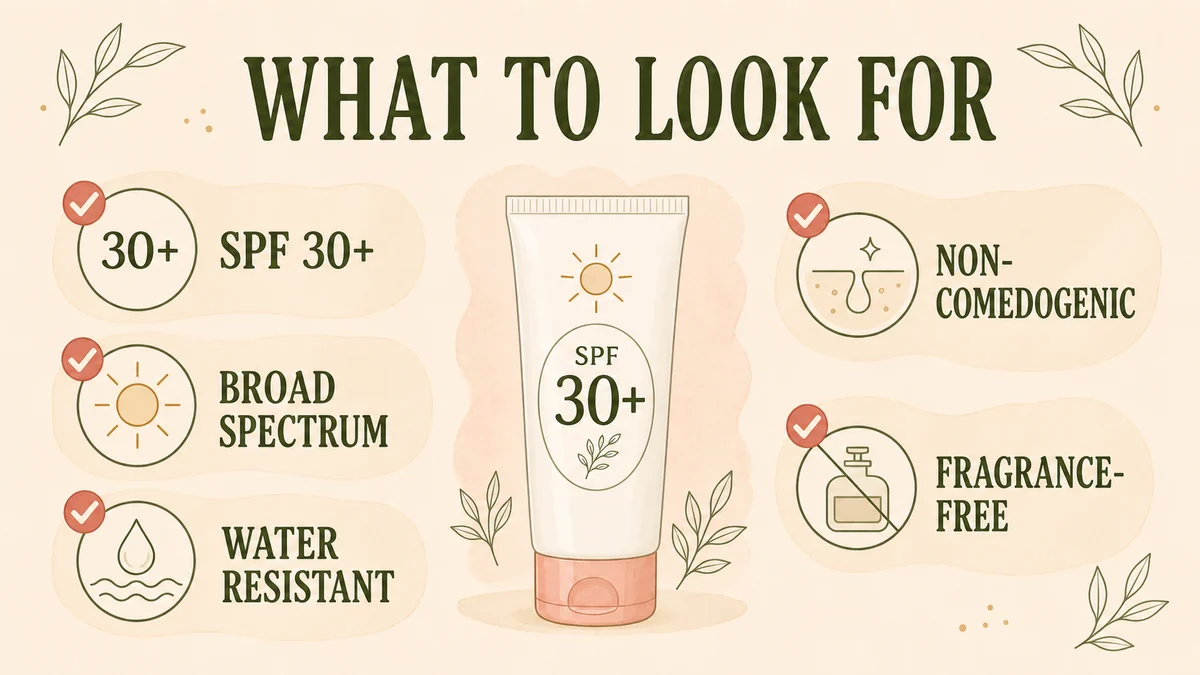
Choose broad-spectrum SPF 30 or higher. The American Academy of Dermatology also recommends water resistance, especially when sweating or swimming.4 A product that passes your ingredient checker but is unpleasant to apply, pills badly, or leaves you using too little is not a good sunscreen.
2. Favor a texture you will apply generously
Light fluids, gels, and thin lotions often feel better on oily or humid skin. Texture is not a treatment for Malassezia, but a wearable sunscreen reduces the temptation to skip protection. A heavy feel alone does not prove a product is feeding yeast.
3. Look for non-comedogenic labeling if acne is also present
Non-comedogenic does not mean Malassezia-proof, but it is a more relevant signal for acne-prone skin than a home-made fungal blacklist. The AAD recommends looking for non-comedogenic or won't clog pores wording for oily or acne-prone skin.5
4. Choose fragrance-free if your skin is reactive
Fragrance can complicate the picture by causing irritant or allergic reactions. If every sunscreen burns or creates a rash, a simpler fragrance-free formula is easier to troubleshoot.
| Priority | Look for | Why it matters |
|---|---|---|
| UV protection | Broad-spectrum SPF 30+ | Protects against UVA and UVB when used correctly. |
| Sweat | Water resistant 40 or 80 minutes | Tested claim for swimming or sweating, not a waterproof promise. |
| Acne tendency | Non-comedogenic | More relevant to clogged pores than a Malassezia checker. |
| Sensitivity | Fragrance-free, simple formula | Makes irritation easier to identify. |
| Real life | Comfortable finish | You are more likely to use enough and reapply. |
Do mineral sunscreens prevent fungal acne?
No sunscreen filter type has been proven to prevent Malassezia folliculitis. Zinc oxide and titanium dioxide are mineral UV filters, but the rest of the formula still contains emollients, dispersants, film formers, and preservatives. Organic UV filters also sit inside complete formulas that vary widely.
If mineral sunscreen stings less for you, that is a valid reason to choose it. If a modern organic-filter fluid is the only one you will apply correctly, that matters too. The finished product and your response are more useful than filter ideology.
What about esters, oils, and fatty acids?
These ingredients are often flagged because Malassezia is lipid-dependent. The leap from organism biology to a universal cosmetic blacklist is the weak point. Finished-product concentration, molecular structure, availability on skin, interactions with other ingredients, and individual susceptibility all matter. Direct human trials comparing supposedly safe and unsafe sunscreen formulas in diagnosed Malassezia folliculitis are lacking.
Removing UV protection does not treat Malassezia folliculitis. If your current sunscreen seems to worsen bumps, switch to a simpler comfortable SPF while you arrange appropriate diagnosis. The FDA notes that broad-spectrum labeling and water-resistance claims are tied to standardized testing.6
A practical 14-day sunscreen test
- Choose one broad-spectrum SPF 30+ formula.
- Patch test along the jaw or one side of the forehead for three days.
- If comfortable, use it on the full face while keeping cleanser, moisturizer, hair products, and treatment stable.
- Photograph the same areas in the same light on days 1, 7, and 14.
- Track itch, uniform bumps, comedones, redness, and stinging separately.
- Stop for swelling, hives, blistering, or a rapidly spreading rash.
Fourteen days cannot prove the diagnosis, but it prevents the common mistake of changing five products at once. If the eruption is itchy, monomorphic, recurrent, or resistant to acne treatment, see a clinician. Microscopy or other examination may be needed.
Frequently asked questions
Is sunscreen bad for fungal acne?
No. Sunscreen is not a cause of Malassezia folliculitis as a category. An individual formula may irritate, feel occlusive, or coincide with a flare, but that needs to be tested rather than assumed.
Is zinc oxide fungal acne-safe?
Zinc oxide itself is a UV filter, not a guarantee about the entire formula. Judge the complete sunscreen and your tolerance.
Can sunscreen cause tiny forehead bumps?
It can contribute to irritation or comedonal acne in some people. Hair products, sweat, headwear, and Malassezia folliculitis are other possibilities.
Should I use an ingredient checker?
It can organize a label, but it cannot diagnose your rash or predict a clinical flare with certainty.
Build the cluster
Sources
- Martínez-Ortega JI, et al. Malassezia Folliculitis: An Underdiagnosed Mimicker of Acneiform Eruptions. 2025. PMC.
- Mayser P, Koch C. Malassezia spp. interactions with topically applied lipids. Hautarzt. 2021;72(10):860-867. PubMed.
- Park M, et al. Skin Commensal Fungus Malassezia and Its Lipases. J Microbiol Biotechnol. 2021;31(5):637-644. PubMed.
- American Academy of Dermatology. How to select a sunscreen. AAD.
- American Academy of Dermatology. How do I know if I'm using the right sunscreen? AAD.
- U.S. Food and Drug Administration. Questions and answers on OTC sunscreen requirements. FDA.
Medical note: This article is educational. Persistent follicular eruptions, severe itch, spreading rash, infection, or treatment failure should be assessed by a qualified clinician.
Research first. Panic never. ♡