
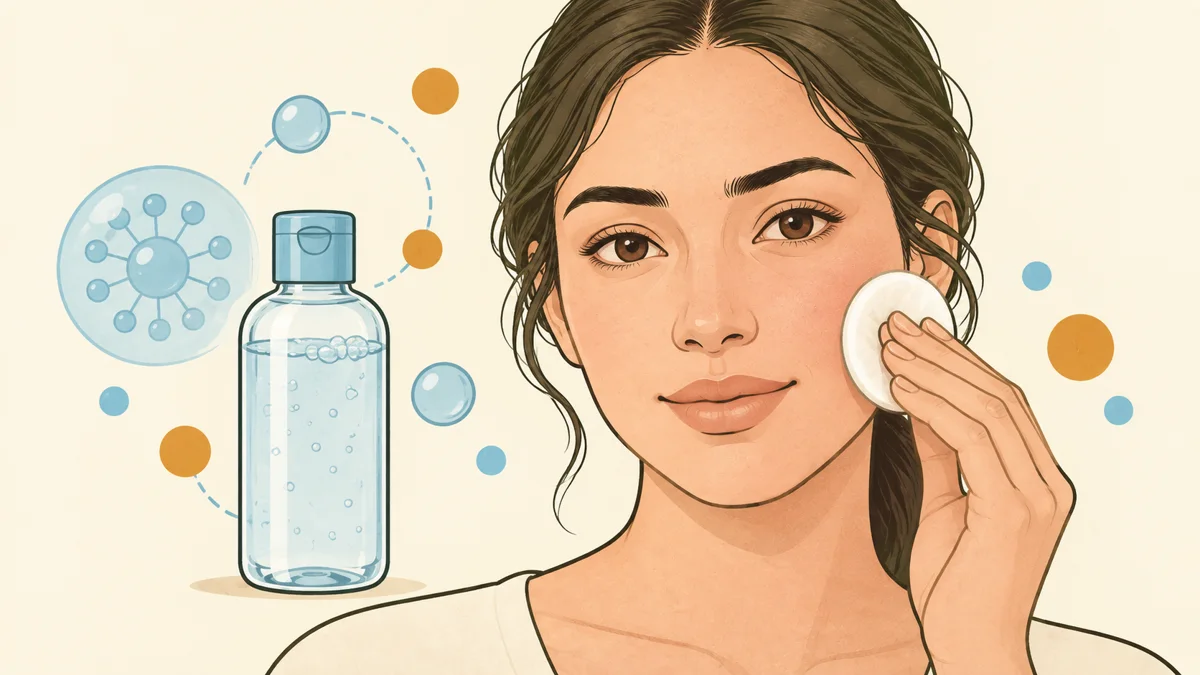
Most micellar waters are designed to be left on. If your skin feels comfortable and your cotton pad removes light makeup or daily grime, rinsing is optional. Rinse or follow with a gentle cleanser if the formula stings, leaves a sticky film, or struggles with heavy makeup or water-resistant sunscreen. There is no good evidence that everyone must rinse micellar water to avoid skin damage.
How does micellar water clean?
Micellar water contains mild surfactants, ingredients that help lift oil and dirt into water. A cotton pad carries away much of that mixture. It is still a cleanser, not plain water, and different bottles use different formulas. Research on cleansers shows that surfactant choice and the full formula affect how gentle a product feels.1
When is it fine to leave it on?
If the label says no rinse, your face feels comfortable, and you only needed a light cleanse, you can leave it on and apply moisturizer. There is no universal rule that leftover traces of a mild micellar product are harmful. An observational study of 400 users of one micellar solution found that reported skin discomfort improved over 28 days. Without a control group, it cannot show that the product caused the improvement or predict how every formula will feel.2
There is no strong head-to-head clinical trial showing that rinsing every micellar water produces better long-term skin outcomes than leaving it on. Product directions and your own skin response are the sensible guide.
When should you rinse or cleanse again?
Rinse if your skin stings, feels tight, or looks red after use. The problem may be the finished formula, repeated rubbing, or an already irritated skin barrier. Stop using a product that repeatedly causes a reaction. For persistent rash, seek a dermatologist's advice.
For full-coverage makeup or water-resistant sunscreen, check whether the pad is actually removing it. If not, use a suitable makeup remover followed by a gentle cleanser. You do not need to scrub until the pad looks perfectly white. Friction can irritate skin too.
- Soak a soft pad and hold it briefly over makeup before wiping gently.
- Use fresh pads as needed, without rubbing hard.
- If residue remains or your face feels sticky, rinse with lukewarm water or use a gentle cleanser.
- Finish with moisturizer if your skin feels dry.
Quick questions
Can I use micellar water instead of face wash?
For a light cleanse, yes, if it removes what you need and your skin feels comfortable. Heavy makeup or water-resistant sunscreen may need a more thorough cleanse.
Can micellar water cause breakouts?
A finished product or incomplete makeup removal may be a poor fit for some people. A breakout does not prove that micelles themselves caused it.
Continue reading
Sources
- Ananthapadmanabhan KP et al. Cleansing without compromise: The impact of cleansers on the skin barrier and the technology of mild cleansing. Dermatologic Therapy. 2004. PubMed.
- Interest in Micellar Solution to Reduce Unpleasant Skin Sensations. Clinical, Cosmetic and Investigational Dermatology. 2021. PubMed.
- American Academy of Dermatology. How to control oily skin. AAD.
Medical note: This article is educational. Seek professional care for persistent, painful, or worsening skin symptoms.
Hot girls read the research. ♡