
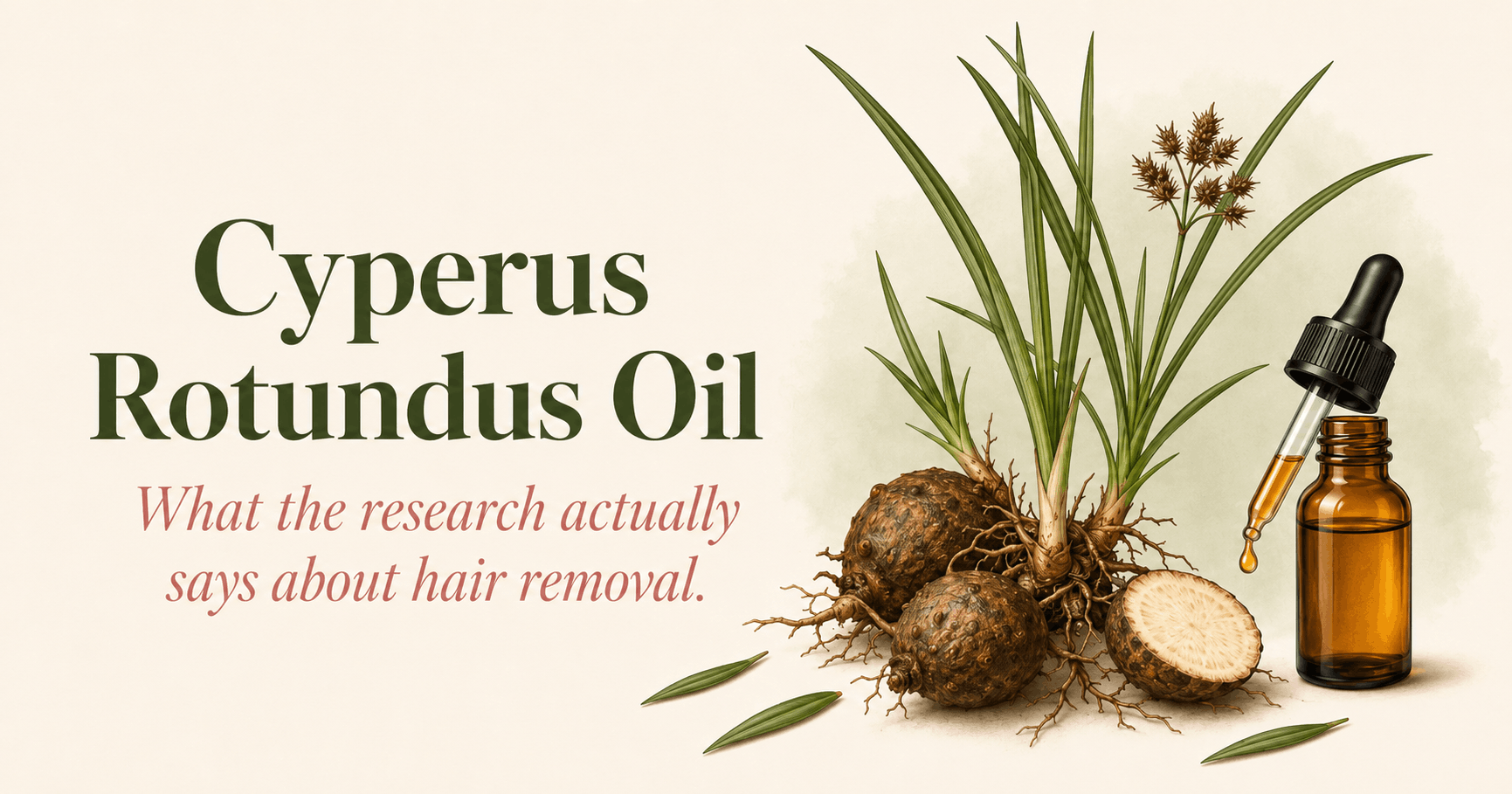
Cyperus rotundus oil, also called nutgrass oil or purple nutsedge oil, is being promoted as a cheap, painless alternative to laser hair removal. The claim is not completely invented. Small human studies reported reduced unwanted hair growth with regular topical use.[1][2]
The evidence is still much weaker than the viral headlines suggest. The overall efficacy evidence base is limited and comes from one investigator or research group. The two primary hair-reduction trials focused mainly on axillary hair, although the 2012 study also included women with hirsutism, with chin hair included in the assessment. Later pigmentation studies reported additional hair outcomes in the axilla and external genital area. The 2012 and 2014 reports also had overlapping recruitment periods and very similar protocols, so it is unclear whether their participant groups were completely independent. None proves permanent hair removal, and none establishes that a random commercial bottle will match the oil used in the studies.[1][2][3][4]
Cyperus rotundus essential oil has a preliminary clinical signal for reducing unwanted hair regrowth. At least four human publications have reported hair-growth outcomes. Two were primarily designed to investigate unwanted-hair reduction. Two later pigmentation studies, one involving axillary skin and one involving external genital-area skin, reported hair reduction as an additional outcome. All were led by the same investigator or research group, so they do not constitute independent replication. None establishes permanent removal or proves equivalence to laser.[1][2][3][4]
Promising signal, low certainty
The human data are worth taking seriously, but the overall evidence base is limited and comes from one investigator or research group. The two primary hair reports may not be fully independent, while the later pigmentation studies were not designed primarily as hair-removal trials. This is not strong enough to call the oil a proven replacement for established hair-removal treatments.[1][2][3][4]
Bottom line: a reasonable research lead, not a settled treatment.
Table of Contents
What Is Cyperus Rotundus Oil?
Cyperus rotundus is a perennial sedge that grows through underground rhizomes and tubers. The essential oil is distilled from plant material, usually the rhizomes or tubers. Its chemical profile is not fixed. Analyses from different locations have found different proportions of compounds such as alpha-cyperone, cyperene, pinene compounds, caryophyllene oxide, and other sesquiterpenes.[7]
That variability matters. Two products labeled “Cyperus rotundus oil” may not have the same composition, concentration, storage history, or skin feel. Results obtained with the specific study-prepared oil cannot automatically be applied to every commercial product.[1][2][7]
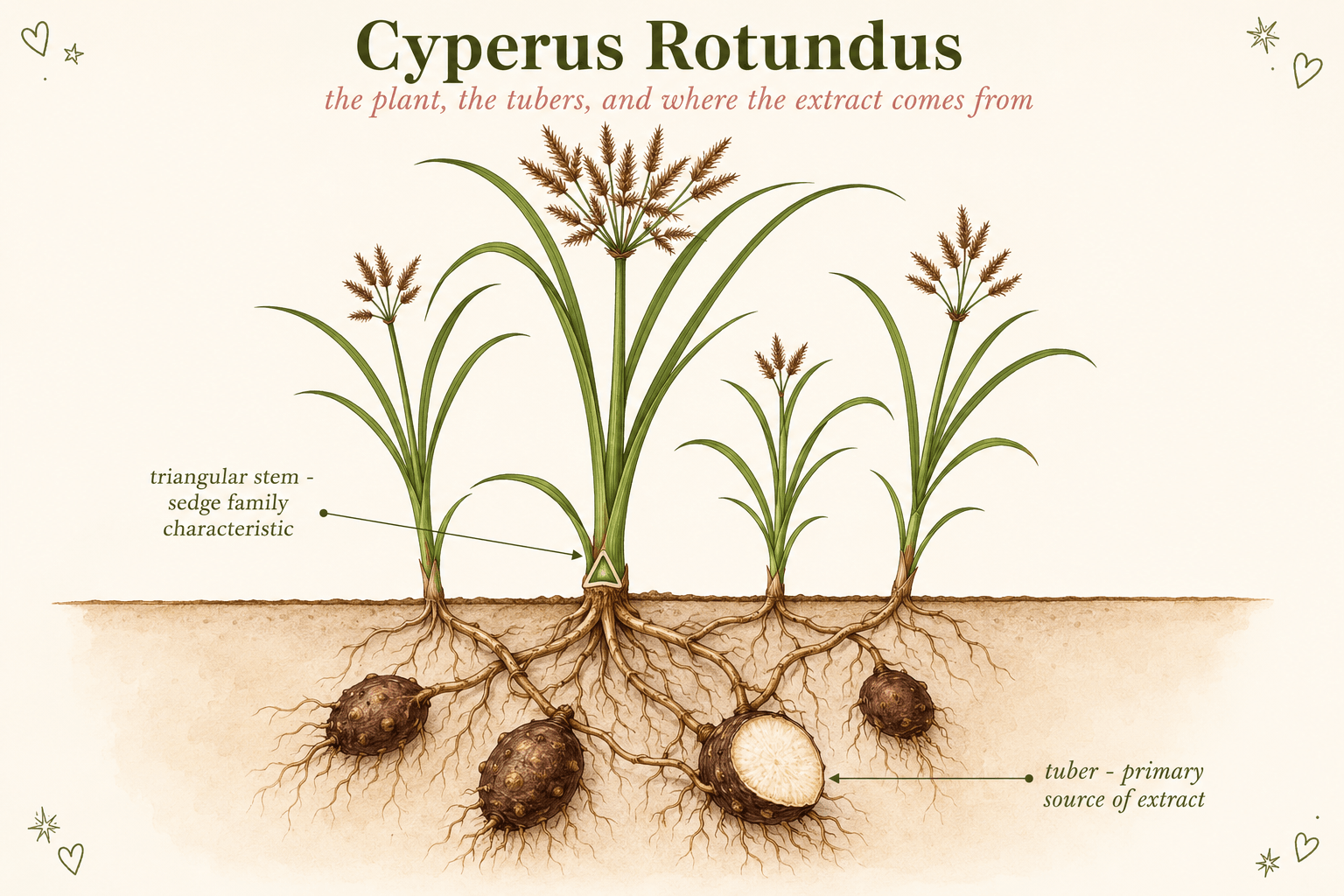
Illustrative botanical image. The oil is usually obtained from underground rhizomes or tubers, and composition can vary by origin and extraction method.
A 2025 narrative review from the same research network summarizes traditional and modern hair-removal claims, but it is background literature rather than independent confirmation.[6] A 2026 cell, ex-vivo follicle, and mouse study found hair-growth-promoting effects from a different Cyperus rotundus rhizome extract and a sesquiterpene-rich fraction. This does not establish what the essential oil does in humans, and it does not directly overturn the clinical oil reports. It does show why a rhizome extract, an essential oil, and a commercial product cannot be treated as interchangeable preparations.[8]
What Did the Human Studies Actually Find?
At least four human publications have reported hair-growth outcomes. Two were primarily designed to study unwanted-hair reduction. Two later pigmentation studies, one involving axillary skin and one involving external genital-area skin, reported hair reduction and related hair measurements as additional outcomes. All four were led by the same investigator or research group. The two primary hair reports used similar protocols and had overlapping recruitment periods, and the publications do not clearly establish whether those participant groups were completely separate. These reports should not be treated as independent replications.[1][2][3][4]
| Study | Design | What participants used | Result | Main limitations |
|---|---|---|---|---|
| Mohammed, 2012[1] | Single-blind, placebo-controlled study. Ninety-one women completed the study. Participants had unwanted axillary hair or hirsutism. | Cyperus oil or 0.9% saline, used twice daily for six months. Participants continued their usual threading or sugaring. | The oil group had significantly greater reduction in hair growth than saline. | Small study, limited reporting, saline was probably an imperfect placebo because oil has a recognizable odor and texture, participant blinding is uncertain, product standardization unclear, and overlap with the 2014 cohort cannot be excluded. |
| Mohammed, 2014[2] | Open-label randomized pilot. 65 enrolled and 60 completed. | Topical oil, saline, or Alexandrite laser for unwanted axillary hair, followed by a two-month post-treatment observation period. | No statistically significant difference between oil and laser overall. White-hair reduction favored the oil. | Small, open-label, axilla only, not a formal equivalence or noninferiority trial, only two months of post-treatment follow-up, and possible participant overlap with the 2012 report. |
| Mohammed, 2022[3] | Double-blind study of 153 participants with axillary hyperpigmentation. | Cyperus oil, hydroquinone, or cold cream for eight weeks. | Hair-growth decrease favored the oil, but hair reduction was an additional outcome in a pigmentation study. | Not primarily a hair-removal trial, short duration, same research group. |
| Mohammed and colleagues, 2022[4] | Genital-pigmentation study involving 308 women. | Topical Cyperus oil was studied for external genital-area pigmentation. | The publication reported reductions in hair-growth percentage and hair thickness in the Cyperus group, but these were additional outcomes. | Not primarily a hair-removal trial, sensitive body area, same research group, and not independent replication. |
How the limitations were assessed: sample size, masking, follow-up and treatment details come from the publications. Comments about imperfect placebo matching, uncertain participant independence and the absence of a formal equivalence or noninferiority design are editorial methodological assessments based on the reported protocols.[1][2][14]
“No significant difference” does not automatically mean two treatments are equally effective. A valid equivalence or noninferiority conclusion generally requires a prespecified margin and a trial designed and analyzed for that question. The 2014 paper was a small open-label pilot, so the safest interpretation is that the result was encouraging, not definitive.[2][14]
Is Cyperus Oil Really as Effective as Laser Hair Removal?
The viral claim comes from the 2014 study. Participants were randomized to Cyperus oil, saline, or Alexandrite laser. The oil and laser groups did not differ significantly in the overall assessments. The oil also appeared to perform better for white hair. One plausible explanation is that Alexandrite laser relies on melanin and therefore responds poorly to white hair, while a topical treatment would not depend on pigment in the same way. That explanation is biologically plausible, but it does not prove how the oil works.[2]
That is interesting, but it is not enough to replace the larger laser evidence base. The study was open-label, only 60 people completed it, and it covered underarms. Treatment lasted six months and was followed by a two-month post-treatment observation period. This gives limited evidence that the measured reduction remained briefly after treatment, but it does not establish long-term durability or permanent follicle destruction. In the oil and saline groups, participants continued sugaring or threading every three weeks, so the oil was tested alongside ongoing physical hair removal. The laser group received six monthly laser sessions.[2]
The 2018 Endocrine Society guideline recommends photoepilation for auburn, brown, or black hair and electrolysis for white or blonde hair. Cyperus oil is not included as a recommended standard treatment.[9]
How Might It Slow Hair Growth?
The exact mechanism in human hair follicles is not established. The clinical papers propose antiandrogenic activity, but this was not directly demonstrated in treated human follicles. Possible roles for plant terpenes or flavonoids remain speculative and rely mainly on laboratory, chemical, animal, or indirect evidence.[1][2]
Local effect on hair growth
The human trials reported reduced regrowth during regular topical use.[1][2]
Specific hormone blocking
No study directly showed reduced DHT signaling in the treated human follicles.[1][2]
Permanent follicle destruction
The trials did not establish permanent damage to the follicle.[1][2]
Same effect from every bottle
Oil composition changes with plant source and extraction, so commercial products may differ.[7]
Does It Permanently Stop Hair Growth?
No published trial demonstrates permanent hair removal. The evidence supports reduced growth during treatment and, in one small pilot, through a two-month post-treatment observation period. Longer-term durability is unknown.[1][2]
The more accurate phrase is hair-growth reduction or slower regrowth. Calling it permanent would go beyond the evidence.
What About Facial Hair or PCOS-Related Hirsutism?
The 2012 study included women described as having hirsutism, which is more relevant than an underarm-only cosmetic study. Still, it does not show that Cyperus oil treats PCOS, lowers circulating androgens, restores ovulation, or addresses the medical cause of new facial hair.[1]
New or rapidly worsening facial or body hair can have an endocrine cause. A topical oil may change the visible hair without addressing that cause. Medical assessment matters when hair growth progresses rapidly or occurs with menstrual disturbance or other signs of androgen excess.[9]
How Was It Used in the Studies?
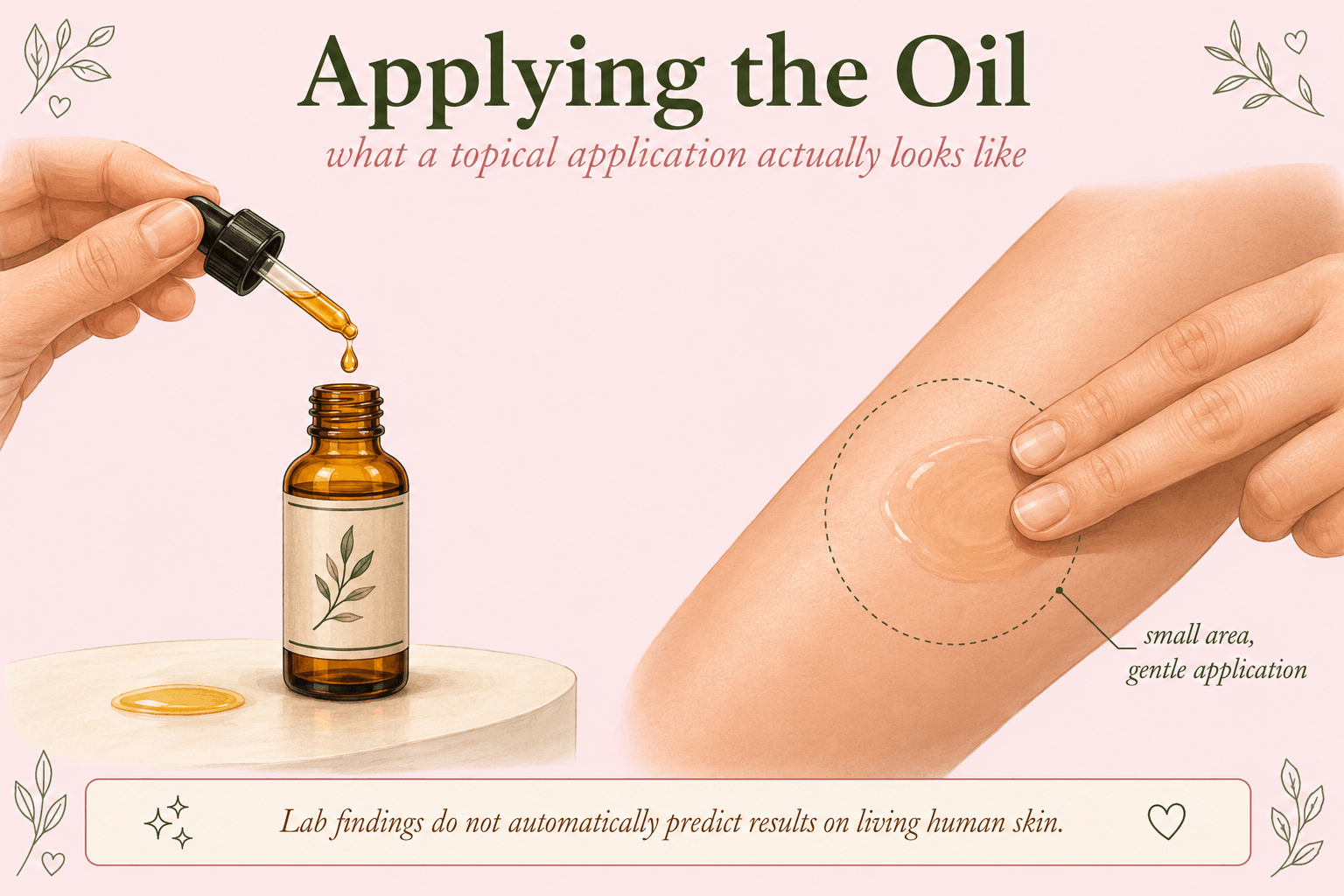
In the 2012 protocol, participants used 0.25 mL on the treated area after threading or sugaring, rubbed it in for two minutes, and continued applying it twice daily after washing. Treatment lasted six months.[1]
This tells us what was studied. It does not automatically create a safe home recipe. Essential oils are concentrated mixtures, and the composition of the research oil may not match the product you can buy. The cited clinical reports do not establish a validated consumer concentration, commercial formulation, or home-treatment schedule.[1][2][7]
- Choose a product that clearly identifies Cyperus rotundus, not a different Cyperus species.
- Prefer a finished cosmetic formulated for skin and follow its label instead of copying an undiluted research protocol. DermNet advises against applying neat essential oils directly to skin because this can contribute to sensitization.[11]
- Perform a home use test on a small area twice daily for seven to ten days before wider use.[10]
- Do not apply it to broken, freshly irritated, sunburned, or eczematous skin.[11]
- Stop if you develop persistent burning, itching, swelling, scaling, or a rash.[10][11]
Passing a home use test does not guarantee that delayed irritation or sensitization will not develop with longer use.[10][11]
Safety and Side Effects
The two primary hair-growth publications did not report notable cutaneous adverse effects. Unpleasant odor was reported, and one participant in the 2012 study discontinued because she could not tolerate it. The small studies cannot exclude uncommon reactions or establish long-term safety for daily use across large areas. Another randomized study reported less pain and redness with short-term use after laser treatment, but that does not prove the safety of twice-daily, long-term application.[1][2][5]
Essential oils can cause irritant or allergic contact dermatitis. Sensitization may appear after repeated exposure, even when the first applications feel fine. Dermatology guidance warns against assuming that “natural” means non-irritating, especially with neat essential oils.[11]
The cited trials do not establish safety during pregnancy, breastfeeding, or childhood. Pregnant and breastfeeding participants were excluded from the major hair studies. People with active eczema or anyone considering use on genital or mucosal skin should also avoid unsupervised use. Keep it away from the eyes. A clinician should guide treatment when unwanted hair may be linked to PCOS or another hormonal condition.[1][2][9][11]
Cyperus Oil vs Other Hair-Removal Methods
| Method | What it does | Evidence | Best fit | Main drawback |
|---|---|---|---|---|
| Cyperus rotundus oil | May slow regrowth during repeated use | Small preliminary studies[1][2][3][4] | People who understand the uncertainty and want an experimental adjunct | Unknown permanence, variable products, irritation risk |
| Laser or photoepilation | Uses light to damage pigmented follicles | Established clinical use and guideline support[9] | Dark hair, with device choice adjusted for skin tone[9] | Cost, multiple sessions, poor response of white hair[9] |
| Electrolysis | A probe delivers electrical energy to individual follicles to damage the hair-growth tissue. | Established direct-removal method[9] | White or blonde hair and small areas[9] | Slow, operator-dependent, uncomfortable |
| Eflornithine cream | Slows facial hair growth[12] | Prescription evidence and guideline use[9][12] | Female facial hirsutism, often with removal methods[9][12] | Availability varies. The UK prescribing information remains listed by the electronic Medicines Compendium. In the United States, an ASHP record updated March 30, 2023 reported that Allergan had discontinued Vaniqa and that no presentations were available at that time. That record does not establish current worldwide availability.[12][13] |
| Waxing, threading, shaving | Shaving cuts the hair shaft. Waxing and threading pull the shaft out through the follicular opening but do not remove or destroy the follicle. | Reliable temporary removal | Immediate cosmetic result | Regrowth, irritation, ingrown hairs |
Hair oils are often marketed with stronger claims than the evidence supports. Read our guide to what hair growth oils actually do.
Final Verdict
Cyperus rotundus oil is not pure internet fiction. Two primary hair-reduction publications from the same investigator reported reduced unwanted hair growth after six months of treatment. Two later pigmentation publications from the same research group also reported hair outcomes. The independence of the two main participant groups is unclear, and the white-hair finding remains very preliminary. The evidence is still too narrow to claim permanent removal or true laser-level reliability.[1][2][3][4][14]
The largest problem is not that the publications found nothing. It is that the human evidence is concentrated in one research group, possible cohort overlap is not clearly resolved, the primary hair trials were small, and the study oil was not chemically characterized well enough for consumers to match it to a commercial product. In the literature located for this review, I found no independent human replication.[1][2][3][4][7]
Promising enough to study. Not proven enough to replace established treatment.
Stylish & Healthy verdictFrequently Asked Questions
Does Cyperus rotundus oil permanently remove hair?
No. The 2014 pilot included only two months of follow-up after treatment ended. That is too short to establish long-term durability or permanent follicle destruction.[2]
Is it as effective as laser hair removal?
One small pilot found no significant difference from Alexandrite laser for underarm hair. That is not the same as proving formal equivalence.[2][14]
Can it work on white or blonde hair?
The 2014 pilot reported a statistically significant white-hair result favoring the oil over Alexandrite laser. The study was small, the subgroup evidence was limited, and I found no independent human replication in the literature located for this review.[2]
Can I use it for facial hair or PCOS?
Evidence is too limited for a confident recommendation. The 2012 study included women with hirsutism and assessed chin hair, but it was not a dedicated facial-hair trial. Cyperus oil has not been shown to treat the hormonal cause of PCOS-related hair growth.[1][9]
Should it be used undiluted?
The 2012 and 2014 protocols used study-prepared essential oil without a reported carrier dilution. That does not establish a safe concentration for consumer products or justify copying the protocol at home. DermNet advises against applying neat essential oils directly to skin because of sensitization risk. A finished skin product used according to its label is the more cautious option. Passing a short home use test does not rule out delayed sensitization.[1][2][10][11]
Sources
Primary studies are listed first. Later reviews and professional guidance are used for context and safety. Search scope: this review used the supplied research dossier, primary publication records, publisher pages, and reference-list checking available through July 16, 2026. Statements about the absence of independent replication are limited to the literature located through that process.
View references
- Mohammed GF. Role of Cyperus rotundus oil in decreasing hair growth. Journal of Intercultural Ethnopharmacology. 2012;1(2):111-118. doi:10.5455/jice.20120626100304
- Mohammed GF. Topical Cyperus rotundus oil: a new therapeutic modality with comparable efficacy to Alexandrite laser photo-epilation. Aesthetic Surgery Journal. 2014;34(2):298-305. doi:10.1177/1090820X13518801
- Mohammed GF. Topical Cyperus rotundus essential oil for treatment of axillary hyperpigmentation: a randomized, double-blind, active- and placebo-controlled study. Clinical and Experimental Dermatology. 2022;47(3):534-541. doi:10.1111/ced.14959
- Mohammed GF, Al-Dhubaibi MS, Mohamed ML. Genital whitening with topical Cyperus rotundus oil enhances sexuality and quality of life. Journal of Cosmetic Dermatology. 2022;21(10):4490-4502. doi:10.1111/jocd.14918
- Mohammed GF. The effectiveness of Cyperus rotundus essential oil in reducing the side effects of laser hair removal. Journal of Cosmetic Dermatology. 2022;21(4):1501-1505. doi:10.1111/jocd.14301
- Mohammed GF, Al-Dhubaibi MS, Bahaj SS, AbdElneam AI, Al-Dhubaibi AM, Atef LM. The potential of Cyperus rotundus L. as a natural hair removal agent: a review of traditional and modern applications. Phytomedicine Plus. 2025;5(4):100854. This background review includes the investigator responsible for the principal clinical reports, so it is not independent validation. doi:10.1016/j.phyplu.2025.100854
- Lawal OA, Oyedeji AO. Chemical composition of the essential oils of Cyperus rotundus L. from South Africa. Molecules. 2009;14(8):2909-2917. doi:10.3390/molecules14082909
- Hu Y, Hu K, Liang J, Zhang X, Li H, Wu J, Huang Q. The extract of Cyperus rotundus rhizome promotes hair growth and modulates hair cycle in vivo and in vitro. Chinese Journal of Natural Medicines. 2026;24(2):203-214. This study tested a different rhizome extract and a bioactive fraction, not the topical essential oil used in the human hair-reduction publications. doi:10.1016/S1875-5364(26)61091-6
- Martin KA, Anderson RR, Chang RJ, Ehrmann DA, Lobo RA, Murad MH, Pugeat MM, Rosenfield RL. Evaluation and treatment of hirsutism in premenopausal women: an Endocrine Society clinical practice guideline. Journal of Clinical Endocrinology & Metabolism. 2018;103(4):1233-1257. doi:10.1210/jc.2018-00241
- American Academy of Dermatology. How to test skin care products. Updated August 10, 2021. Accessed July 16, 2026. View guidance
- DermNet. Allergic contact dermatitis to essential oils. Accessed July 16, 2026. View clinical overview
- Electronic Medicines Compendium. Vaniqa 11.5% cream: Summary of Product Characteristics. Last updated May 30, 2022. Accessed July 16, 2026. The UK prescribing information lists eflornithine for treatment of facial hirsutism in women. View prescribing information
- American Society of Health-System Pharmacists. Eflornithine hydrochloride cream shortage detail. Updated March 30, 2023; accessed July 16, 2026. The record reports that Allergan discontinued Vaniqa in the first quarter of 2023 and that no presentations were available at the time of that update. View shortage record
- Piaggio G, Elbourne DR, Pocock SJ, Evans SJW, Altman DG; CONSORT Group. Reporting of noninferiority and equivalence randomized trials: extension of the CONSORT 2010 statement. JAMA. 2012;308(24):2594-2604. doi:10.1001/jama.2012.87802
Medical disclaimer: This article is for education only. It does not diagnose hirsutism, PCOS, or another medical condition, and it does not replace advice from a dermatologist or other qualified clinician.
Research first, hype second.
Filip