“Cruelty-free” sounds simple, but the label does not follow one worldwide rule. In the United States, the FDA does not give the term one legal definition, and some claims cover only the finished product rather than ingredients or suppliers.[1]
The label can still be useful. The key is knowing who set the standard, what the policy covers, and how the company proves it.
Cruelty-free usually means a policy against new animal testing. It does not automatically mean vegan, independently certified, free of historical animal data, safer, or cleaner. Stronger programmes cover ingredients, suppliers, third parties, and regulatory requests, and explain how the policy is verified.
Table of Contents
- The Stylish & Healthy rating
- What cruelty-free actually means
- Cruelty-free, vegan, and “not tested” are different
- Where the supply-chain loopholes appear
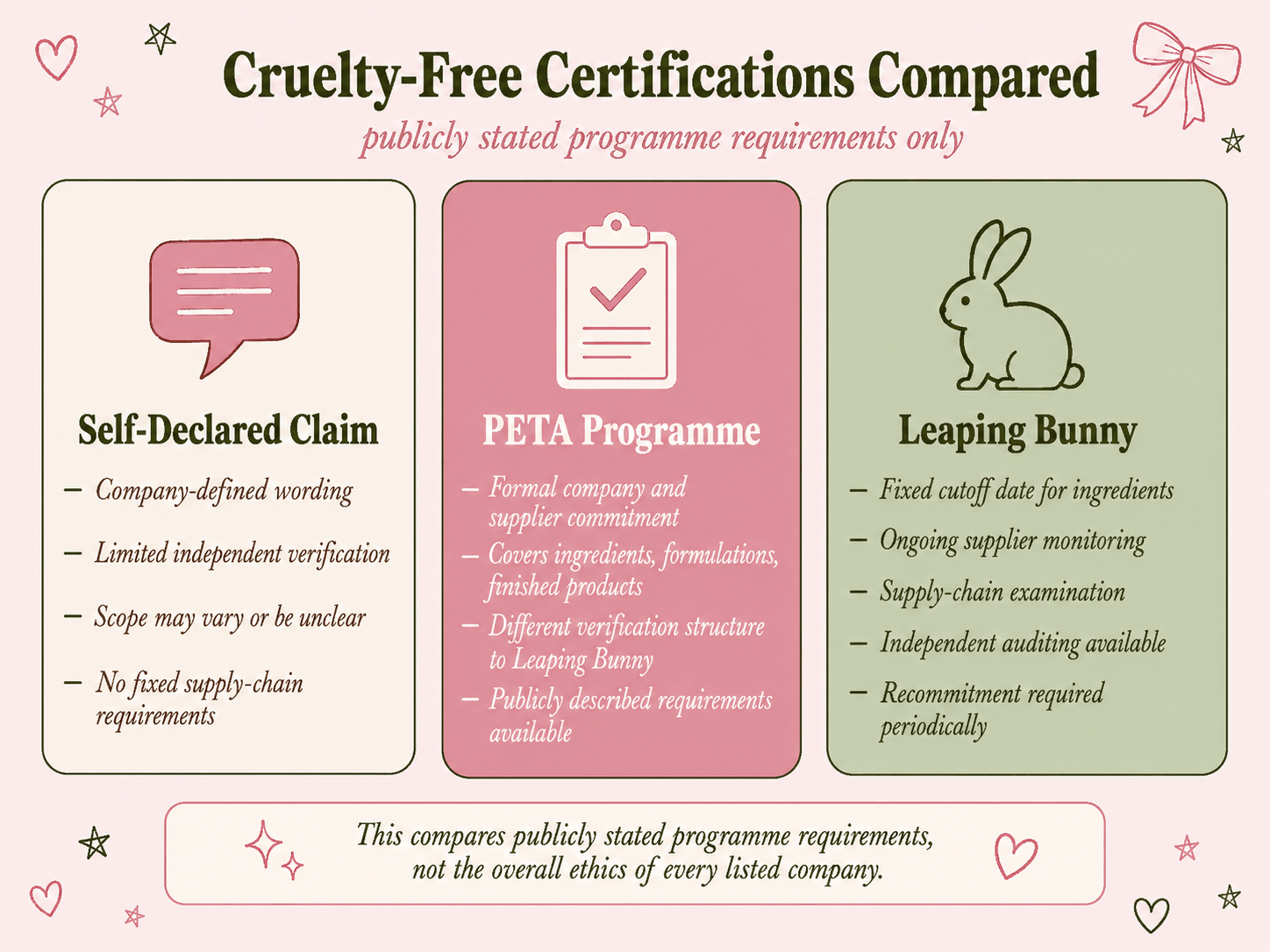
- Leaping Bunny, PETA, and self-declared claims
- How the law differs around the world
- What science can replace animal tests
- Does cruelty-free mean safe?
- Common myths
- How to check a claim in 60 seconds
- Frequently asked questions
- References
What does cruelty-free actually mean?
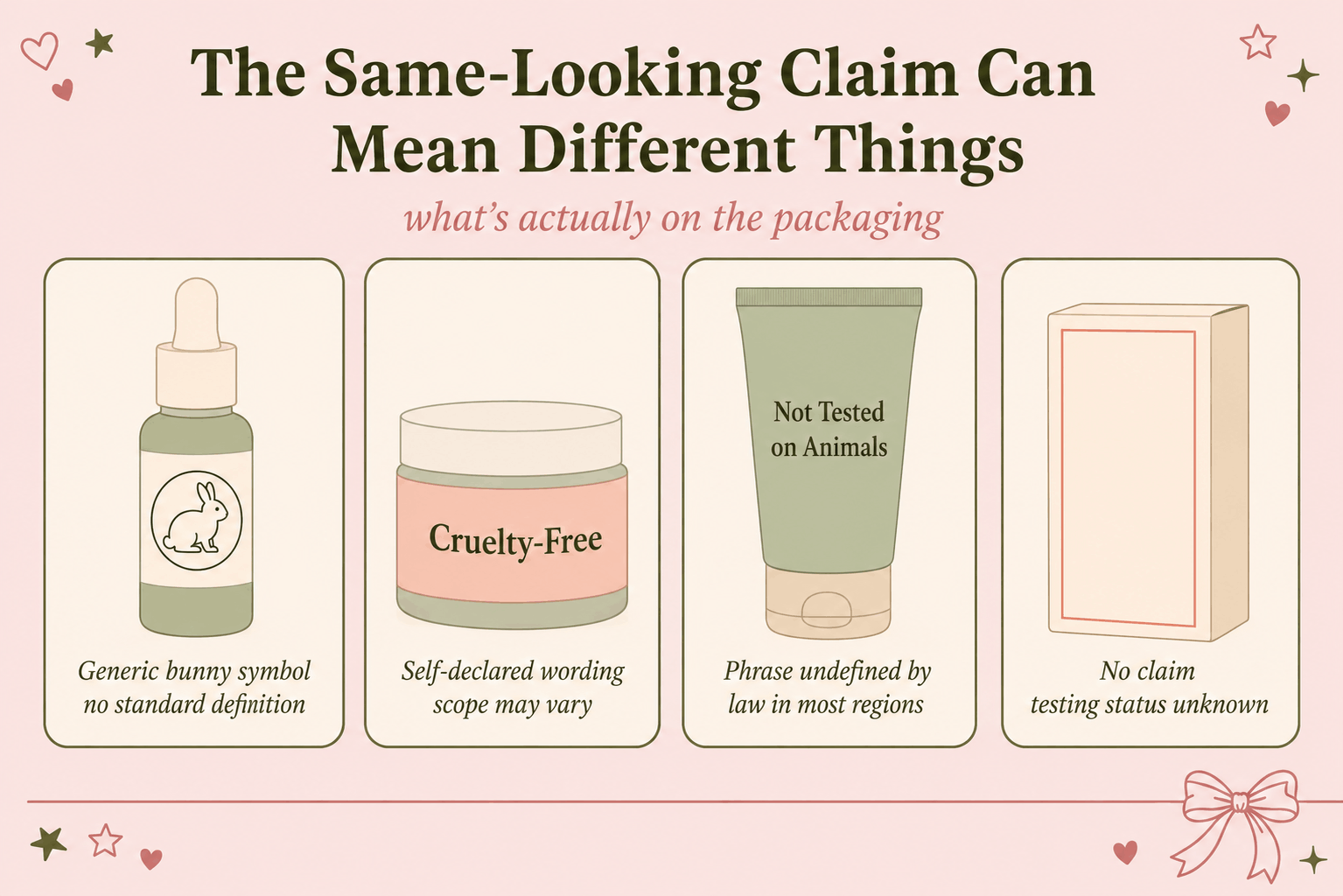
In beauty marketing, cruelty-free usually describes a policy against new animal testing for cosmetics or their ingredients. The scope varies. A narrow claim may cover only the finished formula. A broader one may include ingredients, suppliers, manufacturers, laboratories, and tests requested by regulators.
A credible claim states what is covered, how suppliers and third parties are handled, and what happens if a regulator requests animal data. The claim does not prove that every ingredient has never been tested in the past.
What is a fixed cutoff date?
It is a date used by a certification programme to prevent new animal testing after that point. Cruelty Free International requires an approved brand to maintain a fixed cut-off-date policy and proactively monitor suppliers.[8] Older animal data may still exist.
Cruelty-free, vegan, and “not tested on animals” are not the same claim
| Claim | What it addresses | What it does not prove |
|---|---|---|
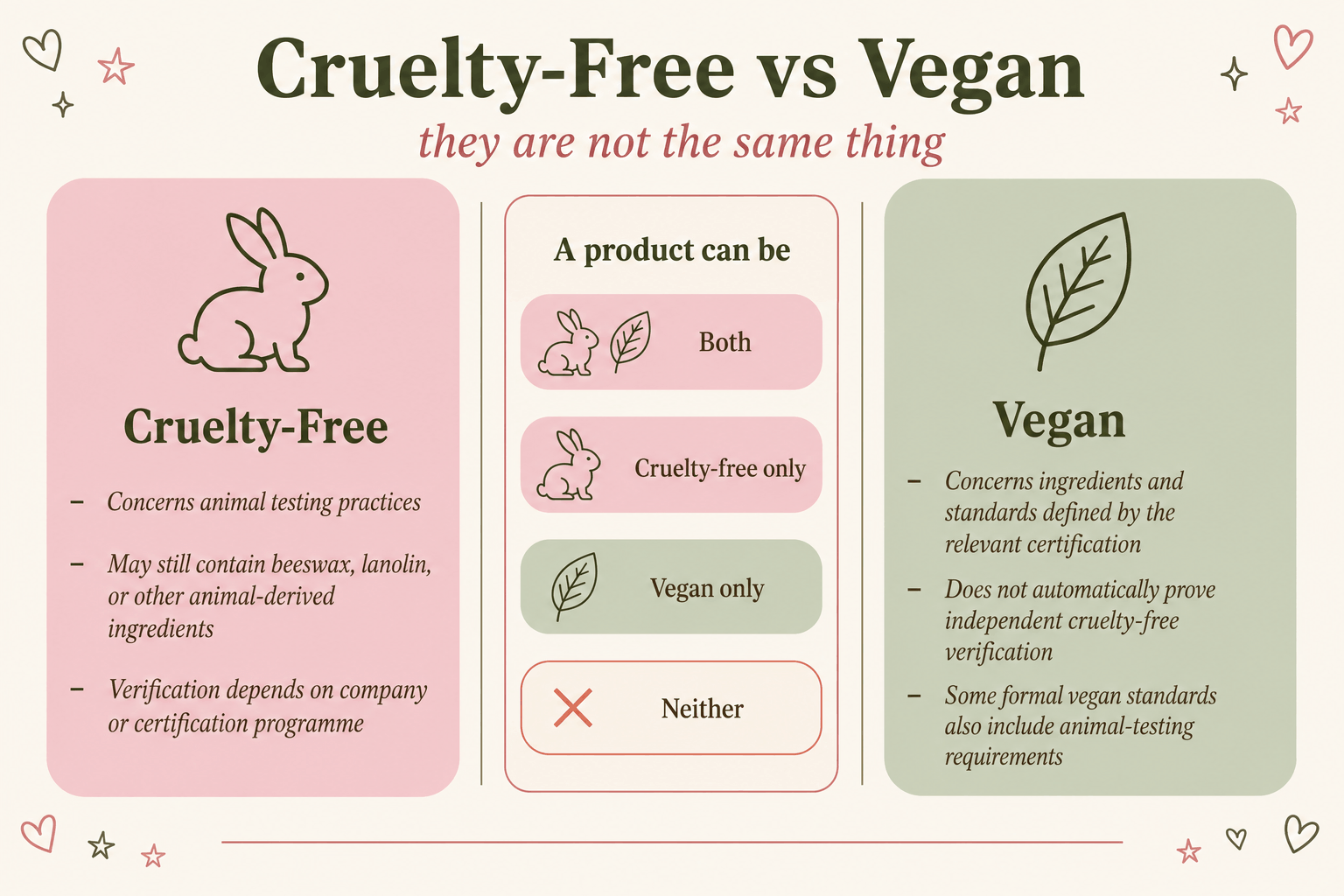
| Cruelty-free | Animal-testing policy | Vegan ingredients, safety, sustainability, or no historical testing |
| Not tested on animals | May cover the product, formula, or company policy | Ingredient and supplier coverage unless stated |
| Finished product not tested | The final mixture was not tested on animals | That ingredients or suppliers were not involved |
| Vegan | Scope depends on the standard or company policy and may include ingredients, processing, manufacturing, or testing | Independent cruelty-free verification unless the standard includes it |
| Vegetarian | No single cosmetics definition; some standards allow materials such as honey, milk, or lanolin | Vegan or cruelty-free status |
| Clean or natural | Marketing terms that vary by market and company | Safety, gentleness, sustainability, or cruelty-free status |
A generic vegan claim does not by itself prove independent cruelty-free verification. Under the Vegan Society’s trademark standard, products and ingredients must exclude animal-derived materials, and animal testing initiated by the company, conducted on its behalf, or conducted by parties it controls is prohibited.[10] A cruelty-free product can still contain animal-derived ingredients such as beeswax or lanolin and therefore not be vegan.
Why the supply chain makes the label difficult to verify
The brand name on the bottle may not belong to the company that made the ingredients, manufactured the formula, completed the safety work, or handled regulatory submissions.
A useful policy should answer five questions:
- Does it cover the finished product and ingredients?
- Are suppliers and third-party laboratories included?
- How does the company prevent new testing?
- What happens when a regulator requests animal data?
- Does the same policy apply in every sales market?
Historical data and parent companies
Many long-used ingredients have old animal-test data. The more useful question is whether the company creates, funds, or accepts new testing that conflicts with its policy.
Certification should not be assumed to cover a parent company or every affiliated brand. Cruelty Free International states that brands apply for approval for their own-brand products in specified product categories, so check the exact approved brand and scope in the official directory.[8] Whether to avoid the wider corporate group is a separate ethical choice.
Leaping Bunny, PETA, and self-declared logos
| System | Publicly stated requirements | S&H verdict |
|---|---|---|
| Self-declared claim | The company sets and substantiates its own policy | Weak alone |
| PETA’s Ultimate Cruelty-Free List | Company and supplier verification covering ingredients, formulations, and finished products[9] | Meaningful written commitment |
| CFI Leaping Bunny | Fixed cutoff date, supply-chain examination, supplier monitoring, and independent auditing[8] | Most verification-intensive framework compared here |
| Vegan claim or certification | Scope varies and may include ingredients, processing, manufacturing, or testing | Separate but sometimes overlapping |
A bunny image can be designed by the brand itself. Check the programme name and search the certifier’s official directory.
How cosmetic animal-testing law differs around the world
“Banned” can mean different things. A country may ban finished-product testing, restrict new animal data, ban sales in defined cases, or keep exceptions for chemicals used outside cosmetics.
| Market | Main rule | Do not assume |
|---|---|---|
| United States | Federal law does not specifically require cosmetic animal testing, and the FDA does not define “cruelty-free.” Companies remain responsible for safety.[1][2] California restricts certain sales and includes exemptions.[17] | That every claim follows the same standard |
| European Union | Testing bans were phased in for finished products in 2004 and ingredients in 2009. The full cosmetics marketing ban took effect in 2013 for tests performed to meet cosmetic requirements.[3] | That ingredients have no animal data from other laws |
| Great Britain | Rules restrict animal testing for cosmetic-regulation purposes, and claims must be truthful and supported.[6][7] | That Great Britain and Northern Ireland use identical routes |
| Canada | Restrictions took effect on December 22, 2023, with exceptions and continued use of existing data.[11] | That historical data disappear |
| Australia | Australia restricts new animal-test data for industrial chemicals introduced for cosmetic use, with conditions and exceptions.[12] | That it has a simple EU-style sales ban |
| India | Cosmetics tested on animals after November 12, 2014 may not be imported, and import documentation includes a signed compliance declaration.[13] | That legal compliance equals private certification |
| Mainland China | Special cosmetics use a registration route and general cosmetics use a notification route. NMPA is progressively expanding animal-testing exemptions and alternative methods, so sale in mainland China alone does not establish whether a specific product was animal-tested.[14][15] | That country of sale alone proves or disproves cruelty-free status |
Regulatory information checked July 6, 2026. Laws and market-access rules can change. This is a consumer overview, not legal advice.
Ingredients used in cosmetics may also be used in workplaces or industrial products. Under REACH, registrants may need animal data to assess worker or environmental risks when accepted alternatives cannot provide the required information; vertebrate testing remains a last resort.[4][25] EU market compliance is therefore not the same as private cruelty-free certification.
June 2026 update: The European Commission adopted a roadmap with more than 30 recommendations for gradually phasing out animal testing in chemical-safety assessments. It was not an immediate complete ban.[23]
What can replace animal testing?
Modern safety assessment uses several types of evidence together, including existing data, laboratory methods, computer predictions, exposure estimates, and read-across from similar chemicals.
Validated non-animal methods answer specific questions within defined limits. No single test can yet answer every complex toxicology question.
Validated methods
- OECD TG 431: reconstructed human epidermis for skin corrosion.[18]
- OECD TG 439: reconstructed human epidermis for skin irritation.[19]
- OECD TG 492: helps identify chemicals that do not require eye-hazard classification.[20]
- OECD TG 492B: identifies chemicals in UN GHS eye-hazard categories No Category, Category 2, and Category 1.[24]
- OECD Guideline 497: combines several non-animal evidence sources for skin-sensitisation assessment.[21]
Computer models and organ-on-chip systems
Read-across and QSAR models use chemical similarity or molecular structure to predict effects. Under REACH, computer modelling, read-across, weight-of-evidence approaches, and testing waivers may be used when the legal and scientific conditions are met.[4][25]
Tissue chips, also called organs-on-chips, are built from human cells and mimic aspects of organ structure and function. NIH says these systems can reduce the need for animals but require further improvement before they can completely replace animal models.[22]
Use validated non-animal methods when they answer the question, combine evidence when one method is not enough, and keep developing tools for complex systemic effects. The EU describes this through replacement, reduction, and refinement, known as the 3Rs.[4]
Does cruelty-free mean the product is safe?
No. Cruelty-free is an ethics and testing-policy claim, not a safety grade.
US companies remain responsible for cosmetic safety even though the FDA does not require one specific animal-testing programme.[2] In Great Britain and the EU, the responsible person must ensure that a formal safety assessment is completed before sale.[5][6]
Safety may be supported by established ingredient data, non-animal methods, computer models, stability and microbiological testing, exposure calculations, carefully justified human studies, and monitoring of adverse reactions.
A cruelty-free fragrance can still trigger allergy, and a cruelty-free acid can still irritate or burn skin if misused.
Why the label has so much marketing power
In one survey of 326 Indonesian participants, 73.9 percent reported an intention to buy cruelty-free personal-care products. It measured self-reported intention, not confirmed purchases, and cannot be generalized worldwide.[16]
That commercial value makes precise wording important because shoppers may infer more from the label than it actually proves.
Common cruelty-free myths
| Claim | Verdict | What is accurate |
|---|---|---|
| “Cruelty-free means vegan.” | False | Testing and ingredient origin are separate questions. |
| “A bunny logo means certified.” | False | Check the official directory. |
| “A cutoff date means no ingredient was ever tested.” | False | It prevents new testing after the declared date within the standard’s scope. |
| “Every EU cosmetic is cruelty-free in every sense.” | Misleading | Multi-use ingredients may still fall under other chemical laws. |
| “Selling in mainland China always proves animal testing.” | Outdated | Dossier requirements depend on product category and conditions. |
| “Cruelty-free means safer.” | False | Safety depends on formula, exposure, manufacturing, and evidence. |
How to check a cruelty-free claim in 60 seconds
- Check the programme name. A bunny icon alone proves nothing.
- Read the scope. Look for ingredients, suppliers, manufacturers, and third parties.
- Find the no-new-testing rule. This may be a fixed cutoff date or another clear prospective commitment.
- Check verification. Independent audits and supply-chain checks provide more confidence than an unsupported claim.
- Read the exceptions. Pay attention to wording such as “except where required by law.”
- Verify the exact brand and market route. Certification may not cover the parent company, every product, or every sales route.
Prefer a transparent third-party programme, confirm the exact listing, and check how it covers suppliers, third parties, regulatory requests, and new testing.
Frequently asked questions
Does cruelty-free mean no animal testing ever?
No. Historical data may exist. Current policies focus on preventing new testing within a defined scope.
Is cruelty-free the same as vegan?
No. Vegan scope depends on the standard and may include ingredients, processing, manufacturing, or testing. A generic vegan claim may not verify cruelty-free status.
Are all EU cosmetics cruelty-free?
EU law bans testing for cosmetic purposes, but some multi-use ingredients may still be tested under other chemical laws.
Does selling in mainland China always mean animal testing?
No. Dossier requirements depend on product category and conditions. Country of sale alone does not prove testing or private certification.
Is Leaping Bunny stronger than a self-declared logo?
Based on public requirements, it includes a fixed cutoff date, supplier monitoring, supply-chain examination, and independent auditing.
Can a certified brand have a non-certified parent company?
Yes. Approval may apply only to the listed brand or product range. Check the exact entity in the official directory.
References
View all 25 references
Every numbered citation in the article links to the source used. Official and primary sources were prioritized. Cited July 6, 2026.
- U.S. Food and Drug Administration. “Cruelty Free”/“Not Tested on Animals” [Internet]. FDA; 1995 Mar 14 [updated 2000 Feb 24; cited 2026 Jul 6]. Available from: https://www.fda.gov/cosmetics/cosmetics-labeling-claims/cruelty-freenot-tested-animals
- U.S. Food and Drug Administration. Animal Testing & Cosmetics [Internet]. FDA; 1999 May 31 [updated 2006 Apr 5; content current 2022 Mar 4; cited 2026 Jul 6]. Available from: https://www.fda.gov/cosmetics/product-testing-cosmetics/animal-testing-cosmetics
- European Commission. Ban on animal testing [Internet]. Directorate-General for Internal Market, Industry, Entrepreneurship and SMEs; [cited 2026 Jul 6]. Available from: https://single-market-economy.ec.europa.eu/sectors/cosmetics/ban-animal-testing_en
- European Commission. Communication from the Commission on the European Citizens’ Initiative (ECI) ‘Save cruelty-free cosmetics – Commit to a Europe without animal testing’ (2023/C 290/01) [Internet]. Official Journal of the European Union. 2023 Aug 18;C 290:1. [cited 2026 Jul 6]. Available from: https://eur-lex.europa.eu/legal-content/EN/TXT/HTML/?uri=CELEX%3A52023XC0818%2801%29
- European Parliament and Council of the European Union. Regulation (EC) No 1223/2009 of 30 November 2009 on cosmetic products (recast) [Internet]. Official Journal of the European Union. 2009 Dec 22;L342:59–209. Current consolidated version: 2026 May 1 [cited 2026 Jul 6]. Available from: https://eur-lex.europa.eu/legal-content/EN/TXT/?uri=CELEX:32009R1223
- Office for Product Safety and Standards. Regulation 1223/2009 and the Cosmetic Products Enforcement Regulations 2013: Great Britain [Internet]. GOV.UK; 2023 May [updated 2026 Jun 29; cited 2026 Jul 6]. Available from: https://www.gov.uk/government/publications/cosmetic-products-enforcement-regulations-2013/regulation-20091223-and-the-cosmetic-products-enforcement-regulations-2013-great-britain
- European Commission. Commission Regulation (EU) No 655/2013 of 10 July 2013 laying down common criteria for the justification of claims used in relation to cosmetic products [Internet]. Official Journal of the European Union. 2013 Jul 11;L190:31–34. [cited 2026 Jul 6]. Available from: https://eur-lex.europa.eu/legal-content/EN/TXT/?uri=CELEX:32013R0655
- Cruelty Free International. Our Approval Programme: The global approval programme for cruelty-free brands [Internet]. [cited 2026 Jul 6]. Available from: https://www.crueltyfreeinternational.org/for-brands/our-approval-programme/
- People for the Ethical Treatment of Animals. PETA’s Ultimate Cruelty-Free List [Internet]. PETA; [cited 2026 Jul 6]. Available from: https://www.peta.org/lifestyle/personal-care-fashion/petas-ultimate-cruelty-free-list/
- The Vegan Society. Vegan Trademark Standards [Internet]. [cited 2026 Jul 6]. Available from: https://www.vegansociety.com/trademark/vegan-trademark-standards
- Health Canada. Animal testing ban on cosmetics [Internet]. Government of Canada; 2023 Dec 4 [cited 2026 Jul 6]. Available from: https://www.canada.ca/en/health-canada/services/cosmetics/animal-testing-ban.html
- Australian Industrial Chemicals Introduction Scheme. Use of animal test data [Internet]. Australian Government; [updated 2025 Sep 8; cited 2026 Jul 6]. Available from: https://www.industrialchemicals.gov.au/business/use-animal-test-data
- Government of India, Ministry of Health and Family Welfare. Cosmetics Rules, 2020. G.S.R. 763(E) [Internet]. New Delhi: Central Drugs Standard Control Organisation; 2020 Dec 15 [updated 2022 Nov 21; cited 2026 Jul 6]. Available from: https://cdsco.gov.in/opencms/opencms/en/Acts-and-rules/Cosmetics-Rules/
- National Medical Products Administration. NMPA Announcement on Issues about Implementing the Rules for Registration and Notification Dossiers of Cosmetics [Internet]. CCFDIE; 2021 Mar 5 [cited 2026 Jul 6]. Available from: https://english.nmpa.gov.cn/2021-03/05/c_661070.htm
- National Medical Products Administration. Policy Interpretation of the NMPA’s Opinions on Deepening the Reform of Cosmetics Regulation and Promoting High-Quality Industry Development [Internet]. CCFDIE; 2025 Dec 22 [cited 2026 Jul 6]. Available from: https://english.nmpa.gov.cn/2025-12/22/c_1156417.htm
- Amalia FR, Darmawan A. Exploring consumer purchase intention towards cruelty-free personal care products in Indonesia. Cleaner and Responsible Consumption. 2023 Dec;11:100136. doi:10.1016/j.clrc.2023.100136. Available from: https://www.sciencedirect.com/science/article/pii/S2666784323000372
- California Legislature. California Civil Code § 1834.9.5: prohibition on the sale or importation of certain cosmetics developed or manufactured using animal testing [Internet]. Added by Statutes 2018, Chapter 899, Section 1 (SB 1249); operative 2020 Jan 1 [cited 2026 Jul 6]. Available from: https://leginfo.legislature.ca.gov/faces/codes_displaySection.xhtml?lawCode=CIV§ionNum=1834.9.5
- Organisation for Economic Co-operation and Development. Test No. 431: In vitro skin corrosion: reconstructed human epidermis (RHE) test method. OECD Guidelines for the Testing of Chemicals, Section 4 [Internet]. Paris: OECD Publishing; 2025 Jun 25 [cited 2026 Jul 6]. doi:10.1787/9789264264618-en. Available from: https://www.oecd.org/en/publications/test-no-431-in-vitro-skin-corrosion-reconstructed-human-epidermis-rhe-test-method_9789264264618-en.html
- Organisation for Economic Co-operation and Development. Test No. 439: In Vitro Skin Irritation: Reconstructed Human Epidermis Test Method. OECD Guidelines for the Testing of Chemicals, Section 4 [Internet]. Paris: OECD Publishing; 2025 Jun 25 [cited 2026 Jul 6]. doi:10.1787/9789264242845-en. Available from: https://www.oecd.org/en/publications/test-no-439-in-vitro-skin-irritation-reconstructed-human-epidermis-test-method_9789264242845-en.html
- Organisation for Economic Co-operation and Development. Test No. 492: Reconstructed human Cornea-like Epithelium (RhCE) test method for identifying chemicals not requiring classification and labelling for eye irritation or serious eye damage. OECD Guidelines for the Testing of Chemicals, Section 4 [Internet]. Paris: OECD Publishing; 2025 Jun 25 [cited 2026 Jul 6]. doi:10.1787/9789264242548-en. Available from: https://www.oecd.org/en/publications/test-no-492-reconstructed-human-cornea-like-epithelium-rhce-test-method-for-identifying-chemicals-not-requiring-classification-and-labelling-for-eye-irritation-or-serious-eye-damage_9789264242548-en.html
- Organisation for Economic Co-operation and Development. Guideline No. 497: Defined Approaches on Skin Sensitisation. OECD Guidelines for the Testing of Chemicals, Section 4 [Internet]. Paris: OECD Publishing; 2026 Jul 2 [cited 2026 Jul 6]. doi:10.1787/b92879a4-en. Available from: https://www.oecd.org/en/publications/guideline-no-497-defined-approaches-on-skin-sensitisation_b92879a4-en.html
- National Center for Advancing Translational Sciences. Tissue Chip for Drug Screening [Internet]. National Institutes of Health; [updated 2025 Dec 26; cited 2026 Jul 6]. Available from: https://ncats.nih.gov/research/research-activities/tissue-chip
- European Commission. Roadmap towards phasing out animal testing for chemical safety assessments [Internet]. Directorate-General for Internal Market, Industry, Entrepreneurship and SMEs; 2026 Jun 1 [cited 2026 Jul 6]. Available from: https://single-market-economy.ec.europa.eu/sectors/chemicals/reach/roadmap-towards-phasing-out-animal-testing_en
- Organisation for Economic Co-operation and Development. Test No. 492B: Reconstructed Human Cornea-like Epithelium (RHCE) Test Method for Eye Hazard Identification. OECD Guidelines for the Testing of Chemicals, Section 4 [Internet]. Paris: OECD Publishing; 2024 Jun 25 [cited 2026 Jul 6]. doi:10.1787/0d603916-en. Available from: https://www.oecd.org/en/publications/test-no-492b-reconstructed-human-cornea-like-epithelium-rhce-test-method-for-eye-hazard-identification_0d603916-en.html
- European Parliament and Council of the European Union. Regulation (EC) No 1907/2006 of 18 December 2006 concerning the Registration, Evaluation, Authorisation and Restriction of Chemicals (REACH), establishing a European Chemicals Agency [Internet]. Official Journal of the European Union. 2006 Dec 30;L396:1–849. Current consolidated version: 2026 May 11 [cited 2026 Jul 6]. Available from: https://eur-lex.europa.eu/legal-content/EN/TXT/?uri=CELEX:32006R1907
Editorial note: This article does not claim that every uncertified company tests on animals or that every certified product is vegan, sustainable, hypoallergenic, or medically superior.
Hot girls read the research.